There’s Are No Political Mulligans

Ezra Klein wishes that the Democrats had been better strategists:

The way this should have gone is that Democrats should have proposed turning the Bush tax cuts into a two-year payroll holiday, and adding some other relief measures besides. We should be cutting taxes during a recession — the cuts just shouldn't be focused on the rich. But Democrats didn't run that play. They didn't really run any play. Obama simply opposed the tax cuts for the rich. And so this outcome, in being completely different than the one they said they were going for, is being understood as a loss, and even a capitulation. But they're losing their way into a better deal, and one that looks more like the deal they should've been going for in the first place.

The Limits Of Anonymous

Babbage chats with members of Anonymous, a group currently launching denial-of-service attacks in support of Julian Assange:

Anons do understand their limitations. The ones I talked to know that to take down a Swedish prosecutor's website does not halt the prosecution in Sweden. They described their motivations, variously, as trying “to raise awareness”, “to show the prosecutor that we have the ability to act” and “damage and attention”. This is all that a denial-of-service attack can do: register protest. It is not cyberwar. It is a propaganda coup. And it's limited to a limited set of websites: vulnerable, but important.

R.M. at DiA is unsettled:

One area where I disagree with [Babbage] is in his insistence that all a  denial-of-service attack can do is register protest. When you take down the website of a PostFinance or MasterCard, as Anonymous has done in the past, it does more than simply show disapproval, it affects business. This is the future of activism, and it is both empowering and scary. A group like Anonymous isn't really trying to impose anarchy as much as it's trying to impose the will of its members (or whichever members are active at a certain time). As it fights for freedom on the internet, it constricts the net itself, by taking down websites and halting e-commerce.

Mounting A Primary Challenge Against Obama

Weigel thinks it's a bad strategy:

All of this liberal discussion about challenging Barack Obama (it really is limited so far to Robert Kuttner, Michael Lerner, and a handful of other people) misses the point about how to effectively pressure a political party into doing what you want. The least effective way of pressuring the party is to back a stunt campaign against the president of the United States. Nothing gets more coverage. Nothing is less winnable. 

Seriously: Lerner and Kuttner? I suspect they'd even get Mickey back on the Obama bus.

The Daily Wrap

Today on the Dish, on the tax front, Andrew argued the deal would win back independents and some Republicans. Andrew parsed the two sides to Obama, and cheered that a post-partisan president could pop the bubble of demonization that the GOP had drummed up. Nate Silver previewed the GOP line of attack for 2012, readers responded, and Leonhardt imagined three outcomes for the tax cut game in 2012. Macroeconomic Advisers did the math, Howard Gleckman assessed it from both sides, we realized not even the Tea Party train could stop Bush's tax breaks, and we tracked the rest of opinion on the tax compromise here, here, and here.

Assanged was transforming from punk to hero, and Serwer feared for national security journalism if Assange gets prosecuted. Samuels expected better of journalists, Michael Moynihan tried to resist the conspiracy theories surrounding the rape accusations against Assange, and E.D. Kain asked the pertinent question of whether we'd let China do to Assange what we want to.

The DADT repeal teetered on the brink of getting to the floor. Steve Chapman was hopeful about DADT since he realized familiarity with gays breeds acceptance. Scott Morgan predicted a cannabis-friendly campaign for 2012 hopeful Gary Johnson, and Larison could hardly contain his enthusiasm for Johnson to run. McCain reversed himself on the DREAM Act, abortion politics stayed the same even when everything else changed, and Amanda Marcotte didn't understand what's so grand about marriage. Reza Aslan pleaded for a Palestinian state, and the most conservative part of the country ate like gluttony isn't a sin. The greenest packaging may already exist in banana leaves, Clive Thompson gushed over Instagram, and e-cigarettes celebrated a judicial victory. Tom Friedman baited Matt Taibbi with his bad metaphors, and Marty Beckerman sailed free with crotchless men's underwear.

Creepy ad watch here, chart of the day reax here, VFYW here, MHB here, and FOTD here.

–Z.P.
Where Obama And The Left Agree

Sargent puts the tax fight in perspective:

Obama's argument with the left, at bottom, is more a dispute over what's achievable, and less an argument over what is desirable to achieve. Obama opposes extending the high end tax cuts, just as the left does. His disagreement with the left is over whether there's another way to achieve the goals Obama and the left agree on: Extending the middle class cuts and extending unemployment benefits. The left says a protracted fight would achieve those things. Obama and his advisers say a fight wouldn't achieve those things, or at least that a fight wouldn't achieve them in time to stave off a tax hike for the middle class. Hence his willingness to reach a deal.

Indeed, Obama's outburst yesterday was rooted in genuine frustration with the left for not agreeing with him about what's possible given today's political realities.

Anyone But Palin

PPP points to Palin’s general election weak spot:

[A] lot of the Republicans who don’t like [Palin]- in contrast to the Republicans who don’t like Huckabee, Gingrich, or Romney- aren’t willing to hold their nose and vote for her in the general election. Across the 7 individual states where we’ve done 2012 polls so far- Michigan, Minnesota, Missouri, Massachusetts, North Carolina, Montana, and Virginia- Palin averages receiving 77% of the Republican vote against Barack Obama. That puts her slightly behind Gingrich at 80% and well behind Romney and Huckabee at 84%.

What’s So Grand About Marriage?

Amanda Marcotte doesn't understand:

Sure, marriage chauvinists can point to things such as marriage's impact on health and well-being, and to the fact that married men are less anti-social. I'm skeptical, though, because these kinds of studies lump all nonmarried people into one group.  People who are in long term, committed relationships without that piece of paper are put in the same group as people who've never held a relationship together.  I want to see apples to apples comparisons.  How do unmarried people who've been together for five or 10 years hold up next to people who have been together that long but tied the knot in their first year or two together? That people are giving up on marriage doesn't mean they've given up on love or commitment.  In fact, many of us believe our commitments are made stronger by the fact that they are only to each other and not to an institution.

“An Identity-Politics Totem”?

Douthat ponders the abortion divide:

[T]he country still divides pretty cleanly along educational lines, with high school dropouts strongly opposed to abortion-on-demand, college graduates tilting in its favor, and high school graduates somewhere in between. And surprisingly, that divide hasn’t really changed since the 1970s, despite the changes on other issues, and the shifting pattern of religious practice.

This suggests that — well, I’m not exactly sure what it suggests, beyond the obvious point that reality can make mincemeat of any pundit’s neat schematic. But it made me think about the way abortion, because it’s so high profile and politicized, may have become much more of an identity-politics totem than, say, issues like divorce and premarital sex, or even personal habits like churchgoing. In other words, it may be that calling yourself pro-choice has become one of the the ways of identifying yourself with the educated class, even if your views on other subjects have shifted, subtly or starkly, in a more traditionalist direction. And likewise, calling yourself pro-life has become one of the ways of identifying as a morally-upright conservative middle American, even if you don’t go to church and don’t really hew to conservative ethics on almost any other front.


No DADT Vote Tonight

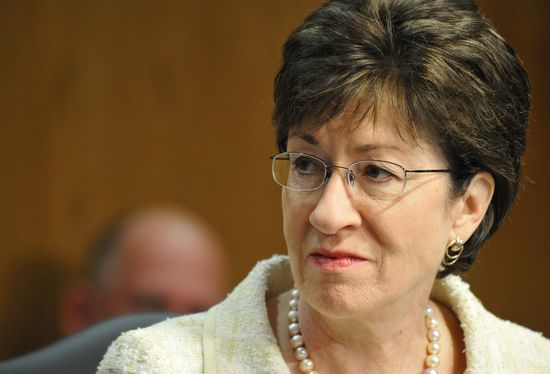
COLLINSKarenBleier:Getty

According to Brian Beutler, who updates us on Sen. Susan Collins' negotiations with Reid. More details here. David Kurtz's reading of the situation:

Collins has finally made her demands concrete and public. And they are not outrageous. At one point she wanted or was said to want two weeks of debate. Now she's asking for a manageable 4 days. Would we have gotten here anyway? Maybe. Did Reid's forcing the issue make the difference? Hard to say for sure, but probably.

This much is clear: the day started with DADT repeal looking completely dead and ends with a very plausible way forward to 60 votes in the Senate in this lame duck session. Not a done deal yet, but prospects for repeal are a whole lot better than they were 12 hours ago.

Greg Sargent reports that Sen. Lisa Murkowski has come out for repeal of DADT, with conditions. The president is also weighing in with Senators. For the first time, I feel confident this will pass. If it does, this lame duck session will have been quite something. But we're not there yet.

(Photo: Karen Bleier/Getty.)

How Hard Is It To Pass High School?

A reader writes:

As a high school and community college teacher of sixteen years, I can assure Mr. Joyner that it is absolutely getting harder for more and more sixteen year olds to stay a year or two more to finish.  I teach in a college town in the midwest where education is valued on the whole.  Yet, more and more of my students from lower income homes are either the sole economic provider for the home or are a major contributor to the economic stability/instability of the home.  They work countless hours through the week.  Their classwork and homework suffers.  They sleep in class.  They find "traditional" coursework boring compared to the immediate needs and demands of a weak economy, their economic lot in life, and a lack of effective and efficient alternate means to complete a diploma.

Another reader:

Does Joyner realize that most students that drop out are years behind in school by the time they drop out?  People do not drop out because they are being intentionally irresponsible (well most of them) they drop out because they cannot read.  And most of the time their problems start before they are 10.  So Joyner is willing to condemn a whole group of people as irresponsible for schooling issues they had when they were 10 or younger?  Certainly by the time you are 16 or 17 you should take some responsibility for your decisions.  But the problem is that those students that are making irresponsible decisions at 16 or 17 are making the decisions based on their inadequate (to that point) education.  Students that are on grade level virtually never drop out.