Winning Back The Independents

Fi06fyezt0ek0gny2zbb9w

My view is that the McConnell-Biden deal – for that’s who negotiated it – is great for Obama. Why? Because it will greatly add to economic growth in the next two years, the sine qua non of survival in this economic climate; because, once the Democrats had failed to pass a budget before the election, this was the best Obama could possibly get; and because Obama – especially in his riveting press conference yesterday – took the angry and beleaguered position of doing the post-partisan best for the American people, rather than trying to score one against the GOP or for the Dems.

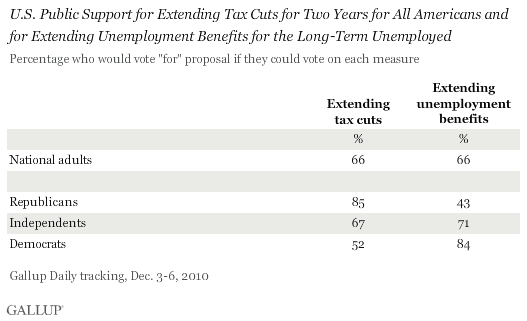
I know many Democrats voted for him to get revenge on Bush (I sure understand the sentiment) but many others voted for him to get past this partisan crap and get things done that would pragmatically ease America’s economic woes, tackle deep issues such as the debt and healthcare and end the wars responsibly. In my view, that‘s his core identity, and why he’s president. Taking on his base as he did yesterday will help him. Gallup’s early polling suggests I’m not crazy or so in the tank I should be dismissed as delusional:

By yielding on the tax cuts, Obama extracted Republican leaders’ support for extending unemployment benefits for the long-term unemployed — and large majorities of independents support both measures. Additionally, according to a post-election Gallup poll, by 49% to 24%, independents are more inclined to favor partisan compromise over principled standoffs in Congress. Thus, rather than get mired in a partisan squabble that could result in higher taxes for the middle class come January, Obama can present himself as the architect of a new era of compromise.

While Republicans generally don’t agree with extending unemployment benefits, they broadly support extending the tax cuts, and at least a slim majority of Democrats support both measures. In fact, the only groups not supporting both proposals are liberal Democrats and conservative Republicans. The more moderate members of both parties join independents in generally supporting the proposals. 

Bloomberg’s polling focuses on the unpopularity of tax cuts for upper-income Americans. What’s needed now, of course, is for Obama to pivot from this to using his State of the Union for a major push for long-term debt reduction in the next two years. He’s gotten all the pro-growth spending he needed to get re-elected, now he needs to cement his standing with Independents, centrist Democrats and Republicans, and make saving our fiscal future his overwhelmingly dominant theme of the next two years.

The rationale? He was elected to tackle the hard stuff, as pragmatically as possible. He has tackled the recession and health insurance; he has reshaped the war on terror; he now needs to revolutionize America’s long-term fiscal health along Bowles-Simpson lines. And Paul Krugman will just have to stomach it.
The Long Game: A Mirage?

Larison makes the case:

The most tiresome response to this deal I have seen is the claim that it somehow helps Obama with “the center” because the left is unhappy about it. It seems clear to me that he has put himself in the position of being identified with the interests of the wealthy and powerful yet again, which has been one of the administration’s problems for two years. Something like two-thirds of the public favored letting the top rate go up, and that includes the precious voters of “the center,” and Obama has now effectively taken the very unpopular side of this debate.

Too-clever-by-half interpretations of this hold that Obama is playing a cunning long-term game. However, it is never cunning to abandon a core commitment, disillusion one’s most active supporters, and cede an opponent everything he wants from a relative position of strength in the hopes that the opponent will later be easier to outmaneuver after he has become even stronger. “Centrist” and conservative pundits who have been urging Obama to capitulate on this issue are rather like Gollum urging Frodo on into Shelob’s lair. “No, really, this is the right way to go!” Obama’s defenders on this are reduced to saying that the lair could have been a lot worse. Provided that he isn’t eaten by the spider, all will be well. 

Cannabis On The Campaign Trail

MarijuanaChristopherFurlongGettyImages

GOP presidential hopeful Gary Johnson used marijuana to treat pain after breaking his back in a paragliding accident. Scott Morgan spies a political advantage:

Johnson's medical use creates a unique opportunity to bring personal experience into the discussion and powerfully expose the cruelty and ignorance of any opponent who dares to defend arresting sick people. This could play out any number of ways, but if I were Mitt Romney or Tim Pawlenty, I'd already be worrying about how to handle the situation. When it comes to medical marijuana, Gary Johnson will enter the debate with the American people on his side, and he has everything to gain by going on the offensive early and often.

The Economic Effect

Macroeconomic Advisers does the math on the compromise:

Based upon what is currently known of these three key [tax cut compromise] proposals, our preliminary analysis suggests that GDP growth in 2011 would be boosted by roughly ½ to ¾ percentage point. This is on top of the 3.7% growth of GDP anticipated for 2011 in our recently published forecast. Growth in 2012 could also be expected to be several tenths of a percentage point higher, with modest drag on growth in 2013, as the temporary provisions expire.

What Obama Should Do Next

Noah Millman's pitch:

To make a difference in budgetary terms, we’ve got to put new, broad-based taxes on the table. So here’s a proposal for the new year: make the payroll tax cut permanent in exchange for the establishment of a new consumption-based tax – the latter not to take effect until 2013. The next two years should feel like a sales-tax holiday, pulling consumption forward, which supposedly is what we need, and the payroll tax cut would put money into people’s pockets to spend during that same period. Of course, businesses would plan for an expected slowdown as a consequence of the tax hike to come in 2013 – but any massaging of the business cycle would have that problem (which is why some argue it can’t be done). But the budgetary consequences of delaying implementation of such a tax for two years would be negligible over the long term, while laying down the marker that new, broad-based taxes are possible – and that we need to levy at least some of them on consumption rather than wages or income – would be worth far more than anything President Obama gave up in this deal.

Chart Of The Day, Ctd

Unemployment_Electorate

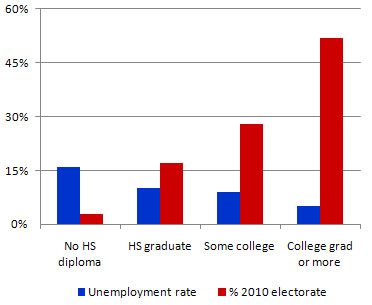
Kevin Drum tweaks this chart and muses:

[T]his chart largely explains why sky-high unemployment hasn’t produced any real sense of urgency in our political class. It’s because unemployment is high among people who don’t vote and low among people who do. If the stock market were crashing or corporate profits were down, that would be one thing. But unemployment? It’s just not that big a deal.

James Joyner has little sympathy:

An alternative view of the charts is that the unemployed are mostly people who’ve done an incredibly poor job of managing their own lives. … In this day and age, it’s simply irresponsible not to finish high school — or at least get a GED.   Hell, you’re required by law to go to school through age 16.  How hard is it to hang around another year and get that diploma?

The 2012 GOP Attacks, Available Now

Nate Silver offers a preview:

Suppose that the economy is showing relatively robust signs of recovery by 2012: not necessarily spectacular rates of growth (in which case, Mr. Obama’s re-election might be almost a sure thing), but G.D.P. growth on the order of 3 or 3.5 percent, and a reasonably significant reduction in unemployment. (Most economists do think that the deal will have some stimulative effect.)

See, this is proof that lower taxes work, I would argue if I were a Republican.

The stimulus — all that government spending — didn’t work. It just increased unemployment. But keeping taxes low worked, and the economy is finally recovering. So why on earth would we want to raise anyone’s taxes now?


How To Turn A Punk Into A Hero

Jack Shafer thinks that Julian Assange's arrest will help his image:

Assange's jailing changes the "conversation" from how-dare-he to how-dare-they almost as efficiently as if a deranged vigilante had put a bullet in his brain. Our culture loves to protect and defend "victims," which is what the legal proceedings are turning him into. Overnight, he's becoming an albino Rev. Martin Luther King Jr., writing his letter from jail.

A Weaker Hand Than People Realize?

Nyhan explains why Obama couldn't get what he wanted on the Bush tax cuts. Bernstein is in neighboring territory

The truth is that there are a lot of people who just don't accept that the President of the United States can want something, fight for it, fight effectively and correctly, and still not get it.  If it doesn't happen, it must have been — in Obama's words — a "betrayal."  Those people are wrong.

And yet it's awful hard to believe that calling people out on it — his allies, the activists within the Democratic party –  will do him any good.