It's always good to get a sharp cold shower of epistemological conservatism from Jim Manzi. Noah Millman defends pragmatic economics in response. The important thing, it seems to me, is to resist economics' claims to the same level of proof as math or physics. The best economists make no such claims; but laymen sometimes think they do.
Month: December 2010
Against Hypocrisy
Illinois state senator, Ricky Hendon, tells it like it is on civil unions:
The Dumbest Alcohol Law Yet, Ctd
A reader writes:
Why is even an age restriction a compelling reason to regulate beer sales?
I grew up in Wisconsin, in the days when the legal drinking age was 18, a restriction seldom or never enforced. There was some drunkenness among my high school classmates, but mostly supervised by parents, and seldom dangerous. When I went to college out of state, we Wisconsin folks were the ones drinking responsibly, because we had learned to do it.
Now I live in a large Italian city, in a neighborhood with a lot of bars frequented by young people. The legal drinking age here is 14, but as weakly enforced as the 18 of my Midwest youth. Even on weekends, there is never (read NEVER) a drunk kid to be seen. The streets and bars are crowded with Italians drinking responsibly. I credit the lack of an enforced drinking age.
In the Wisconsin of my youth, I learned to drink responsibly with my parents at the tavern around the corner. In the Turin of my middle age, I continue to be surrounded by responsible people for whom drinking is a natural part of life. Ah, la vita è bella!
Another writes:
Colorado liquor laws are, indeed, a bit crazy, but it's ironic that the tavern owner is complaining about these rules being the product of a "nanny state" when a big part of the reason that the rules are as they are is because liquor stores and taverns and breweries (which have a lot of pull in the state) have successfully lobbied for the 3.2% delineation that restricts supermarkets and convenience stores from selling anything heavier (much to their chagrin), with the compromise being that only the markets can sell the weaker brews.
The tavern owners basically want to have their cake and to eat it, too – by restricting supermarkets to weak alcohol that lowers competition while constantly skirting those same rules so that they can cut into the supermarket's business. So it's a little hard for me to feel too much sympathy when they get hoisted by their own legislative petards.
Another:
There is a lot of background omitted in the DP article you linked to. Colorado has a long history of law around 3.2 beer, lots of it ultimately tied up around economics and business competition as around puritanical impulses toward blue laws. It was legal for 18 to 21 yo's to drink 3.2 beer for a period after the drinking age was raised. You could consume 3.2 beer in public places like parks (still can in a lot of places). Liquor stores were not allowed to be open on Sunday, groceries stores and gas stations could only sell 3.2 beer but they could do it on Sundays. (Incidentally of course, in the past 20 years Colorado has become a microbrew mecca.)
What upset the applecart was the change in law two years ago that allowed liquor to open on Sunday (a glorious day, the first Sunday of July 2009 was). An amendment to that legislation would have also allowed groceries and convenience stores to sell regular beer. That was struck down, and the 3.2 franchise, such as it is/was in the new world, was continued. So this is really just a turf protection move, the grocery stores and gas stations saying, hey, you wanted it this way…
Too Close For Comfort
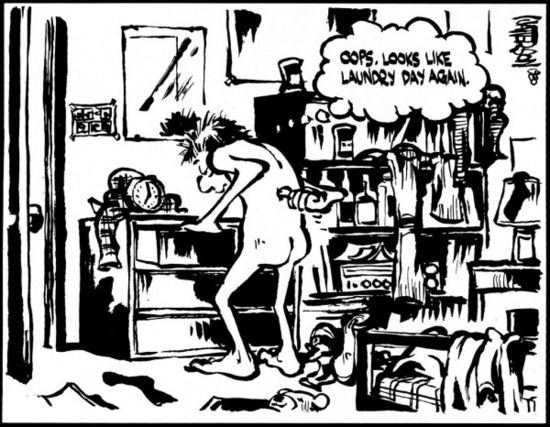
A glimpse into the early work of Calvin and Hobbes' Bill Watterson – and the general logic of the Sullivan-Tone household. The back-scratch is what nails it.
The Prop 8 Oral Arguments: What Happened Yesterday?
Lyle Denniston provides highlights:
If there was a surprise, it was that the one judge on the three-judge panel known as a conservative, Circuit Judge N. Randy Smith, found a possibly fatal flaw in logic in support of the ban. What is rational, Judge Smith asked, about a state giving gay and lesbian couples complete equality in the legal rights and benefits that married couples have, including the right to raise children, but then to deny them marriage itself. The state’s voters, he said, had just opted to omit a single word, “marriage,” and how is that rational? He seemed skeptical of the response by Charles Cooper, Proposition 8 lawyer, that “it is a word that is essentially the institution; you cannot separate the two.”
But, however Judge Smith might vote on the constitutionality of the ban, if the panel gets to that, it seemed clear that his two colleagues, Circuit Judges Stephen R. Reinhardt and Michael Daly Hawkins would nullify the ban, provided they could do so without having to write a sweeping opinion that established a national constitutional right of gay marriage. At most, they seemed inclined only to rule that California had first allowed a right to same-sex marriage, then took it away by singling out gays and lesbians for the loss of an existing right — a targeted exclusion that could only have resulted from bias.
It Makes Sense, If
Douthat's take on the tax cut compromise:
As policy, the bargain Barack Obama just struck with Congressional Republicans is a classic “it makes sense, if …” situation. Given the parlous state of the economy, it makes sense to maintain the low Bush-era tax rates, it makes sense to extend unemployment benefits, and it makes sense to temporarily drop the payroll tax rate … if, that is, our leaders use the time between today and 2012, when this bargain comes up for renegotiation, to make real progress on a strategy for long-term deficit reduction, joined to a base-broadening, rate-lowering tax reform package that renders the debates over the Bush tax cuts obsolete.
But that’s a big if.
And a big opportunity the Dish has been begging Obama to seize. Howard Gleckman is on the same page, but more pessimistic:
It would be nice if Congress did what former Budget Director Peter Orszag, my Tax Policy Center colleague Len Burman, and others have suggested, which is to use the next couple of years to enact serious tax reform. It would be nice. But it won’t happen.
Remember the virtuous talk of fiscal prudence that washed over Washington for, oh, three days last week. Forget it. Forget as well the promises of change that Republicans (and Obama before them) brought to Washington. This is business as usual and at its worst: You have a bad and expensive idea. I have a bad and expensive idea. Let’s compromise and pass both of our bad ideas.
Avent looks at the bright side:
It's worth continuing to argue for sensible deficit-reduction policy. But it's difficult for me to see movement within Congress for meaningful deficit reduction until bond markets provide pressure. And the shortest way to get there is via a strong economic recovery. Which, happily, will make austerity more bearable. In short, this deal seems to amount to a meaningful if modest improvement in the near-term impact of fiscal policy on the economy, without bringing with it much of an additional budget cost. In the highly imperfect world of Washington policymaking, America could have done much worse.
Chait's warning:
[If] Obama caves again, or if Republicans win the White House and push through another tax cut extension, this deal will go down as a huge blunder for Obama. The good news for Obama is that the deal probably increases the chance that he'll get that second term. If so, he'll need to handle this issue better than he did the first time around.
Scenarios For American Collapse
Salon presents them. A sample:
After years of swelling deficits fed by incessant warfare in distant lands, in 2020, as long expected, the U.S. dollar finally loses its special status as the world's reserve currency. Suddenly, the cost of imports soars. Unable to pay for swelling deficits by selling now-devalued Treasury notes abroad, Washington is finally forced to slash its bloated military budget. Under pressure at home and abroad, Washington slowly pulls U.S. forces back from hundreds of overseas bases to a continental perimeter. By now, however, it is far too late.
Faced with a fading superpower incapable of paying the bills, China, India, Iran, Russia, and other powers, great and regional, provocatively challenge U.S. dominion over the oceans, space, and cyberspace. Meanwhile, amid soaring prices, ever-rising unemployment, and a continuing decline in real wages, domestic divisions widen into violent clashes and divisive debates, often over remarkably irrelevant issues. Riding a political tide of disillusionment and despair, a far-right patriot captures the presidency with thundering rhetoric, demanding respect for American authority and threatening military retaliation or economic reprisal. The world pays next to no attention as the American Century ends in silence.
If only it weren't so credible …
How The Tax Cut Is Playing On The Right
Reporting from inside the bubble, Ed Morrissey has a good round-up of Republican reaction.
Huckabee: What If He Runs?
Allahpundit gets deep in the weeds:
It’s not a done deal that he’s running. He had to scrounge for funds to keep his campaign going two years ago and he just took out a huge mortgage to build his new home in Florida, so unless he’s got evangelical leaders ready to help him pass the collection plate around, money is a major issue. Even so, if Palin decides not to run and Mitt looks like a prohibitive frontrunner early, does anyone seriously think he won’t jump in? Social conservative votes will be there for the taking, and you know he’s just itching to vanquish that pointy-headed white-collar Romney who went to all the right schools ‘n stuff. If Palin does run then his decision is tougher, since the longer he waits, the more time she’ll have to solidify her support among the same constituencies he’s targeting. Of course, jumping in early might not help against her either. Huck acknowledged a few weeks ago that she could run away with the whole thing, and I’m guessing he wouldn’t be thrilled with an outcome whereby he and she enable a Romney victory by splitting base voters.
The Return Of Mr. Nice Gay
Jonathan Rauch argues that the gay rights movement has gone mainstream and therefore needs to abandon some of its minority movement tactics:
In a messy world where rights often collide, we can’t avoid arguing about where legitimate dissent ends and intolerable discrimination begins. What we can do is avoid a trap the other side has set for us. Incidents of rage against “haters,” verbal abuse of opponents, boycotts of small-business owners, absolutist enforcement of antidiscrimination laws: Those and other “zero-tolerance” tactics play into the “homosexual bullies” narrative, which is why our adversaries publicize them so energetically.
The other side, in short, is counting on us to hand them the victimhood weapon. Our task is to deny it to them.
There is a dynamic here. The more we advance the arguments for equality, the more intolerable inequality becomes, and the more unfathomable opposition seems. And so, even as solid, substantive change is obviously occurring (national opinion polls now reveal over 50 percent support for marriage equality and far higher levels for non-discrimination more generally), we feel as if we are losing terribly, and so adopt a posture and rhetoric more extreme than necessary and potentially counter-productive. At this stage in a civil rights movement, we have to keep the conviction behind change, while allowing the losers some time to save face and come around.
One simple word of advice: when you are tempted to use the word "hate", substitute "fear" or "bias". It's usually more true and dials down the temperature a notch – where the rational advantage held by the case for gay equality still holds.
 The Dish