“Millionaire”

Andrew Gelman notes that the definition has changed:

It used to be that a millionaire was someone with million dollars. Nowadays, though, the term is often used to refer to people who make a million dollars a year. (See here, for example, in a discussion of the so-called millionaire's tax break.. I guess it makes sense–lots of Americans have a million dollars in assets, and so for "millionaire" to keep its traditional meaning of "really rich," it had to shift somehow. It still seems funny to me, that this change in definition has occurred without it being formally acknowledged.

Where Are America’s Corner Pubs? Portland.

Portland

A reader writes:

Portland, Oregon has more breweries (36) than any city in the US, and they all have their own brewpubs. Oregon law requires bars to serve food, and a lot of them serve stunningly good fare. 

The Stone is my local drinkery. It's quaint, rustic, and they have about a half-dozen regulars there regardless of what time or day it is.  I like to call it The Winchester.  This is just the pub that happens to be closest to my house; there are countless more on every corner, and a new one seems to open every day.  The County Cork is another awesome pub. We watched the World Cup there with some pretty fervent soccer fans, who were all drinking and cheering and blowing into mock-up vuvuzelas while families with children dined around them.

Another writes:

Steinglass is simply incorrect in his claim that brewpubs are illegal in the US. Here in Oregon, breweries ARE permitted to operate bars, and many do. One of the best-known chains in the Northwest is McMenamins, many of whose establishments are similar to the typical British corner pub. 

McMenamins brews its own beer (which is only available in their establishments; they do not bottle and sell it elsewhere), they have a halfway-decent food menu, and minors are permitted in many establishments until late in the evening.  They also specialize in renovating old buildings and converting them into brewpubs, nightclubs, and hotels – and even run a few converted movie theaters which show second-run films to patrons as they drink.  And McMenamins is far from the only game in town.

What is true in New York or Washington is not necessarily true elsewhere in the country.

Another:

In a significant number of neighborhoods in Portland there are corner pubs, or at least corner restaurants that serve beer, wine, and liquor.  Within a 3/4 mile walk of my house, which is a pretty nice urban neighborhood, there are roughly 14 such spots (11 of which are decent-to-fantastic, and of those, about half could be considered pubs or pub-like – the rest restaurants). Not all neighborhoods here are like that, but plenty are, especially on the east side of the Willamette River (the west side is more suburban in feel, so it has far fewer walkable corner pubs). And every single establishment near my house is independently owned.

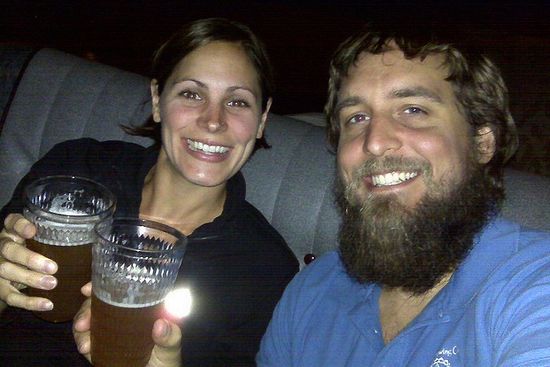
(Photo by Flickrite John Carleton. Caption: "My parents took the kids and we headed down the street to McMenamin's Kennedy School for dinner and a movie. We love McMenamin's because we can do both at the same time! Plus the couches are comfy and the beer is good. Much better than those mall theaters.")
How To Prove A Turk Is Gay

Piotr Zalewski reports on Turkey's military gay ban:

[I]t's practically impossible for Turkish men to avoid exposure to military life, and the burden is on them to prove they are unfit for service. Every man between 20 and 41 years old is required to serve at least six months. Exemptions are granted only under two conditions: a mental or physical disability, and homosexuality. Turkey does not recognize the right to conscientious objection. …

Astoundingly, some gays … report that they were asked to produce photographs showing them as participants in anal intercourse. Even then, Turkish authorities are said to apply special criteria. According to the military, and Turkish society at large, penetrating another man does not necessarily qualify as a homosexual act; only being penetrated is undisputedly homosexual. Hence the unwritten rule when it comes to such photos: "The man should be in the passive position, receiving from behind," L. explains, "and looking at the camera. Preferably while smiling."

Watching Big Brother Watch You

Umberto Eco on the Wikileaks hall of mirrors:

Formerly, back in the days of Orwell, every power could be conceived of as a Big Brother watching over its subjects' every move. The Orwellian prophecy came completely true once the powers that be could monitor every phone call made by the citizen, every hotel he stayed in, every toll road he took and so on and so forth. The citizen became the total victim of the watchful eye of the state. But when it transpires, as it has now, that even the crypts of state secrets are not beyond the hacker's grasp, the surveillance ceases to work only one-way and becomes circular. The state has its eye on every citizen, but every citizen, or at least every hacker – the citizens' self-appointed avenger – can pry into the state's every secret.

(Hat tip: Alexis)

The Death Of Newspapers Has Been Exaggerated, Ctd

A reader writes:

I was hanging out and letting my kid play after school one day. I found a spot near the play structure to spread out my newspaper on the ground and read for a bit while he blew off some steam. A girl who must've been in fourth or fifth grade stopped and looked down at me.
"What's that?" she asked.
"A newspaper," I replied.
"What's it for?"

So there's your future, newspapers. Sorry.

Monumental Fears

Bruce Schneier has a modest proposal:

Securing the Washington Monument from terrorism has turned out to be a surprisingly difficult job. The concrete fence around the building protects it from attacking vehicles, but there's no visually appealing way to house the airport-level security mechanisms the National Park Service has decided are a must for visitors. It is considering several options, but I think we should close the monument entirely. Let it stand, empty and inaccessible, as a monument to our fears.

An empty Washington Monument would serve as a constant reminder to those on Capitol Hill that they are afraid of the terrorists and what they could do. They're afraid that by speaking honestly about the impossibility of attaining absolute security or the inevitability of terrorism — or that some American ideals are worth maintaining even in the face of adversity — they will be branded as "soft on terror." And they're afraid that Americans would vote them out of office if another attack occurred. Perhaps they're right, but what has happened to leaders who aren't afraid? What has happened to "the only thing we have to fear is fear itself"?

An empty Washington Monument would symbolize our lawmakers' inability to take that kind of stand — and their inability to truly lead.

I like Bruce's attitude. We have to have someone in political leadership prepared to say that at some point a free society will have to tolerate some level of terror. Or cease being free.

What Does Israel Cost Us?

$36 billion? $3 trillion? Scott McConnell homes in on the deeper issue:

The essence of the relationship is not its dollar cost, but the fact that the United States has come to perceive its interests in the Middle East through Israel’s eyes. This is what renders it special.

Looking ahead:

In the coming years, as the prospect of a two-state solution disappears, it is likely that Israel will continue its inexorable march toward becoming a state between the Jordan River and the sea, with one set of laws for Jews, who will have the rights of citizens, and another for Arabs, who will be denied full citizenship. What will it cost America’s broader relationship with the Muslim world to maintain a special bond with a state based on this kind of ethnic discrimination? That also would be difficult to quantify. And yet this scenario may be impossible to escape. The threat of Israel’s turning itself into a nuclear-armed desperado striking at will at the oil states in the Gulf cannot, alas, be entirely dismissed. That may be, as Ariel Roth argues, a compelling reason to maintain the special relationship pretty much unchanged.