A Heart-Felt, Manly Love

Brendan Tapley has written one of the stranger defenses of DADT:

As recently as 100 years ago, men talked about their love for each other freely. In fact, the desire for intimate fraternity was considered more than just normal for a male life; it was believed to be essential. Men acted on this desire without fearing prejudice or ridicule. Here's a fairly common example from the 1830s, taken from the journal of Albert Dodd, a Yale student, about his friend John:

"I regard him, I esteem, I love him more than all the rest… it is not friendship merely which I feel for him, or it is friendship of the strongest kind. It is heart-felt, a manly, a pure, deep, and fervent love."

As open homosexuality emerged, however, it became masculinity's foil, its antithesis. Men grew skittish about wanting to express sentiments like Dodd's or participate in environments where fraternization was now equated with gayness. And so men stopped acting on their fraternal impulses, in spite of the fact that they did not go away. In fact, quite the opposite happened: The fear of being gay, effeminate, the anti-male—take your pick—has created a more intense, if repressed, longing in men to find and experience those rare environments where men can be close to other men without "forfeiting" their masculinity.

Tapley later claims that repealing DADT "threatens this [sort of brotherhood] because in bringing even a hint of homosexuality into this community, a man must once more lead that paranoid, self-conscious existence."

I sympathize with Tapley's general point, but think he's gotten things exactly the wrong way round. Yes, when categories such as homosexuality and heterosexuality did not exist, a kind of exuberant, 125 manly affection was more possible – and benefited everyone. But just because those categories did not exist in the public consciousness doesn't mean that homosexuality didn't exist at all. It just meant that this kind of male-bonding was premised on gays' lying about who they were – with all the Brokeback pain and deception and mixed messages that entailed. 
So how to regain male intimacy without the "taint" of homosexuality, while accepting that the closet has been effectively abolished? I don't think artificially recreating the closet via fantasies like DADT is an answer. The answer is to have more interaction and honesty between openly gay men and straight men, and a willingness to move past these boundaries to areas where male bonding is perfectly possible.

It's possible, in my view, because gender is much more powerful a force than orientation – and because homosexuality spans the gamut of behavior, from hyper-feminine to hyper-masculine and every variety in between. Those gay men able and willing to bond with straight guys – even while joking about their own gayness – are perfectly capable of this kind of camaraderie. That's especially true in the military. It's how you can come up with a quote like the classic from the Pentagon report:

“We have a gay guy [in the unit]. He’s big, he’s mean, and he kills lots of bad guys. No one cared that he was gay.”

And once you acknowledge it and don't care about it, that heartfelt, manly love becomes possible again – but on the basis of reality and candor, not oppression and deceit.

I know the transition can be tough. But I'm equally sure it's doable. A dose of self-deprecating humor on both sides is particularly helpful in this respect.

The hope is that the great exception to the reality of more publicly embraced and appreciated male-male love will one day be seen as the era we have just gone through – in which homosexuality was uniquely both recognized as a category and stigmatized. We cannot remove the category because it is true and cannot be unthought. But we can remove the stigma if we want to return to a more durable and honest form of the nineteenth century homosociality. Remove the prejudice, add a little discretion, mix in an amount of deference to majority straight culture, and we can all move forward – in sports, the workplace, and the military. As, in fact, we already have.

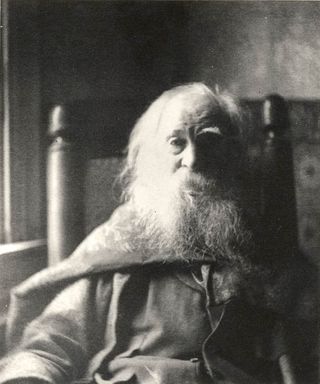
(Photo: Walt Whitman by Thomas Eakins, 1891.)

The Dickishness Of The GOP, Ctd

Building off my post, Steve M. points out an MSM blindspot:

[T]here's an MSM take on Republicans that strengthens the GOP: namely, that no matter what the party does, it's a legitimate party interested in governance. It's one of our major political institutions — it can't ever be talked about as if it's gone off the rails, as if it's thuggish and deliberately acting in opposition to the national interest. Major political parties just don't do that with malice aforethought.

Steve Benen agrees:

In the world of serious discourse, it's entirely appropriate to say a major political party is wrong. It's equally acceptable to accuse the party of having a misguided agenda, or being incompetent, or even having corrupt leaders.

But the point Andrew and Steve are emphasizing is qualitatively different. This is an observation predicated on the notion that a major political party is now operating less as a party and more as a nihilistic, borderline dangerous, gang.

I suspect the vast majority of Americans aren't especially aware of any of this.

Jeffrey Goldberg, Anti-Israel Leftist

I kid you not, via Goldblog. But Israel need not fear:

That’s okay, we Christians will take care of the apple of God’s eye. The left can take care of the godless and those who belong to the Father of Lies, i.e., the muslims. They all will, after all, be in hell for eternity. Karma, as they would say.

My fave:

I don’t understand why American Jews hate their homeland so much.

Yes, there is a point at which Christianist philo-Semitism gets a little creepy.

Palin And The Caribou, Ctd

A reader writes:

Well as I am a part of the Alaska hunting community, I forced myself to watch last night's episode of SPA. I wanted to see how Alaska hunting was portrayed, and particularly how Alaskan women hunters were portrayed.

One thing is patently obvious to any real hunter: Sarah Palin is a poseur; she is not at all familiar with a bolt action rifle. As far as real Alaskan women hunters, lest viewers think otherwise, no woman hunter I know does not operate her own bolt when extracting the brass and inserting a new cartridge. Very odd to see her dad operate the bolt for her as she fired all those bullets downrange. I have my doubts she actually killed that caribou with the other rifle, but we'll never know.

Rifle scopes can sometimes be bonked, a rifle dropped on rocks etc, to where they do go off sight. But there was no indication anything like that happened with Sarah's rifle.

And when they do go off sight, often it's a matter of inches up or down or left or right, and shooting at a broadside caribou from that distance as Sarah was, it is more likely to wound the animal than completely miss it when aiming at the shoulder/lung area.

On top of that, when a rifle scope does go off and needs to be sighted in again, one doesn't take something that small (a 10" diameter paper plate in this case) and put it downrange as a target to check the sighting. Missing something that small doesn't really prove anything … if the rifle scope really was off, it could be six inches off left or right or up or down and still miss the plate, but would still have hit the caribou in the lung/shoulder area. It could be ten inches off and would still have hit the caribou. For Sarah to completely miss that caribou at that range would mean the scope would have to be waaaay off. That just isn't a very likely scenario with today's modern equipment. And taking that (supposed) final shot with the other rifle, when the caribou was no longer broadside (which is the much preferred shot because it provides a much large killing zone) but facing directly toward Sarah … I don't know any hunter who after missing so many times would then choose to take that kind of shot at such a smaller target. It just doesn't add up.

Neither does a 72 year old man walk "four or five miles" from camp on that tundra – which is really undulating ankle-twisting tussocks – as they claimed during the episode, then walk the same distance back. A ten mile hike on that tundra with a loaded pack is a feat for someone young and physically fit. I'm not sure why they chose to lie about that, certainly the camera crew also could not walk that distance carrying their equipment. But that's "reality" television for you. Any hunter who watched that episode should come away with the knowledge that Sarah Palin the "hunter" was a big bold lie.

Another writes:

My favorite moment of this episode was her comment that having the binoculars made this a “fair” contest. I have nothing against hunting, but there is obviously nothing fair about this contest. Palin and her company are equipped with high powered killing machines—rifles with long-distance scopes, so they don’t even have to get near the target. And the caribou obviously hears the shots that miss, but doesn’t understand what they mean, so it makes no effort to get out of the way. This allows Palin to take 6 or so shots before finally killing the animal. How is that fair? How is that even a contest?

I have now seen all episodes but the immediately prior one. I can only say that:

(1) the visuals in the show are spectacularly unspectacular. I expected to see some really terrific vistas of Alaska, but for the most part it’s been less than memorable visually. In last night’s episode, for example, we see lots of very flat, unattractive tundra.

(2) Palin’s speaking parts remain totally banal and uninteresting. I understand that her comments while actually on location are trite and unmemorable, but there are plenty of voice-over segments and segments where she is sitting down and speaking. However, she never says anything particularly insightful about what she has done or is doing or about Alaska. She almost never takes the opportunity to present any facts about the subject matter of the show and when she does the information is minimal. She’s hunting caribou. Is it too much to ask that she tell us something about the origins of this animal or its relation to elk, moose, deer, etc., or that she say something about how large the caribou herds in Alaska are or whether they are growing or shrinking, or something about what they eat or, for that matter, anything at all about the caribou’s habits?

This seems to be a consistent failure on the part of this show. We see Palin engaging in a number of activities that supposedly are typical of Alaska, but she offers no insight into the activities and she gives no “bigger picture” sense as to how these activities fit into the Alaskan economy or way of life. Although she keeps talking about how wonderful Alaska is, the show is all about her, her, her.

And you were expecting … ?

“The Ideal, Perfect Zombie”

Scott Meslow interviews Robert Kirkman, creator of The Walking Dead comic series:

There's very little "new" that's brought to the zombie plate here. [The Walking Dead] is kind of my effort to canonize zombie lore. Vampires have a set bunch of rules, werewolves have a set bunch of rules—but a lot of time, when people try to do something with zombies, they try to reinvent the wheel … It's confusing, and they have to explain it all. So I decided to start with the base, core—what I consider to be the ideal, perfect zombie—and go from there.