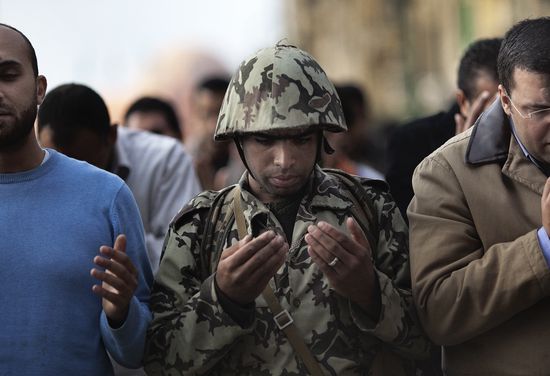
An Egyptian army soldier joins a crowd of Muslim demonstrators during a prayer at the Tahrir square in central Cairo January 30, 201 on the sixth day of mass protests across the country calling for the resignation of long term President, Hosni Mubarak. By Marco Longari/AFP/Getty Images.
Month: January 2011
Dissent Of The Day
by Patrick Appel
A reader writes:
I saw a movie last night, The King's Speech, that allowed me to boil down what bothers me about your coverage of the events in Egypt and other countries where popular revolutions have tried to get off of the ground. I think it's a Dish-wide thing – it's actually been kind of amazing to see how similar the coverage without Andrew has been to the coverage of similar events in the past when he was in charge.
There are two broad things happening in The King's Speech. On one hand, they're trying to describe things that actually happened to real people who actually lived through them. But on the other hand, they're trying to fit stuff into a narrative. And in the movie, the narrative always wins out when it collides with history.
The movie says, basically, that what the King really needed was a friend. And that the King was important because the nation needed him to galvanize people so they could defeat Hitler. It's a British film, but it does something really Hollywood there – it creates this situation where the fate of the world depends on the friendship between those two men.
The problem is that neither of those two key structural points are true. All sorts of people who ought to know have said that the relationship between the two men depicted in the film couldn't have happened and didn't happen – that business about Logue calling the King "Bertie" and sitting on the throne was nonsense. And far from being the one indispensable man in the struggle against Hitler, the King was actually an appeaser.
So the result is a movie that's false in a fairly deep way, even as the people who made it go on and on about how concerned they were with historical accuracy. They spent a lot of time getting Helena Bonham Carter's gloves right, but they were willing to warp really important central things in order to make the story work better.
You guys are covering events in Egypt through the lens of a narrative. I absolutely don't think you do it dishonestly or deliberately, or even that you have any awareness that you're doing it. And I don't think that your narrative collides with with reality in the same way the one in the movie does. But that story about people going out there and standing up for their freedom is almost like a Hollywood story, it has that same kind of appeal, and I think you guys get caught up in that. I think your affinity for that narrative damages your coverage.
I don't know what's going to happen in Egypt. It seems momentous and complicated to me. It's not at all clear to me that the government that will follow the one that seems likely to fall now will be more free. It seems very likely to be hostile to the US. I understand that we've backed the dictator there, kept him in power, and benefitted greatly from our relationship with him. I am not at all proud of that – shame seems to be a more reasonable response. Oil prices are going up, and the dictators we back in neighboring countries are getting nervous.
These kinds of uplifting narratives don't cause you guys to misrepresent the facts. But they skew your coverage – there is lots of breathless coverage of the brave protesters in the streets, while the other stuff is neglected. Not ignored, but neglected.
It seems likely to me that if the Dish and the internet had been around during the Iranian revolution, your coverage of the early days of that event would have fit in to the pattern of coverage typified by your response to the events in Egypt. The Shah was worse than a dictator, he was a monster. And the people who stood up to him were brave. They wanted to be free. But in hindsight, we know that the Iranian Revolution was a lot more complicated than that.
The View From Your Window
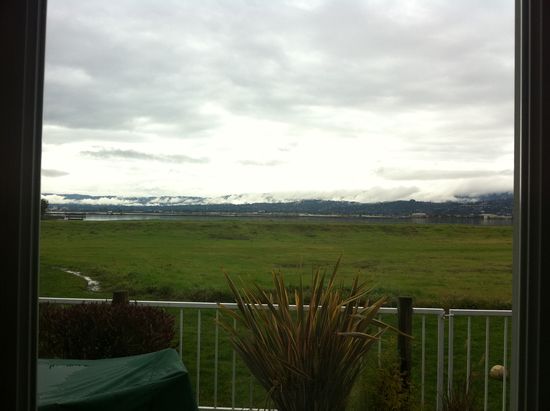
Redwood City, California, 10.19 am
“Rhetorical Make-Believe”
by Patrick Appel
William Easterly skewers Clinton's latest statement:
Secretary of State Hillary Clinton announced today a new US government position on Egypt, calling for a ‘transition to a democratic regime.’ This was also the old US government position on Egypt.
As this blog has pointed out, the “transition” word is a much-used device to appear to be in favor of democracy while in fact taking no position whatsoever. The democracy scholar Thomas Carothers is one who first pointed out the emptiness of the “transition” paradigm, noting a USAID description of the Democratic Republic of the Congo in 2001 as a country in “transition to a democratic, free market society.”
The Face Of The Opposition? Ctd

by Patrick Appel
ElBaradei addresses the crowd in in Tahrir Square:
"Change is coming in the next few days," ElBaradei told the crowd, according to Reuters.
"You have taken back your rights and what we have begun cannot go back… We have one main demand – the end of the regime and the beginning of a new stage, a new Egypt."
"I bow to the people of Egypt in respect. I ask of you patience."
Max Fisher asks:
Should the U.S. keep its distance from Mohamed ElBaradei, whom opposition groups are unifying behind to take over at interim president? The Obama administration would likely be very happy to see the liberal, internationally minded ElBaradei take over. But an official U.S. endorsement of ElBaradei for interim president, some U.S.-based analysts warn, could tar him for many Egyptians. Part of Mubarak's unpopularity comes from the Egyptian perception that he is an American puppet. A June 2010 Pew report finds a 17 percent favorability rating for the U.S. among Egyptians, down from 27 percent the year before.
(Photo via the Lede)
Al-Jazeera’s Revolution? Ctd
by Patrick Appel
Sam Gustin reports:
Al Jazeera’s website saw a 2500% increase in traffic Friday, with over 50% of that spike coming from the US alone, a company spokesperson said. The company’s servers crashed [Friday], but it has taken steps to beef them up.
Will The Army Fire?
by Patrick Appel
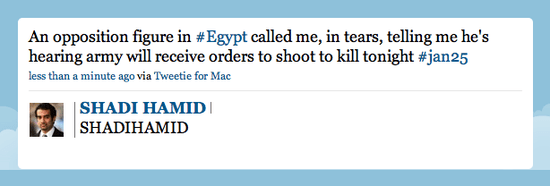
Scott Lucas weighs in on the rumor that the military has been ordered to fire on protesters tonight. Is the truce between the army and the protesters scheduled to end?:
Peter Beaumont reports from Tahrir square. In an audio interview he talks about possible preparations by the army to crackdown against the protesters. Water cannons have been moved in and tanks have been split into two columns, he says.
"The mood amongst the people, who were very positive towards the army, does seem to be changing. People are very very suspicious of the army now. They want to know why a squadron of Egypt's best tanks is sitting in the entrance to square," he said.
Egypt In 2011
by Patrick Appel
Andrew Exum's request:
[C]an we all agree to stop using European historical analogies to describe what is taking place in Egypt? It's not Europe in 1848 or Eastern Europe in 1989 or France in 1789: it's Egypt in 2011.
What is taking place in Egypt today is the result of sui generis social, political, cultural and even geographic phenomena. When we use "western" frames of reference to make sense of what is taking place, by contrast, we a) sound really freaking narcissistic and b) fail to take those local phenomena seriously and thus miss a lot of what is going on.
The Face Of The Opposition?
by Patrick Appel
Max Fisher passes along the news:
Al Jazeera English reports that opposition groups have unified behind Mohamed ElBaradei, who they have selected as the planned interim president if they are successful in forcing President Hosni Mubarak from power. ElBaradei is reportedly now on his way to Tahrir Square in Cairo.
Who’s Running The Country?

by Patrick Appel
Issandr El Amrani speculates:
For me, Omar Suleiman being appointed VP means that he's in charge. This means the old regime is trying to salvage the situation. Chafiq's appointment as PM also confirms a military in charge. These people are part of the way Egypt was run for decades and are responsible for the current situation. I suspect more and more people, especially among the activists, are realizing this.
… The situation is obviously very confusing at the moment. All I can say is that I have a hard time believing that Mubarak is still in charge, and that the hard core of the regime is using extreme means to salvage its position.
(Photo: A military helicopter hovers over demonstrators gathered at Tahrir Square in Cairo on January 30, 2011 on the sixth day of angry revolt against Hosni Mubarak's regime amid increasing lawlessness, a rising death toll and a spate of jail breaks. By Mohammed Abed/AFP/Getty Images)
 The Dish