The Essence Of Democracy

Jonathan Bernstein hopes that the Gifford shooting won't stop politicians from going "about their lives as ordinary citizens, meeting with their fellow citizens and neighbors not just in great democratic events like the one interrupted in Tuscon, but in casual encounters, too." Ezra Klein nods:

There's going to be a desire to do something in the coming days, to respond somehow. And we need to take care to make sure our response pushes us in the right direction. A simple principle, I think, is that whatever we do should emphasize our commitment to the sort of everyday democracy that Rep. Giffords and her constituents were practicing. As I said yesterday, I think one way to pay tribute to those who died or were harmed in the shooting is to do as they did and attend your congressperson's next community meeting. Conversely, making community meetings more difficult and politicians more physically distant from their constituents would be giving something important away, and it's not clear that we'd gain any real safety or security in return.

The Build Down Begins?

Gordon Adams scrutinizes Bob Gates defense cuts:

The Secretary said, and it deserves quotation, "ever since World War I, when we have come to the end of wars, we have dramatically reduced our defense spending, cut our military forces, and then ended up in another war…And when we have had to rebuild quickly to deal with threats, the cost in blood and treasure has been very high."  He is right if he is talking about World War II and Korea.  But for the past sixty years, the US has maintained a large standing Army, has been through three hot wars and one cold one, has built down its forces and built them back up, but has never confronted what he implies: war because we built down and were, as a result, unready.

“It Happened Here”

Jim Burroway lives near where the shooting occurred:

[A]s my partner and I were leaving a Home Depot about a mile south of the shooting, we overheard a man on a cell phone telling someone to stay indoors because someone is shooting. We hadn’t heard anything and just assumed he was talking about something happening somewhere else. Things like that don’t happen here. But now we know it does. And unless we all examine our consciences, worse will happen, not by someone who is mentally ill but by someone who has his wits about him and is capable of doing even more harm.

Military Metaphysics

Andrew Bacevich traces the military-industrial complex from Ike's warning to the present day:

Having defined the problem, Eisenhower then advanced a striking solution: ultimate responsibility for democracy’s defense, he insisted, necessarily rested with the people themselves. Rather than according Washington deference, American citizens needed to exercise strict oversight. Counting on the national-security state to police itself—on members of Congress to set aside parochial concerns, corporate chieftains to put patriotism above profit, and military leaders to hew to the ethic of their profession—wouldn’t do the trick. “Only an alert and knowledgeable citizenry can compel the proper meshing of the huge industrial and military machinery of defense with our peaceful methods and goals, so that security and liberty may prosper together.”

“Ordinary Catastrophes”

Halfstaff

"Now in these dread latter days of the old violent beloved U.S.A. and of the Christ-forgetting Christ-haunted death-dealing Western world I came to find myself in a grove of young pines and the question came to me: has it happened at last?

Two or more hours should tell the story. One way or the other. Either I am right and a catastrophe will occur, or it won't and I'm crazy. In either case the outlook is not so good.

Here I sit, in any case, against a young pine, broken out in hives and waiting for the end of the world. Safe here for the moment though, flanks protected by the rise of ground on the left and an approach ramp on the right. The carbine lies across my lap.

Just below the cloverleaf, in the ruined motel, the three girls are waiting for me. Undoubtedly something is about to happen.

Or is it that something has stopped happening?

Is it that God has at last removed his blessing from the U.S.A. and what we feel now is just the clank of the old historical machinery, the sudden jerking ahead of the roller-coaster cars as the chain catches hold and carries us back into history with its ordinary catastrophes, carries us out and up toward the brink from that felicitous and privileged siding where even unbelievers admitted that if it was not God who blessed the U.S.A., then at least some great good luck had befallen us, and that now the blessing or the luck is over, the machinery clanks, the chain catches hold, and the cars jerk forward?" – the opening sentences to Love in the Ruins by Walker Percy.

As It Happened …

A passage that leaps out from a story about a very adept intern:

Right away, Hernandez saw just how badly Giffords was hurt.

"Immediately I noticed that in the position that she was in, she was in danger of choking on her own blood just because of the way she was laying down on the floor," Hernandez said. "The first thing I did was I picked her up and sat her upright so that she could breathe more easily. She was up against my chest.

"I then started with my bare hands trying to put pressure on her wound to prevent the blood flow from getting worse. Until we were able to get something other than my bare hand we were just applying pressure."

He asked for something clean to help sop up the blood, and butchers brought him smocks.

The Missing: It’s So Personal

A reader writes:

Enough of the judgment from your readers: a well-considered decision to bring either an adopted or biological child into a family is a highly personal one, and the idea that it is well-considered is the important part.  I appreciated the candor of your reader who had 11 miscarriages; her perception that an adopted child may be more risky or difficult to parent may or may not be correct, but if it gives her pause or causes her to think deeply about why she wants to be a parent and what her coping skills realistically are, that is a good thing.  It is far better than someone whose romanticized view of adoption – as a selfless act that is all about giving a child a family, not giving a family a child – leads them into a situation they cannot cope with.

Sometimes, perhaps a decision to hold out for a same-race child may signal that a person has gotten in touch with some hard truths about themselves and is simply being honest about what they think they are equipped for.  I am not sure they should be made to justify the decision or cover it up with a lie.

When someone is making "kim-chi excuses" for why they want to adopt a child of the same race, why are we judging them for that decision?  It may not be based on factual evidence about what is best for an adopted child, and it may not even be the real reason, but it may be based on a lot of soul-searching.  If a person has deeply considered their prejudices and feels for some reason they could not parent a child of another race, should we become indignant about their racism, or should we respect them for being honest with themselves (even as we may be saddened or troubled by the implications of it)? 

Adopting a special needs child is really no different: some people are up to it, but some people know they aren't. And while any child may be born with or develop physical, emotional or mental problems, adopted children are statistically more likely to suffer from such issues.   Fifteen or 18 years ago, The Atlantic Monthly ran a very long cover story on adoption that was so powerful, it still sticks with me: it cited statistics that showed the much higher prevalence of behaviors such as teen pregnancy among even children who were adopted at birth.

And of course no one disputes that parents' emotional and mental issues, substance abuse, or child abuse and neglect – all highly cyclical problems, whether genetic or environmental – are often what precipitate an unplanned pregnancy or foster care placement in the first place.  If someone says kids in foster care are "broken," it is an ugly word, but it acknowledges this higher statistical incidence.  However, it could also point to some careful deliberation; perhaps they are also saying "I'm trying to maximize my chances of a healthy child, because I am worried about my ability to be a good parent to a child who has special needs."  It's not pretty, but at least it is honest. 

Thank God for all the amazing adoptive and biological parents out there who love every child equally, harbor no prejudices, and care for the children in greatest physical and emotional need.  But I am also thankful for those who know in their hearts they are not those kinds of parents, and make decisions accordingly.

Mr Kurtz, He Dead Wrong

If one were to try and muster the most pious response to the attempted Giffords assassination – and actual assassination of a federal judge – it would be hard to beat this:

I hate to say this, but the blame game is already under way.

It began within hours of Saturday's horrifying shooting of Arizona Congresswoman Gabrielle Giffords and nearly 20 others, even before the gunman was identified.

One of the first to be dragged into this sickening ritual of guilt by association: Sarah Palin…

Here we go again in Arizona, as people with political agendas unleash their attacks even before the victims of this senseless shooting have been buried. I find it depressing beyond belief.

This isn't about a nearly year-old Sarah Palin map; it's about a lone nutjob who doesn't value human life. It would be nice if we briefly put aside partisan differences and came together with sympathy and support for Gabby Giffords and the other victims, rather than opening rhetorical fire ourselves.

I have yet to read or hear anyone who has both decried the violent rhetoric of the Palinite right and who doesn't also feel sympathy for the victims of this mass murder – so one of Kurtz's straw men disintegrates upon even momentary reflection. But here's the important point: when public officials are gunned down in public, it is deeply relevant to figure out why, and to ask questions and seek answers immediately. Those questions and answers will inevitably involve politics. To describe this process as "sickening" is a bizarre view for a journalist.

And then there's the second straw man. No one is saying Sarah Palin should be viewed as an accomplice to murder. Many are merely saying that her recklessly violent and inflammatory rhetoric has poisoned the discourse and has long run the risk of empowering the deranged. We are saying it's about time someone took responsibility for this kind of rhetorical extremism, because it can and has led to violence and murder.

The facts, moreover, are these: Palin singles out Giffords as a "target" for attack, illustrated by cross-hairs in gun sights, and urges supporters to "reload". This is pointed out at the time and Giffords herself worries that it took things over the edge. Palin had a chance to apologize or retract or soften the rhetoric. She did nothing of the kind. An individual subsequently guns Giffords down. What more, in many relevant respects, do we need to know than this? Any humane person who had published the kind of material Palin published and used the langage she did would surely now regret it. Well: does she? Kurtz acknowledges:

[Palin's] kind of rhetoric is highly unfortunate. The use of the crosshairs was dumb.

So should Palin accept some responsibility for the violence of her rhetoric and imagery – even though no one is saying she ever wanted any actual harm to come to Giffords?

By Kurtz's own logic, yes.
The Toll

SADRQassemZein:AFP:Getty

Michael Brenner provides the sobering numbers in the 10th year of the war on terror:

To illuminate the point, here are some too readily slighted facts. 100,000 – 150,000 Iraqis are dead as the consequence of our invasion and occupation. That is the conservative estimate. Untold thousands are maimed and orphaned. 2 million are uprooted refugees in neighboring lands. Another 2 million are displaced persons internally. The availability of potable water and electricity is somewhat less than it was in February 2003.

The comparable numbers for the United States would be 1.1 – 1.6 million dead; an equal number infirmed; 22 million refugees eking out a precarious existence in Mexico and Canada; 22 million displaced persons within the country. We did not do all the killing and maiming; we did most of the destruction of infrastructure. To all these tragedies we are accessories before and during the fact.

And the final denouement: handing over the Iraqi state to a militia that was and is more anti-American than any other faction in the country.

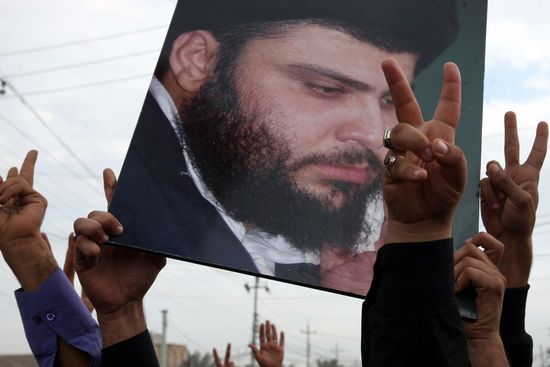
(Photo: Supporters of Iraq's controversial Shiite clergyman Moqtada al-Sadr carry his portrait as they flash the V-sign for victory during his first speech since returning to Iraq after four years of self-imposed exile in Iran on January 8, 2011 in the central shrine city of Najaf, during which he called on his followers to resist the US occupation of their country by all means. By Qassem Zein/AFP/Getty.)