That's Palinspeak for cross-hairs in a gun-sight.
Month: January 2011
“On Extreme Right And Left”
Yes, I used those words to delineate the corrosively caustic and eliminationist rhetoric that can fuel disturbed individuals like Jared Loughner. I did so because it is stupid to deny the vitriol that swamped George W. Bush during and after the recount and then the Iraq war. And there is a defense of heated rhetoric here: what language are you going to use when a president institutes torture or goes to war on empirically false pretenses?
But – and here I return to my recent blog-debate with Pejman – I do believe that the delegitimization and demonization of Barack Obama are in a different league and define the right in ways in which Bush hatred never fully defined the left. George Packer makes an interesting distinction here:
For the past two years, many conservative leaders, activists, and media figures have made a habit of trying to delegitimize their political opponents. Not just arguing against their opponents, but doing everything possible to turn them into enemies of the country and cast them out beyond the pale. Instead of “soft on defense,” one routinely hears the words “treason” and “traitor.” The President isn’t a big-government liberal—he’s a socialist who wants to impose tyranny. He’s also, according to a minority of Republicans, including elected officials, an impostor. Even the reading of the Constitution on the first day of the 112th Congress was conceived as an assault on the legitimacy of the Democratic Administration and Congress.
This relentlessly hostile rhetoric has become standard issue on the right. (On the left it appears in anonymous comment threads, not congressional speeches and national T.V. programs.)
I think that’s right. There are exceptions – congressman Alan Grayson comes instantly to mind; even irony didn’t quite undermine the totality of Keith Olbermann’s “Worst Person In The World”; the “Bushitler” stuff was vile, and I said so at the time. But the level of animus toward the new president and anyone supporting him reached preposterous proportions at the beginning of this presidency; the gracelessness from the Congressional leadership on down, from “You lie!” to “death panels” and “palling around with terrorists” … this is a real problem in a country with its fair share of disturbed individuals and much more than its fair share of guns.
The Palin forces, who have fomented this dynamic more viciously and recklessly than any other group, are reacting today with incandescent rage that they could even be mentioned in the same breath as this act of political terrorism. That’s called denial. When you put a politician in literal cross-hairs, when you call her a target, when you celebrate how many targets you have hit, when you go on national television and shoot guns, when you use the language of “lock and load” to describe disagreements over healthcare provision … you are part of the problem.
What we need now is a presidential speech that can affirm the positive aspects of robust debate while drawing a line under the nihilist elements of personal and ideological hatred. But it is clear to me at least that if American politics is to regain its composure, the forces of Palin and what she represents must be defeated. Not appeased or excused for, but defeated in the derelict public square of what’s left of our common discourse.
A Journey, Not An Escape, Ctd

A reader writes:
I've struggled a great deal to make sense of some of my psychedelic experiences, being all too aware of how they can be reduced to mere "chemicals acting on the brain." That's certainly not what they felt like, but I can't convey that sense of profundity to someone who hasn't had those experiences.
I credit my conversion to Christianity to a couple of experiences I had with LSD in my early 20s. During those experiences, I felt the Holy Spirit come upon me, and felt the salvific grace of Jesus Christ flowing through me, and it was the most beautiful feeling I've ever had.
The thing is, I've had other trips where seemingly profound insights seemed like nonsense upon later reflection. So why did this experience stick with me in a way that others didn't? I certainly can't say that psychedelics reveal some kind of ultimate truth, or else all trips would be as insightful and life-changing as the one I mention. But to simply reduce it to mere "hallucination" just doesn't seem to do it justice either. The word "psychedelic" means "mind-manifesting," and I've always felt there was something profound in that. There are so many aspects of our mind which we shut down during our normal routine. I feel like psychedelics can bring forth the subconscious in a way that, if done appropriately, can help you sort out your thoughts and beliefs in a way that can be both therapeutic and insightful. I also find that these substances tend to override our normal habit and conditioning in such a way as to open us up to the creativity and novelty which is a constant feature of the cosmos.
I think the real spiritual value of psychedelic experiences is the kinds of life changes they can provoke in us. After the initial glow of my conversion experience wore off, I sought to understand it, and began reading as much as I could on philosophy and theology, particularly metaphysics. I found authors like Ken Wilber and Alfred North Whitehead and Teilhard de Chardin who helped me make sense of this phenomenon I'd experienced. I studied meditation and centering prayer, and sought out mystical experiences without the help of chemicals.
I'm well aware that my experience of psychedelics is not the experience of them. I know a guy whose experiences with psychedelics led him to leave the Mormon church and become an atheist. But I think what my experience has in common with his is that we both were led towards a more authentic place in our lives, by some creative beacon of truth which I prefer to call God.
Another writes:
The Dish's pro-psilocybin contributors generally consider the similarities between hallucinogenic and religious experience as an argument in favor of shrooms/LSD. It's odd that this line of reasoning isn't more often turned on its head. Whatever else they may do, hallucinogens demonstrate that most minds have a latent capability for experiencing a mystical sense of oneness with the universe/deep insight into ultimate reality.
It seems likely to me that many of the great religious mystics, so far from being divinely inspired, merely suffered from (or were blessed with) a freak of brain chemistry which enabled them to experience these states without pharmacological
prompting. If the hallucinogenic mind-state descended upon you without apparent cause, what grounds would you have for resisting the instinct that its "insights" are true? Perhaps most of history's famous martyrs sacrificed themselves for a belief in the transcendental preciousness of chemical adjustments which can now be bought for a few twenties.
Another:
A recent commenter wrote, "It forces the tripper to acknowledge and understand that there are many – perhaps an infinite number – of perspectives that can be brought to bear on the same objective reality, and makes us realize that objective reality is one which we can never really know." From a Tibetan Buddhist perspective, this "objective reality" simply doesn't exist, and they label it as "Emptiness" because reality is "empty" of any inherent quality. The human mind revolts at this possibility, because perceptual reality seems so, well, real. But at its most base level, it's all energy, interpreted by our senses. Psychedelics clue you in to this fact, when for a brief moment you realize that everything you experience is 100% God.
Loving this thread. As usual in your blog, consciousness and religion overlap.
(Photo by Noah Kalina)
Face Of The Day

A devotee wipes the face of the Black Nazarene with his towel outside the Quiapo church in Manila on January 7, 2011, ahead of the annual festival which culminates with a religious procession attended by millions. The annual festival centres on a black icon of a cross-bearing Jesus Christ, which many Filipinos believe can perform miracles to cure the sick, drive away bad luck and bring prosperity. By Ted Aljibe AFP/Getty Images.
The Small Things
Johann Hari eulogized his grandmother at her funeral last week:
She got her pleasure in small things – in Coronation Street, in white pudding suppers, in Abba songs, and in horrifically violent horror films. Her favorite film in her last years was Saw III, in fact. But most of all, she got her pleasure from knowing she had looked after her family. And she did that better than anyone I know. She was absolutely consistent in being loving and caring and kind, and when she was dying I thanked her for everything she had done for me, and she said – it was almost the last thing she said to me – “I’d do it all again.”
Still Life Without Man

Frank Wilson salutes his friend Eric Mencher's photography:
Robert Musil said that “all still lifes are actually paintings of the world on the sixth day of creation, when God and the world were alone together, without man!” This is precisely right, as I think Eric’s photo demonstrates it. Still lifes have a quieting effect on us. They do not merely invite us to contemplate; they actually switch off, however briefly, the interior chatterbox. “So it must have been after the birth of the simple light / In the first, spinning place,” wrote Dylan Thomas.
Art can cast the world in a critical light, but at its best — as in this photo — what it does is grant us a glimpse of the world’s original innocence.
The Philosophy Of Cold

Charles Simic meditates on the season:
My late father, who had something good to say about most things, used to console people who complained about bitter cold weather by reminding them of the joys of a hot bowl of soup and of a strong drink being made permissible early in the day by the extraordinary circumstances. In addition, he claimed that the cold concentrates the mind. The moment we step outdoors, we do what we have to do with uncommon intelligence and dispatch, unlike those folks who can afford to sit in the shade on some Mediterranean or Caribbean island. Once we lie down, time ceases to count and we can meditate on eternity, Cioran believed. History, he said, is the product of people who stand up and get busy. Can one be a dreamer or a dolt on the North Pole? My father had his doubts about that.
(Photo: A tree stands in the fog in a snow covered landscape near Wiesbaden, western Germany on January 7, 2011. By Frank Rumpenhorst/Getty.)
After Arizona
The full live-blogged post is here. More tomorrow as we recover more facts.
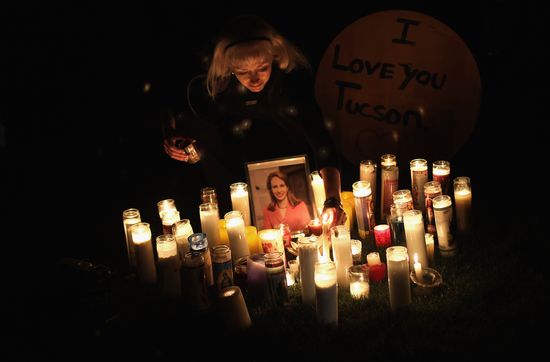
For now: a prayer for all those still miraculously struggling for life, for those who are helping them, for those who have been murdered, and for all the families and loved ones affected by this crime. A prayer too for the dark and twisted soul who committed this act, because it is also a Christian duty to see the human in him as well.
And a prayer that, whatever the precise dynamic that brought this evil to the surface, we can get past the violent rhetoric of our time and the poisonous polarization that fuels it. It has been ugly; it has been cruel; it has been reckless.
And it has to end.
(Photo: Leigh Harris adjusts candles at a vigil for U.S. Rep. Gabrielle Giffords, who was shot January 8, 2011 in Tuscon, Arizona. By John Moore/Getty.)
Shit-Faced, Etc.
Jonathon Green, leading lexicographer of slang, toasts the history of the drunken euphemism:
It all starts, as it should with booze, or rather bouse or bowse, which turns up in the very first ‘slang dictionary’, Robert Copland’s Hye Way to the Spitel Hous, published c. 1535. … After that, the terms come thick and fast. There’s a simple group of similes; [drunk] as a bastard, bat, boiled owl, brewer’s fart, cook, dog, fiddler (or his bitch), fish, fly, fowl, hog, king, little red wagon, lord, monkey, pig, piper, poet, skunk (in a trunk), tick, top, and a wheelbarrow. There is also, of course, pissed, often, if implausibly as a fart, newt or rat.
Bingeing On Not Drinking
Sarah Hepola reflects on her newly-found sobriety:
I decided to quit drinking for one day. And then I tried a month. And then six. Honestly, it's kind of how I drank too, when I was trying to cut down: Well, I'll just have one beer. OK, I'll have four. Wait, four makes me think six would be really good. I have no idea if I've quit drinking forever. Who knows if they've stopped doing anything forever? I don't even know if I want HBO next year. But that unpredictability is kind of the point right now, that there is the possibility of another story that's different from the one that came before. I'm totally confused about how to date without drinking, how to dance on a table without drinking, how to say yes without drinking. Which is thrilling when you let it be, a question mark that stretches into the horizon, instead of hanging grimly over the night that passed.
 The Dish