“We Will Not Leave Until He Leaves”

by Patrick Appel

Screenshot of Tahrir Square in Cairo from EA's live-blog:

Tahrir30
Heba Morayef of HRW is on the ground:

At least 20,000 protesters in Tahrir square now, it's absolutlely packed. Two fighter jets have been flying overhead for the last 10 minutes – people are cheering the flyovers. They're chanting "we will not leave until he leaves" and "long live the crescent together with the cross." There are judges, independent journalists, the Muslim Brotherhood, the National Association for Change, April 6th movement – all standing together and leading the chants.

America’s Tone Changes

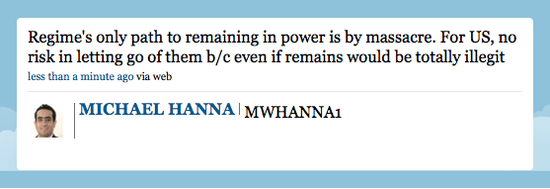
EgyptTweet
by Patrick Appel

Max Fisher live-blogs the news:

Secretary of State Hillary Clinton, speaking this morning on network news shows, called for a peaceful transition to democracy in Egypt. Clinton said the U.S. opposes Egypt becoming a "military dictatorship" but noted that the military has so far shown restraint. Clinton denied earlier reports that the U.S. was "reviewing" its massive aid to Egypt, saying there had been no discussions about canceling or reducing it. In the Obama administration's strongest statement to date, Clinton told Fox News that the U.S. wants an "orderly transition" in Egypt. Given that it's near-impossible to foresee any free election reelecting Mubarak, especially after his crackdown has claimed well over 100 lives, it's difficult to read Clinton's comments as anything but the U.S. calling for an end to Mubarak's rule. 

Marc Lynch isn't so sure:

Is Clinton calling for Mubarak to go or not? Hard to parse here, probably in Cairo too unless private communications more direct. 

Off The Air

by Patrick Appel

From Al Jazerra's live-blog:

Just spoke with staffer at the Cairo bureau. While our correspondent and other staff were out, security forces (not army) entered the office and demanded filming permits and press IDs. They were told that all the recently arrived staff hadn't had time to get their paperwork in order and so didn't have any. They ordered our bureau staff to take down the camera doing live shots from the balcony and threatened to take it if we didn't. So now we're just showing "latest pictures".

And Still They Protest

EgyptGetty30
by Patrick Appel

The Guardian summarizes this morning's news:

• Thousands of protesters have returned to the streets of Cairo on the sixth day of protests. There is a heavy military presence in Tahrir square. Protesters are demanding the resignation of president Hosni Mubarak, and his newly appointed deputy Omar Suleiman.

• Al-Jazeera has been taken off air in Egypt, in move that has been widely condemned as an attack on free speech. The network was also banned from showing live footage in Cairo.

• The Foreign Office has advised Britons to leave Cairo, Suez and Alexandria. Many other countries, including the US, are planning evacuation flights.

• There are reports of a mass prison break out. Leading members of the opposition Muslim Brotherhood were among those freed, the organisation said. Residents have taken control of law and order in many neighbourhoods.

• Israel has expressed concern about stability and security in Egypt. Britain's foreign secretary, William Hague, said there was a danger of extremism taking hold.

 (Photo: Men in Tahrir Square hold Egyptian flags on January 30, 2011 in Cairo, Egypt. By Peter Macdiarmid/Getty Images) 

Santo Not So Subito, Ctd

by Zoe Pollock

Nicholas P. Cafardi gets in the weeds:

The Ratzinger who in 1988 sought a speedier canonical process for handling abusive priests delayed decisions to remove them later. … By all accounts, Ratzinger’s awareness of the sexual-abuse crisis evolved over time, not always in a straight line, and often in conflict with other curial officials. …

Obviously, there’s no shortage of blame to go around. The Catholic community deserves a fuller explanation of Rome’s reticence in laicizing known abusers. (In turn, church critics ought to acknowledge that cutting a molester loose doesn’t necessarily protect kids.) The pope could do that. He should do that. We need less “back story” and more openness. If there’s anything we can say with certainty about the crisis, it’s that secrecy does more harm than good. What if Ratzinger’s exchange with Castillo Lara had been published when it took place? The discussion that might have engendered among bishops, canonists, and the faithful could have saved the church—and her victims—from profound and enduring grief.

The Rodney Dangerfield Of Religion

by Zoe Pollock

Stephen T. Asma argues that the developing world needs religion, and specifically animism:

The be­lief that na­ture is load­ed with in­visi­ble spir­its that live in lo­cal flo­ra, fau­na, and environmen­tal land­marks is gen­er­al­ly char­ac­ter­ized by West­ern­ers as "prim­i­tive" and high­ly irration­al. Even re­li­gious dev­o­tees of mono­the­ism in the de­vel­oped West look down their noses at an­i­mism. An­i­mism is the Rod­ney Dan­ger­field of re­li­gions. But most of the world is made up of an­i­mists. The West is naïve when it imag­ines that the ma­jor op­tions are mono­the­istic. In ac­tu­al num­bers and geo­graph­ic spread, be­lief in na­ture spir­its trounces the One-Godders. Al­most all of Af­ri­ca, South­east Asia, ru­ral Chi­na, Ti­bet, Ja­pan, ru­ral Central and South America, indig­e­nous Pa­cif­ic Islands—pret­ty much ev­ery­where ex­cept West­ern Eu­rope, the Mid­dle East, and North America—is dom­i­nat­ed by an­i­mis­tic be­liefs. …

Con­trary to the progress-based sto­ry the West tells it­self, an­i­mis­tic ex­pla­na­tions of one's dai­ly ex­pe­ri­ence may be ev­ery bit as em­piri­cal and ra­tional as West­ern science, if we take a clos­er look at life in the de­vel­op­ing world.

Religion, even the wacky, su­per­sti­tious stuff, is an an­al­ge­sic sur­viv­al mech­a­nism and sanc­tuary in the de­vel­op­ing world. Religion pro­vides some or­der, co­her­ence, re­spite, peace, and trac­tion against the fates. Per­haps most im­por­tant­, it quells the emo­tion­al dis­tress of hu­man vulnerabil­i­ty. I'm an ag­nos­tic and a cit­i­zen of a wealthy na­tion, but when my own son was in the emer­gen­cy room with an ill­ness, I prayed spon­ta­ne­ous­ly. I'm not naïve—I don't think it did a damn thing to heal him. But when peo­ple have their backs against the wall, when they are tru­ly help­less and hope­less, then grov­el­ing and ne­go­ti­at­ing with any­thing more pow­er­ful than themselves is a very hu­man re­sponse. It is a re­sponse that will not go away, and that should not go away if it pro­vides some gen­u­ine re­lief for anx­i­ety and ag­o­ny. As Rog­er Scruton says, "The consolation of imag­i­nary things is not imag­i­nary con­so­la­tion."

Egypt’s Darkside

by Patrick Appel

Jane Mayer reports on Egypt's new veep:

Suleiman is a well-known quantity in Washington. Suave, sophisticated, and fluent in English, he has served for years as the main conduit between the United States and Mubarak. While he has a reputation for loyalty and effectiveness, he also carries some controversial baggage from the standpoint of those looking for a clean slate on human rights. As I described in my book “The Dark Side,” since 1993 Suleiman has headed the feared Egyptian general intelligence service. In that capacity, he was the C.I.A.’s point man in Egypt for renditions—the covert program in which the C.I.A. snatched terror suspects from around the world and returned them to Egypt and elsewhere for interrogation, often under brutal circumstances.

How To Live

  4147498814_701734fce1_b

by Zoe Pollock

Spitalfields Life profiles Maurice Franklin, ninety-one year old wood turner:

“What’s the secret?” I asked Maurice, curious of his astonishing vitality, and causing him to break into a smile of wonderment at my question. “All you’ve got to do is keep on living, and then you can do it. It isn’t very difficult.” he said, spreading his arms demonstratively and shaking his head in disbelief at my obtuseness.

“Are you happy?” I queried, provocative in my eagerness to seize this opportunity of learning something about being a nonagenarian. “I’ll tell you why I am happy,” said Maurice, with a grin of unqualified delight and raising one hand to count off his blessings, “I’ve got a wonderful family and wonderful children. I’ve been successful and I’ve got an appetite for life, and I’ve eaten every day and slept every night.”

(Photo by Flickr user Marcel Oosterwijk)