After The Enlightenment

by Zoe Pollock 

Mark Vernon looks for answers:

[W]hat is it that makes life good for us humans? The Enlightenment left us with few resources for thinking about that larger question, because it was so focused on winning individuals their freedom. …There is another ethical tradition that can help. It’s known as virtue ethics. Virtue ethics begins by asking what it is to be human, and proceeds by asking what virtues — or characteristics, habits and skills — we need in order to become all that we might be as humans. It’s much associated with the ancient Greek philosopher Aristotle, who discussed the meaning of friendship as a way to illustrate his approach to ethics.

Science tells us we are social animals, Aristotle observed. But in order to live well as social animals, we also need a vision of what our sociality can be.

 

Prayer As Protest, Ctd

PrayingGetty

by Patrick Appel

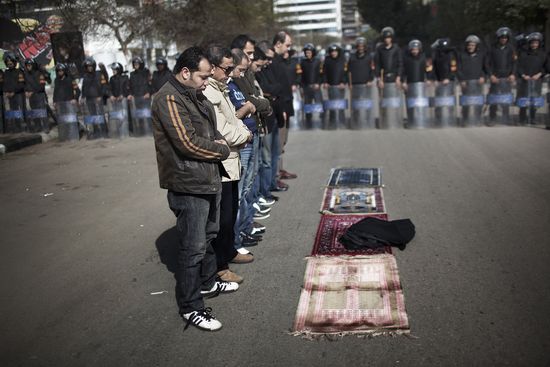
Henry Farrell focuses on the role of mosques:

One of the most significant problems in coordinating widespread collective protests in undemocratic regimes is figuring out where and when people should meet. One can converge upon major public sites – but one faces obvious risks in so doing, unless one is already part of a large group. When there is (a) a social institution or set of social institutions through which people meet in large groups at particular places at regular times, and (b) that institution is vaguely or strongly associated with unhappiness with the regime, then they help solve this problem. People can meet and congregate in larger groups and then take action. Mosques (in a country where the Islamic Brotherhood is repressed) can obviously play that role in Egypt and did play that role. Even without any other means of communication, people could plausibly have predicted that the mosques' Friday services would be the obvious place for protestors to congregate in large groups (or, if there was no large group, to reassess the probable costs of protest and slink away).

(Photo: Egyptian riot police officers watch people praying outside the Mustafa Mahmud Mosque in Cairo, on January 28, 2011)

Many Americas

AmericaEgypt

by Patrick Appel

Reihan emphasizes that America's government and America are not the same thing:

In the contemporary United States, the entire population does not feel as though the national security apparatus speaks for them. This was always true, of course. But now the dissenting minority can actually exercise “soft power” of its own, through the deployment of philanthropic resources, knowledge capital, etc. Americans aren’t just embedded in diaspora-based “brain circulation” networks. They are embedded in free software “brain circulation” networks, the WikiLeaks movement,  social enterprise networks, increasingly cosmopolitan evangelical religious networks, and many other networks that are based on shared affinities, ideologies, etc., and not on shared ethnolinguistic background or nationalist loyalties.

He goes on:

So when idiots on the Internet tell me that America is to blame for Hosni Mubarak, I have to ask, which America and which Americans? The America that Egyptian authorities are blaming for sponsoring and protecting a handful of young Egyptian democracy activists who may well be at the center of the disturbance? U.S. think tanks like the American Enterprise Institute that publish books like Reuel Marc Gerecht’s The Islamic Paradox that make the explicit case that (a) democratization in the Arab Middle East will lead to anti-U.S. and anti-Israel governments and that (b) this is nevertheless a crucial first step to more decent, humane societies in the region that the United States government should support?

(Photo: People demonstrate in support of the Egyptian people's protests against the regime of President Hosni Mubarak in front of the Egyptian embassy in Washington on January 29, 2011. By Nicholas Kamm/AFP/Getty Images)

A Tunisian Tsunami? Ctd

by Chris Bodenner

Some early indications of more ripples:

0122 GMT: After Egypt, some Syrians are calling for protests in that country on February 5. Calls for the Sudanese to come out to protest against their dictator Omar Al Bashir are also being circulated.

And this from yesterday:

1629 GMT: In Algeria, the National Coordination for Change and Democracy has called for a national march on 12 February in Algiers. One of the main demands will be the lifting of the State of Emergency, imposed in 1992. The NCCD is a coalition of political parties, associations, and human rights activists.

Non-Committal Commitment

by Zoe Pollock

Tracy Clark-Flory collects stories of "friends with benefits" gone wrong:

It isn't that every generation thinks it's invented sex so much as a better way of doing it — like you can remove the messiness from human intimacy. No strings, no attachment, no complications! "Friends with benefits" situations seem a solution to negotiating companionship and pleasure amid any number of inconvenient, complicated scenarios — from an all-consuming career to a personal crisis to a drinking problem to a fear of intimacy to good old-fashioned loneliness. But these friendly hookups aren't actually new: I'm living proof, seeing as in the late '70s my free-loving parents were just friends who slept together — until things got complicated and they fell in love.

A Poem For Saturday

  Guerra

by Zoe Pollock

"Remembrance" by Hortense Flexner appeared in The Atlantic in March 1916:

‘An aeroplane has been brought down in the Aegean Sea.’ – Dispatch

Wounded, the steel-ribbed bird dipped to the sea,
Its vast wings twisted, struggling with the air
That would not bear it up – and heavily
Struck the still water, sleeping idly where
The gold-arched noon had lulled it into dream.
So there was foaming tumult and the fret
Of waves on heated steel – then silver steam,
That hung like fallen cloud, where they had met.
And that small, striving thing that fought away,
Free of the wreckage, did he, dying, hear
The waters murmuring of another day,
A noon, now long ago, yet strangely near;
The waters telling drowsily of one
Who with his wings of wax dared woo the sun?

(Image by Guerra de la paz, an artistic duo of Alain Guerra and Neraldo de la Paz.)

Sexuality Is In The Eyes

by Zoe Pollock

Tom Ford gives a great interview to the painter John Currin. Ford:

Someone asked me recently about male nudity, and I brought up the subject that, in our culture, we use female nudity to sell everything. We’re very comfortable objectifying women. Women go out and they are basically wearing nothing. Their feet and toes are exposed, their legs are exposed, their breasts are exposed. Everything is exposed—the neck, the arms. You have to be really physically perfect, as a woman, in our culture to be considered beautiful. But full frontal male nudity challenges us. It makes men nervous. It makes women nervous. Other times in history, male nudes have been regarded in a different way. The Olympics were originally held nude. The reporter I was explaining this to said, “This would make a great story.” I explained how when I come home I actually take off all my clothes, and I wear no clothes until I leave. I eat naked. I do everything completely naked. He said, “That would make a great interview.” I said, “Fine, we have to do it nude.”…

Anyway, we did the interview. The interviewer was straight, and I made it a point to desexualize the interview even though I was sitting with my legs wide open, completely naked. At the end of the interview, I put on a dressing gown and he put on his clothes, and I sat next to him on the sofa and said, “Was that sexual?” He said, “Absolutely not.” And I said, “That’s because I didn’t make it sexual. Sexuality is in the eyes, it’s an expression, it’s in a look.” Then, all of a sudden, I looked at him in a very different way, and it made him very nervous.

Sniper On Killing Spree

by Chris Bodenner

Unconfirmed report from EA:

2230 GMT: Escalating story tonight of at least one sniper in the Ministry of Interior picking off protesters outside the building. Witnesses are saying 10 to 15 people have been shot dead and dozens have been wounded. Dr Muhammad Hassan tells Al Jazeera that dead protestors from the area are flooding the makeshift field hospital.

Brian Eno Babies

by Zoe Pollock

Timothy Gabriele explores "womb music" for newborns:

Ambient and experimental electronic music regularly incorporate sounds like running water, hums, drones, buzzes, noise, Tibetan throat singing, and other low frequency tones, all of which value (electro) acoustic space similar in rhythm and overtone to the prenatal environment.  … Newborns, it seems, are predisposed to noise music, specifically that of a fuzzy, warm, and liquid timbre.  It’s only later that we begin to favor harmony and melody.