The RNC debate was like something out of Orwell, apparently. Worth noting when reading Krauthammer/Will:
The [candidates] likewise tripped over one another to answer in the affirmative when asked whether Sarah Palin could win a general election.
The RNC debate was like something out of Orwell, apparently. Worth noting when reading Krauthammer/Will:
The [candidates] likewise tripped over one another to answer in the affirmative when asked whether Sarah Palin could win a general election.
I am finally proud to say: I really don't care. And this sounds like someone analyzing the Pope:
Max Read at Gawker suggests that her decision to delve into such a politically charged post could have been driven by a number of motives. Though he doesn't discount potential confusion or a simple mistake as a catalyst, Read also believes that it's possible that Palin believed it to be the proper forum to outline her stance on gay rights, a social issue that she has kept mostly quiet about during her rise to political stardom.
Crooks and Liars compares quotes from Judy Miller:
Judith Miller (now “Judy” for Fox News) makes a crack about Wikileaks’ Julian Assange being a “bad journalist” because –wait for it–
“he didn’t care at all about attempting to verfiy the information that he was putting out or determine whether or not it would hurt anyone.”
That’s very interesting coming from Miller, an instrumental component in taking us into the Iraq War, and the subsequent deaths of tens, perhaps hundreds of thousands of Iraqis and 4430 American troops. Miller would later say about her role:
[M]y job isn’t to assess the government’s information and be an independent intelligence analyst myself. My job is to tell readers of The New York Times what the government thought about Iraq’s arsenal.
The National Association For Marriage, a group devoted to preventing gays from marrying legally, is boycotting CPAC because of the presence of a tiny splinter group of what's left of Log Cabin, GOProud. This seems a sad piece of meretricious animus – banning a fiscally conservative group because it specifically appeals to gays is not exactly a way to expand libertarianism or frugality. But now the big dogs are wagging their tails as well:
In November, the far-right American Principles Project instigated the CPAC boycott over GOProud’s involvement back in November, and groups such as American Values, Capital Research Center, the Center for Military Readiness, Liberty Counsel, Liberty University, and the National Organization for Marriage followed the APP’s lead in boycotting the conference.
Today, WorldNetDaily, which has provided support for the boycott movement, reports that the Family Research Council and Concerned Women For America have decided to boycott CPAC. FRC and CWA are easily the largest groups to join the boycott movement, and FRC hosts a similar conference that is geared to Religious Right activists, the Values Voter Summit. WorldNetDaily reports on their decision and the ensuing praise from anti-gay rights activists Peter LaBarbera and Mat Staver.
These are major Christianist right players. This is the rhetoric they warm to:
God cut Gideon's army up, slicing and dicing it until it represented only a tiny fraction of its numbers. God didn't want a big army to win victory. He wanted a miracle performed by a tiny army listening carefully and being in obedience to His commands.
God purged thousands from Gideon's army.
Conservatives need God's help, not GOProud's.
Purges can make an organization or a movement stronger.
Purges can help to refine, rather than redefine, what an ideology is all about.
Purges can sharpen and strengthen a movement – bringing it back to the core convictions and principles that made it successful.
And that's why the purge of the conservative movement should begin with David Keene and his administrative team at ACU.
Really: purges? And NOM and FRC and CWA are all on board? Perhaps CPAC will move toward economic issues and the Values Summit will stick to Christianism. But that itself would be an interesting split.
Andrew Sprung expands his critique of political scientist and blogger Jonathan Bernstein:
I don't think it's terribly controversial or clever – or naive – to posit that sometimes an elected official's understanding of good politics will conflict with her understanding of good policy; that sometimes a politician will have to choose between the two; and that sometimes – including when the stakes are highest – politicians choose against political advantage. In Taylor Branch's The Clinton Tapes, Clinton asserts – credibly, I think – that he acted against his short-term political interest in the Mexican bailout, the Aristide restoration, and the bombing of Serb targets in Bosnia; he also confesses that he was unwilling to expend the necessary political capital to reverse a policy he considered stupid, the Cuban embargo. I think George W. Bush is also credible in asserting that he placed the national interest as he perceived it against the short-term interests of his party. I think these points are so self-evident that I suspect Bernstein will claim that I've oversimplified or misrepresented his presentation of the relationship between politics and policy. And it may be so – but not in the posts I cited.
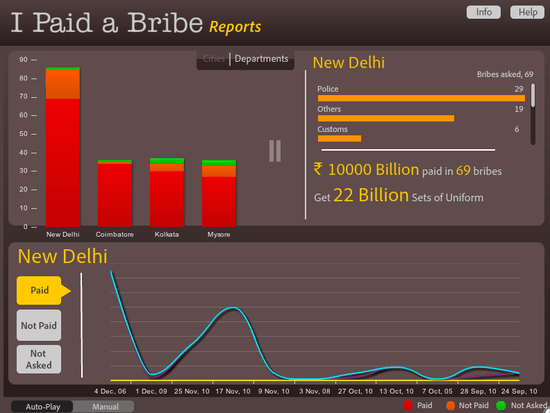
Aleks Jakulin finds a novel project:
I Paid a Bribe by Janaagraha, a Bangalore based not-for-profit, harnesses the collective energy of citizens and asks them to report on the nature, number, pattern, types, location, frequency and values of corruption activities. These reports would be used to argue for improving governance systems and procedures, tightening law enforcement and regulation and thereby reduce the scope for corruption.
Leonhardt highlights it:
[E]ven those with health insurance experience rationing. How? In many ways.
This country has not spent the money to install computerized medical records, and we suffer more medical errors than many other countries. We underpay primary care doctors, relative to specialists, and we’re left stewing in waiting rooms while our primary-care doctors try to see as many patients as possible. Specialists are usually not paid for time they spend collaborating with doctors in other specialties, and many hard-to-diagnose conditions go untreated. Nurses are usually not paid to counsel people on how to improve their diets or remember to take their pills, and manageable cases of diabetes and heart disease become fatal.
"As we sadly learned with all the sound and fury that attended the Republican Revolution of 1994, the real risk isn't that a tidal wave of right-wing kookery will wash over the land. The greater likelihood is that the GOP rebels will quickly lose their reformist spirit after a few fizzled confrontations with the bipartisan Beltway establishment and end up governing much like the Democrats they replaced," – W. James Antle III, The American Spectator
This comes from sparse polling over the holidays so should be treated with skepticism:
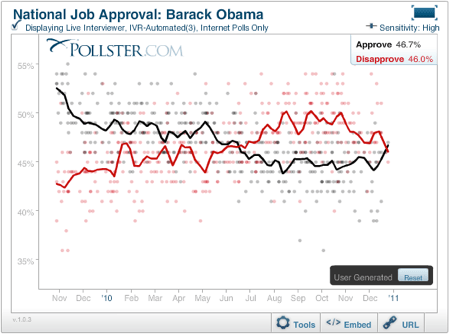
I'll check in as more data emerge.
Matt Yglesias rails against parking regulations. Kevin Drum dissents. Ryan Avent comes to Matt's defense:
Let’s say you’re a private business owner and you want to provide parking for your customers but are worried about other stores free-riding on your spaces. What could you do? Well, you could build the parking, charge for it, and validate for your customers. And if you’re another business that doesn’t want to pay for parking but wants to make sure that your customers can park, you can approach someone who owns parking and offer to pay for your customers to park so you can validate too. It’s extremely easy to exclude people from private parking, so property rights are clear, so there’s absolutely no reason why businesses can’t negotiate efficient arrangements on their own. And in the real world, they basically always do when left to their own devices. So why should government mandate minimum parking? It shouldn’t, obviously.
 The Dish