People V. Planet

by Zoë Pollock

 Robert Kunzig considers a growing global population, projected for 9 billion by 2045:

Before the 20th century, no human had lived through a doubling of the human population, but there are people alive today who have seen it triple. Sometime in late 2011, according to the UN Population Division, there will be seven billion of us. …

Carbon emissions from fossil fuels are growing fastest in China, thanks to its prolonged economic boom, but fertility there is already below replacement; not much more can be done to control population. Where population is growing fastest, in sub-Saharan Africa, emissions per person are only a few percent of what they are in the U.S.—so population control would have little effect on climate. Brian O’Neill of the National Center for Atmospheric Research has calculated that if the population were to reach 7.4 billion in 2050 instead of 8.9 billion, it would reduce emissions by 15 percent. “Those who say the whole problem is population are wrong,” Joel Cohen says. “It’s not even the dominant factor.” To stop global warming we’ll have to switch from fossil fuels to alternative energy—regardless of how big the population gets. The number of people does matter, of course. But how people consume resources matters a lot more.
“Sans-Serif Badassery”

by Zoë Pollock

Kieran Healy struggles with a new report that argues the efficacy of some of the world's uglier fonts:

Short version: setting information in hard-to-read fonts, including Comic Sans Italic, led to better retention amongst research subjects because of “disfluency”. When you have to work harder to read it, you remember it better.

Ah, bitter vindication for the classic McSweeney's monologue, "I'm Comic Sans, Asshole." Money quote:

You don't like that your coworker used me on that note about stealing her yogurt from the break room fridge? You don't like that I'm all over your sister-in-law's blog? You don't like that I'm on the sign for that new Thai place? You think I'm pedestrian and tacky? Guess the fuck what, Picasso. We don't all have seventy-three weights of stick-up-my-ass Helvetica sitting on our seventeen-inch MacBook Pros. Sorry the entire world can't all be done in stark Eurotrash Swiss type. Sorry some people like to have fun.

It’s So Personal … On MTV

by Zoë Pollock

Lynn Harris praises MTV's 30-minute interview special on abortion, "No Easy Decision":

Seriously, they nailed it. And by "nailed it," I don't mean they just did a great PSA for abortion. I mean they told the many-sided truth: that abortion is safe and common, that abortion has been made difficult to get, and, most importantly, that abortion is a complex decision made by complex human beings. (That thump you heard around 11:35 p.m. EST was the sound of 100 feminist media critics falling off our collective couches.)

Desperately Seeking Sacrifice

by Zoë Pollock

Sam Harris bemoans the current state of economic inequality in America and proposes a few solutions:

While the United States has suffered the worst recession in living memory, I find that I have very few financial concerns. Many of my friends are in the same position: Most of us attended private schools and good universities, and we will be able to provide these same opportunities to our own children. No one in my immediate circle has a family member serving in Afghanistan or Iraq. In fact, in the aftermath of September 11th, 2001, the only sacrifice we were asked to make for our beloved country was to go shopping.

Nearly a decade has passed, with our nation's influence and infrastructure crumbling by the hour, and yet those of us who have been so fortunate as to actually live the American dream–rather than merely dream it–have been spared every inconvenience. Now we are told that we will soon receive a large tax cut for all our troubles. What is the word for the feeling this provokes in me? Imagine being safely seated in lifeboat, while countless others drown, only to learn that another lifeboat has been secured to take your luggage to shore…

Question Of The Week: “Dominion”

by Conor Friedersdorf

A reader writes:

I'm inclined to say Matthew Scully's amazing book Dominion, about animal welfare and humanity's moral responsibility toward animals. Scully is, of course, a conservative, and the detailed, careful, persuasive and, indeed, conservative argument he made about the moral duty we all face to treat animals (and, by extension, the natural world) with dignity and even with pietas, completely turned this conservative's thinking around, and revealed to me with singular power how entirely wrong-headed and unconservative the mainstream Right is on animal welfare and related issues.

Question Of The Week: “Topsoil And Civilization”

by Conor Friedersdorf

A reader writes:

History as taught in school emphasized war, conquest, and political leaders; industry and architecture; and, sometimes, religion and art. I became bored with it or, at least, I couldn't put each of these critical elements of civilization in a context that engaged me. Though I didn't really understand it at the time, what I was missing was the natural and cultural history of what was real around our farm in Iowa: land, air, water, and soil; domesticated seed and livestock; tractors, weed control, harvest, and storage; farm-to-market roads, towns, railroads, and barges; hard work, a bountiful crop, and a table filled with food. Farm work, biology classes, and a visit to the State Fair seemed to offer more a sense of reality than these history books.

Then I read Topsoil and Civilization.

Carter and Dale's thesis is that civilization is a function of how we use the resources of the natural world to, first and foremost, feed, clothe, and shelter ourselves. A sustainable agricultural system is a prerequisite to civilization. Likewise, an agriculture which depletes the soil and other productive resources will weaken a civilization making it vulnerable to collapse. It's pretty simple, really. People who don't eat don't exist to fight wars, lead nations, build buildings, and worship their god.

Gregor Mendel or Wang Zhen are clearly more pertinent to my life than Alexander or Kant. The cultural legacy embedded in a seed of corn is more valuable than gunpowder or the arch. Local hero Norman Borlaug has likely saved more lives than Hitler destroyed, several times over. And, no, I am not dismissing Alexander, gunpowder, and Hitler as unimportant. Just not as important as agriculture and natural resource conservation. And most historians missed this truth.

Though I would decide that this book is flawed by culturally bigoted analysis and inadequate citations of facts, the truth that the sustainable production of food and fiber is a foundation of all I care about and love has stuck with me. It is why I have chosen agriculture and natural resource conservation as my vocation.

“The Talmud Is Not A Business Model”

by Zoë Pollock

Isaac Stone Fish reports on China's fascination with Jewish business acumen:

Han Bing, the (pseudonymous) author of Crack the Talmud, says a series on the “Jewish Bible” by a prominent publisher made him realize that “ancient Jews and today’s Chinese face a lot of the same problems,” such as immigration and isolation. The business rules he lists include such unsurprising—and universal—exhortations as “tell a customer about defects,” “help more people,” and “a partnership based on emotions is not dependable.” No statistics are available on the sales of this sliver of the book market. …

Han Bing says he has never met a Jew and cautioned NEWSWEEK that he’s not sure if he’s gotten his portrayal right. But he nevertheless states that “Jews understand that money itself is neither good nor bad.” He sees his book as “bringing some light into the dark room of Chinese businesses.”

Stanley Kurtz’s “Radical In Chief”

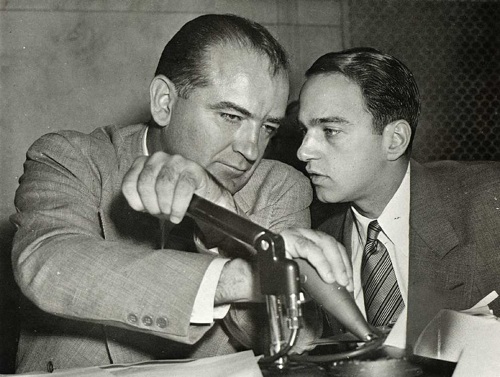
Mccarthy

by Conor Friedersdorf

Says Mr. Kurtz in National Review:

There’s no doubt that Radical-in-Chief’s cover art draws the reader’s eye with a spectacular symbol of classic Marxist socialism. It would have been tough to put a picture of the Midwest Academy on the book, since no-one’s ever heard of it, and since the Midwest Academy keeps its socialism secret in any case. I get at the stealthy, pragmatic, and incremental Midwest Academy-style socialism the reader will learn about inside through the book’s subtitle.

But the fact is that a lot of Radical-in-Chief is about good old fashioned Marxism. There’s the story of Reverend Wright’s adventures in Cuba, for example, which drew Obama to Wright’s church, I claim. And Obama himself was a revolutionary Marxist at Occidental College.

Similarly, there's no doubt that readers of this post will find their eyes drawn to the large picture of Senator McCarthy I've put at the top. It might have been more fair and intellectually defensible to lead with a photograph of Kurtz, but it would've been "tough" because no one knows what he looks like. And in the body of this post, I get at my actual point, which is that red-baiting is more effective when it's plausible.

For example, a Marxist revolution never happened at Occidental College. And rather than overthrow the capitalist order at the end of his two years there, Barack Obama transfered to Columbia University. So I have a hard time putting him in a category with Trostsky, Lenin, Castro, Mao and Gueverra.

Feed The Machine

by Zoë Pollock

Allison Arieff interviewed New York Times reporter Matt Richtel, who spent the past year on the series, Our Brain on Computers:

[All the people I talked to] talk about technology as being analogous to food. You need food, you need technology. This is not a Luddite philosophy–it’s just that some food is Brussels sprouts and some is Twinkies. Just as you can overeat, you can abuse your brain by overindulging or making bad choices about technology. No one would say ‘food is good, let’s eat as much as possible.’