Feel The Internets

by Zoë Pollock

John Borland reports on the DIY transhumanism trend, "the fringe of a movement that itself lies well outside the mainstream of philosophy, ethics, technology and science.":

For decades, transhumanists have argued that science and technology are approaching (or have approached) the point at which humans can take evolution into their own hands, transcending limitations of sensation or movement or even lifespan that are purely the accident of evolution. Some thinkers focus strictly on the “post-human” physical body, while others write of evolved social systems as well.

[Lepht] Anonym’s vision of the transhuman is rather different. Less visionary, possibly, but more realistic. What she does is “grinding,” with homemade cybernetics and an intimate familiarity with medical mistakes, driven by a consuming curiosity rather than a philosophical creed. She does her own surgery, with a scalpel and a spotter to catch her if she passes out, and an anatomy book to give her some confidence she isn’t going to slice through a vein or the very nerves she’s trying to enhance.

“The existing transhumanist movement is lame. It’s nano everything. It’s just ideas,” she says. “Anyone can do this. This is kitchen stuff.”

Face Of The Day

107834529

A Sri Lankan Buddhist devotees light oil lamps after offering prayers at The Kelaniya Temple in Kelaniya on January 1, 2011. The tropical island economy has grown at a blistering pace since government troops in May 2009 ended a 37-year ethnic conflict with Tamil Tiger rebels that the United Nations estimates left over 100,000 people dead. By Ishara S. Kodikara AFP/Getty Images.

The Shifting Tide Of Empathy

by Zoë Pollock

Jamil Zaki explores one possible explanation for the decline in empathy over the past thirty years:

The types of information we consume have also shifted in recent decades; specifically, Americans have abandoned reading in droves. The number of adults who read literature for pleasure sank below 50 percent for the first time ever in the past 10 years, with the decrease occurring most sharply among college-age adults. And reading may be linked to empathy. In a study published earlier this year psychologist Raymond A. Mar of York University in Toronto and others demonstrated that the number of stories preschoolers read predicts their ability to understand the emotions of others. Mar has also shown that adults who read less fiction report themselves to be less empathic.

Question Of The Week: An Article About A Woodpecker

by Conor Friedersdorf

A reader writes:

I have a fairly unusual answer to your question of the week, I think. A magazine article that had probably the biggest impact on my life and the way I view the world was an article on evolution in an issue of The Plain Truth, an evangelical magazine put out by Garner Ted Armstrong and the Worldwide Church of God in the '60s and '70s.  My mother subscribed to the magazine and I discovered it lying around one day when I was eight or nine years old.  I was a precocious and voracious reader, so I devoured it along with any other piece of reading material I could get my hands on.

The article in question was about the "so-called" evolution of the woodpecker.  

It had the usual mocking tone of creationist arguments (which I kind of liked) and put forth the idea that the woodpecker was so perfectly suited to drilling holes in trees, it would be inconceivable to imagine any intermediate forms.  There was an accompanying illustration of the woodpecker as a machine, with great metallic legs gripping the tree, a piston neck and a drill-like beak. I loved that illustration and stared at it for hours.  More than anything, it convinced me that a partly-evolved woodpecker, flying around the forest, bashing his head against trees was ridiculous.  I become, before I even understood what evolution was, a creationist.

My conversion lasted about six months.  I went camping with my family in British Columbia and, one day, while wandering the woods near our campsite, I spotted a bird (not a woodpecker) pecking away at a tree. I saw it pluck something from the tree and fly away.  I moved to the tree to take a closer look.  I couldn't see anything of interest to a bird in the rough bark, so I dug a little at it with my pocket knife. There were bugs, not just in the cracks of the bark, but deeper inside the bark as well.  "There's stuff to eat all the way inside," I thought.  And, suddenly, I understood how a partly-evolved woodpecker could develop.  By eating the stuff available all the way inside and gradually developing stronger beaks, stronger necks and so on.  I had my first true inkling of how evolution worked.

For a moment, I was elated.  Then, suddenly, I was furious.  I had been lied to.  A magazine with the word "Truth" in its title had lied to me.  Grownups, trying to teach me about the world, had lied to me. It was a disturbing and frightening realization for someone my age, and it created in me a deep skepticism that remains to this day.  On the whole, this has been a good thing, and, I have to say, if I ever ran into the author of that article, I'd thank him, although he might not appreciate the sentiment.

And that picture of the mechanical woodpecker really was totally cool.

The Act Of Bearing Witness

by Zoë Pollock

Roger Ebert watched the 1985 Holocaust film "Shoah," which runs over nine hours:

What is so important about "Shoah" is that the voices are heard of people who did see, who did understand, who did comprehend, who were there, who know that the Holocaust happened, who tell us with their voices and with their eyes that genocide occurred in our time, in our civilization.

There is a tendency while watching "Shoah" to try to put a distance between yourself and the events on the screen. These things happened, after all, 40 or 45 years ago. Most of those now alive have been born since they happened. Then, while I was watching the film, came a chilling moment. A name flashed on the screen in the subtitles, the name of one of the commandants at Treblinka death camp. At first I thought the name was "Ebert" — my name. Then I realized it was "Eberl." I felt a moment of relief, and then a moment of intense introspection as I realized that it made no difference what the subtitle said. The message of this film (if we believe in the brotherhood of man) is that these crimes were committed by people like us, against people like us.

While at Yad Vashem, we met with a survivor who told his story and answered our questions. It's a scary thought that future generations won't have that opportunity.

Question Of The Week: “The Myth Of Sisyphus”

by Conor Friedersdorf

A reader writes:

By far the most influential work of art for me was Albert Camus' brief essay on Sisyphus, which I read when I was 17. I was confused and unhappy about a lot of things, only one of which was the death of my father. Because I'd had a pretty sheltered upbringing, I had never experienced any deep suffering before. I was in a state of turmoil and feeling sorry for myself. Camus' essay simply blew me away. Sisyphus was condemned for all eternity to one repetitive, back-breaking and utterly futile task – but Camus wrote that, by accepting his fate, Sisyphus transcended it. I have never forgotten the overwhelming last line, "One must imagine Sisyphus happy."

In the years since then, I've encountered this idea (the transformative power of accepting suffering) elsewhere – for example, in Buddhism – but Camus' essay was the thing that made me get over my self-pity and grow up.

Quote For The Day

by Zoë Pollock

"I take a dark view of many, perhaps most things, but I try very hard to live life with a smile. Somewhere or other Joseph Epstein wrote that H.L. Mencken's lifelong pessimism never stopped him from getting a good dinner, which seems to me exactly the right attitude toward the world and its myriad woes. I know that they exist, but I also know that I am a lucky man, and so long as my luck holds, I hope never to do it the injustice of ingratitude," – theater critic Terry Teachout, reflecting on the past year and how to survive the future.

Religion As Worldview

by Zoë Pollock

Mark Vernon reviews Hannah's Child, the memoir of theologian Stanley Hauerwas:

[W]hat I found odd was coming away with little feeling for what it means to be a Hauerwasian Christian – to be Christian as opposed to do Christianity. He confesses that he is not much given to prayer, and that counts for inner reflection too. … It also means that Christianity comes across not as a spiritual reality – there's little sense of struggle and relationship with Christ or God, which you powerfully get when reading the autobiographies of an Augustine – but rather Christianity is a practical matter, a worldview that delivers policy.

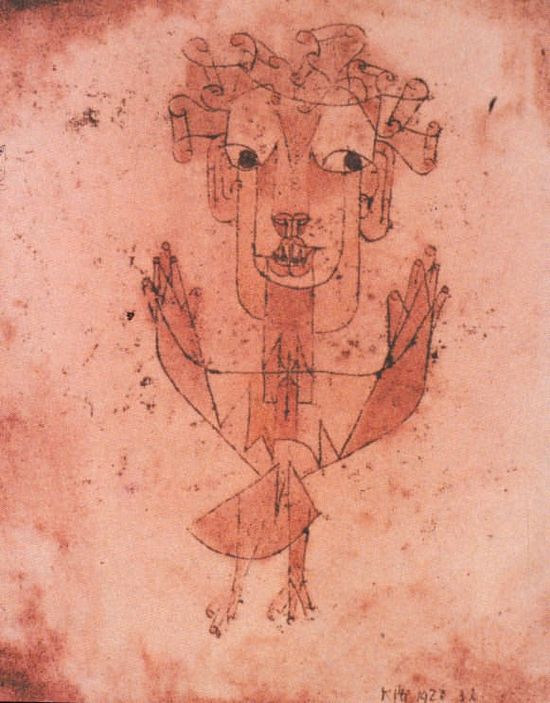
Drawing On The Angel Of History

Klee

by Zoë Pollock

David Kaufmann reviews Uwe Steiner’s new book on Walter Benjamin, the Jewish theorist who committed suicide in 1941. Kaufmann relishes the passage below and connects it to Benjamin's notion of religion:

A Klee painting named Angelus Novus shows an angel looking as though he is about to move away from something he is fixedly contemplating. His eyes are staring, his mouth is open, his wings are spread. This is how one pictures the angel of history. His face is turned toward the past. Where we perceive a chain of events, he sees one single catastrophe which keeps piling wreckage upon wreckage and hurls it in front of his feet. The angel would like to stay, awaken the dead, and make whole what has been smashed. But a storm is blowing from Paradise; it has got caught in his wings with such violence that the angel can no longer close them. The storm irresistibly propels him into the future to which his back is turned, while the pile of debris before him grows skyward. This storm is what we call progress. …

Benjamin’s thought was essentially religious. It clung to the twin promises of redemption and transcendence. The man worked from the clearly Jewish intuition that justice cannot be derived from the world as it is. Justice is precisely that small break from nature instituted by the Law. Our problem is not that nature is sinful. Our problem lies with the fact that on its own, nature just isn’t enough. It needs to be transcended, if only just a bit. As his friend T. W. Adorno was fond of reminding us, the Talmud says that the redeemed world will be like this one, but a little different. And that tiny shift means everything.