The Pope's Christmas thought of the day for the BBC created quite the stir:
… it was not a political liberation that [Jesus] brought, achieved through military means: rather, Christ destroyed death for ever and restored life by means of his shameful death on the Cross.
Richard Dawkins was outraged. In a promising new blog, Eric MacDonald glimpsed the larger lesson after witnessing his wife's long battle against MS:
But one thing, during all those years of increasing disability and loss and pain, became very clear. Though we celebrated Jesus’ suffering and death at Christmas time, even as we sang carols about his birth, people did not want to hear about suffering, real human suffering and loss. As I mourned the dying of the light, watching someone I loved so dearly disintegrate before my very eyes, no one wanted to hear about real suffering at Christmas. They did not want to be reminded that people still grew sick and died, amidst the tinselly joy of Christmas time. Some were even offended if I mentioned it, even though they could see, year by year, Elizabeth’s abilities degrading more and more. …
But there is something, to my mind, even more shameful.
It is the claim, made without the slightest apology, that death has been destroyed and life has been restored. Like the meaningless mumblings of all religions, this is a scandal, to tell someone who is suffering and dying that death has been destroyed, to say that the misery, the pain, the humiliation, the disintegration that happens to people as they die, has been already destroyed, that the torment and torture are past and the horror gone.
Malkin Award: With over a 1,700 votes, Roger Ailes of Fox News takes the prize for this comment:
"[NPR executives] are, of course, Nazis. They have a kind of Nazi attitude. They are the left wing of Nazism. These guys don’t want any other point of view. They don’t even feel guilty using tax dollars to spout their propaganda"
Yglesias Award: With around a thousand votes, Joe Scarborough wins highest honors for calling out Newt Gingrich:
"The same politician who once saw himself as a latter-day Winston Churchill — sent by God to save Western civilization — now gets rich off political hate speech. These days, Newt Gingrich’s modus operandi is to smear any public figure who fails to share his worldview. His insults are so overblown and outrageous that after the rhetorical dust settles, the reputation most damaged is his own. The former speaker seems oblivious to that fact. Or maybe he knows that in a political landscape driven by talk shows, their childish insults resonate in Washington as nowhere else. In a recent New York Magazine cover story called 'Cable Ugly', Gabriel Sherman noted that among most prime-time cable hosts, 'schoolyard rules rule."
Frederika, Sacha Goldberger's super-hero grandmother, won with around a quarter of the vote. An explanation of the project:
A few years ago, French photographer Sacha Goldberger found his 91-year-old Hungarian grandmother Frederika feeling lonely and depressed. To cheer her up, he suggested that they shoot a series of outrageous photographs in unusual costumes, poses, and locations. Grandma reluctantly agreed, but once they got rolling, she couldn't stop smiling.
Moore Award: After asking his readers to vote for him, TBogg of Firedoglake managed more than 1,600 votes for a come-from-behind victory. The winning quote:
"[A] traumatized America that, up until [9/11], thought it was “all that” was easily manipulated into being the blunt instrument of war that Bill Kristol and his chickenhawk buddies at PNAC had their hearts set on since the late 90’s. To them, the attack on 9/11 was the greatest fucking day of their lives because it gave them the causus belli fantasy that they had been masturbating to for years… [Kristol should] just fuck off and die, you evil piece of shit."
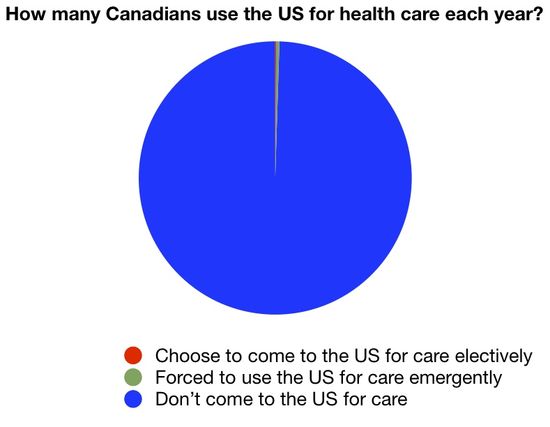
With more than a quarter of the vote, Aaron Carroll's chart showing just how few Canadians use the US health care system exploded a talking point and took the prize. His original comment on the winning pie chart:
I’m not denying that some people with means might come to the United States for care. If I needed a heart/lung transplant, there’s no place I’d rather be. But for the vast, vast majority of people, that’s not happening. You shouldn’t use the anecdote to describe things at a population level. This study showed you three different methodologies, all with solid rationales behind them, all showing that this meme is mostly apocryphal.
Hewitt Award: Dinesh D'Souza won handedly – earning almost half the vote for his nutty Forbes article on Obama. The quote we selected:
"Obama supports the Ground Zero mosque because to him 9/11 is the event that unleashed the American bogey and pushed us into Iraq and Afghanistan. He views some of the Muslims who are fighting against America abroad as resisters of U.S. imperialism. Certainly that is the way the Lockerbie bomber Abdel Baset al-Megrahi portrayed himself at his trial. Obama's perception of him as an anticolonial resister would explain why he gave tacit approval for this murderer of hundreds of Americans to be released from captivity.
… Incredibly, the U.S. is being ruled according to the dreams of a Luo tribesman of the 1950s. This philandering, inebriated African socialist, who raged against the world for denying him the realization of his anticolonial ambitions, is now setting the nation's agenda through the reincarnation of his dreams in his son."
Shut Up And Sing: Paul McCartney and Stevie Wonder share the award for the "the smuggest, most pretentious pop song in history":
Von Hoffmann Award: With nearly 40 percent of the vote, Clifford Stoll won easily. He was nominated for this very, very wrong prediction from 1995:
"Visionaries see a future of telecommuting workers, interactive libraries and multimedia classrooms. They speak of electronic town meetings and virtual communities. Commerce and business will shift from offices and malls to networks and modems. And the freedom of digital networks will make government more democratic. Baloney. Do our computer pundits lack all common sense? The truth in no online database will replace your daily newspaper, no CD-ROM can take the place of a competent teacher and no computer network will change the way government works."
Hathos Alert: And last, and perhaps least, it should come as no surprise that Bristol Palin and The Situation's teen sex discussion was voted the Hathos Alert of the year:
So many cultural artifacts have had an influence on my over the years, though if I had to pick the one that ties everything together and sums me up rather nicely it would have to be Big Black’s "Songs About Fucking".
The CD came out in when I was three, but I bought it when I was 15 and it’s been with me ever since. It started out as a band I came upon trying to navigate my way through a punk clique that thought me too weird to tolerate (Asperger Syndrome was a new thing then and I went undiagnosed for ten more years), leaving me to develop my tastes on my own. Big Black didn’t sound like anything the people I wanted to fit in with were listening to. Punk to suburban kids was and is about three things: drinking, women and a nostalgia for drinking and women that borders on the conservative. Big Black was not conservative by any means, nor were they communal; they were about violence and aggression—and lots of noise. More importantly they were about individual expression and against institutions (in their case major labels).
In addition to being an awesome band with some of the best guitar sounds ever conceived, Big Black influenced how I would make the best of my idiosyncrasies and the temperament they produced. It’s a temperament of hatred, braininess and plain bad manners, particularly when directed at what is generally considered the “status quo,” though I do this through writing rather than music. The band challenged me psychologically and creatively, influencing me to put my skills to good use and to seek out new ways of expressing my displeasure of things that don’t include punching people and burning down churches.
The influence that Big Black had on me can be connected to the influence that the writing of Jonathan Swift, Ambrose Bierce, HL Mencken, Auberon Waugh, Arthur Schopenhauer, Gore Vidal and even Willmoore Kendall have had on me. From them I can somehow make sense of and express with some coherence my hatred of institutions (political, cultural and educational) and their irredeemable influence on intellect and expression, as well as my overall hatred of the American status quo of optimism, ignorance, nostalgia and material obsession; though more importantly they allowed me to appreciate both individual expression and populism, and freedom in general, and to make some modest attempts to better accentuate it for the ever changing nation. Whether I can exert a similar influence on some other random loser is out of my hands, but at least I can say that I didn’t end up entirely wasting my skills on service journalism (although I kind of did for a little bit). In short, Big Black has helped me rage super-hard while keeping it interesting, if only for myself.
Go buy a box of Franzia Cabernet (not the Merlot or Chianti), which I consider a decent yardstick of value in a good cheap blend. The box costs $15 for five liters. A standard wine bottle has 750 ml, so the Franzia works out to about $2.25 a bottle—about what they pay in Europe for a bottle of good, cheap wine, usually blended. Do a taste test comparing that Franzia to any $15 bottle on the shelf. Unless you choose well or get lucky, the Franzia easily wins at least half the time. And even when it loses, ask yourself: Was the bottle seven times better than the box?
Kimberly Kaye swallows the year-end Broadway showbituaries with a grain of salt, and calls for more off-Broadway support:
[T]he record number of closings on Broadway should not be seen as proof that the theatre scene at large is terminally ill, but as evidence that Broadway is not the only patient. In order for commercial theatre in the city to get a healthy glow back in its cheeks, the industry must be treated in its entirety. New York needs more small commercial theatres so shows like "Bloody Bloody Andrew Jackson" can reach new audiences without sustaining the back-breaking overhead of a Broadway stage.
You live your life in Spanish and you've suffered and enjoyed and had pleasures and pains in Spanish. Words have an emotional resonance in you, huge emotional echoes, when you're speaking in your own language. … When you're speaking in a foreign language, there's like an office in your brain, where people are throwing the words at you. "Give me that word — I need a verb! I need an adjective!" There's a lot of people working in there, and you have to live with that.
Baron points out that just about every other new writing instrument has also been seen as a threat to literacy and a corrupter of youth. The eraser had a particularly bad reputation, under the thesis that “if the technology makes error correction easy, students will make more errors.” I have to add that my own view of the computer as a writing instrument has always been that it’s not so much a better pencil as a better eraser, allowing me to fix my mistakes and change my mind incessantly, without ever rubbing a hole in the page. The first time I held down the delete key on an early IBM PC and watched whole sentences and paragraphs disappear, one character at a time, as if sucked through a straw—that was a vision of a better future for writers.



 The Dish