“Utter Chaos”

by Patrick Appel

Scott Lucas at EA is live-blogging again:

As the night drags on and the military keeps telling people to go home – and in one case to defend their own property -, the mood in Cairo seems to be one of defiance. Nobody seems to want to leave the city center and give Mubarak and his government the chance to come to grips with situation.  

The immediate task of the government isn't forming a new government – it's getting thousands of people who've practically halted the state's day-to-day functioning impossible [sic].  Right now, it matters little who's in-charge because Egypt is in utter chaos. With ElBaradei free, the police scattered, the military unresponsive and the thugs unleashed, communication systems disrupted and the world watching, the government is more vulnerable than President Obama and the West think he is. 

What will Mubarak do? But more importantly, what will he be urged to do by world leaders if the situation remains the same?


Who’s Looting, And Why?

LootedMcDonalds
by Patrick Appel

Al-Jazerra reports:

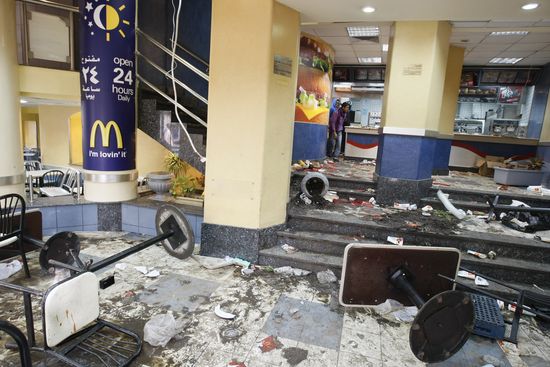
Ayman Mohyeldin reports that eyewitnesses have said "party thugs" associated with the Egyptian regime's Central Security Services – in plainclothes but bearing government-issued weapons – have been looting in Cairo. Ayman says the reports started off as isolated accounts but are now growing in number. 

The Lede:

CNN's Cairo correspondent, Ben Wedeman, reports that some Egyptians have suggested President Hosni Mubarak's regime has withdrawn the police from the streets and ordered the military not to enforce law and order as an intentional ploy to sow chaos and create a situation in which the people will turn to the strongman to restore security.

(Photo: A picture shows a McDonalds store looted and damaged in central Cairo on January 29, 2011 By Mohammed Abed/AFP/Getty Images)

A Sunni Domino? Ctd

by Patrick Appel

Haroon Moghul gives  four reasons why Egypt, should Mubarak fall, wouldn't follow in Iran's footsteps. The most important is that, unlike Iran's Shah, Mubarak didn't attack Islam. Moghul writes that  "Egypt’s revolution doesn’t have to be Islamic because Islam isn’t at the heart of the problem on the ground":

 Muslim societies often have flourishing religious institutions and practices, organic and varied. But in the case of Iran, the regime paradoxically undermined that popular and organic religiosity when they sought to enforce faith through the state. This is an argument for keeping religion and politics separate in the Muslim world: in the interest of defending both from the negative effects of the other. Egypt’s “secular” dictator, who didn’t meddle too far into his people’s religious life—he was no Shah, and no Ben Ali—hasn’t created a sharp cultural divide in his country (the economic one is something else altogether). So why would Egyptians need, want, or stress, an Islamic Revolution?

Fighting For Food Trucks

by Conor Friedersdorf

One of my favorite places to get a cocktail in LA is The Tasting Kitchen, where the whole bartending staff – and especially Justin – manage to make drink mixing into high art. Before ordering, there's a conversation about what exactly I tend to like, my mood that evening, and the homemade syrups and falernums they've recently concoted. Then they surprise me with some twist I've never had before. And so long as things aren't exceptionally busy, they're happy to explain the ingredients, how the drink is prepared, and why it tastes the way it does. If you're fascinated by the renaissance of the American cocktail, as I am, it's worth the premium you pay for a drink. And often you only need one.

The only downside to The Tasting Kitchen is its popularity. Its gotten a lot of attention lately in the national press, hence recent increases in price – it's the sort of place where I can afford to eat dinner once in a great while on a special occasion, but that isn't a viable food option if I just want a drink on a Thursday night. Of course, when you've finished your workday, ordered a cocktail, and chatted for an hour with your girlfriend and your favorite bartender, hunger happens. And lucky for me, the place is located on Abbot Kinney, which has recently become food truck central. Instead of paying $12 for some admittedly delicious wings, I can walk outside, survey the evening's offerings from three or four food trucks, and get twice as much food for $6 from an aspiring restranteur. And the fare is impressive: even Jonathan Gold, LA's answer to Frank Bruni, is on board.

So everybody wins.

Except maybe The Tasting Kitchen, which misses out on an occasional appetizer order. Or maybe not. Maybe I'd go there less if there wasn't a nearby option for cheap, delicious food. I've told this anecdote partly to show that food trucks and brick and mortar establishments sometimes complement one another. In any case, it's a clear win for the consumer, for a lot of aspiring entrepreneurs, and for the cultural landscape of Los Angeles. So one of my pet causes is keeping the anti-food truck lobby from regulating them out of business.

Today I found out that the Institute For Justice, one of the advocacy non-profits whose work I most respect, intends to support food truck culture in a serious way, not especially in Los Angeles, but nationwide. They're starting in the Lone Star State:

El Paso, Texas, has recently made it illegal for mobile food vendors to operate within 1,000-feet of any restaurant, convenience store, or grocer.  The city even prohibits vendors from parking to await customers, which forces vendors to constantly drive around town until a customer successfully flags them down–and then be on the move again as soon as the customer walks away.

Thus, while people across the country embrace mobile vendors for the vitality and creativity they bring to a local restaurant scene, El Paso has decided to threaten vendors with thousands of dollars in fines and effectively run them out of town.  El Paso’s No-Vending Zone scheme is in place for one reason:  to protect brick-and-mortar restaurants from honest competition.  But economic protectionism is not a valid use of government power.

This issue strikes me as a promising one for a left-right alliance. You've got small entrepreneurs yearning to serve multicultural tacos and hot dogs with fancy mustard, avocado slices and arugula on them. And people like this to serve as the movement's face. Especially at a time when American jobs are less secure and permanent than ever, it seems to me that we need to let every aspiring entrepreneur thrive as best we can. And as I tried to explain in City Journal's last issue, that means ensuring our municipal laws fit the times.

The indispensable Ed Glaeser has more.
The View From Your Window Contest

Vfyw-contest-1-29

You have until noon on Tuesday to guess it. City and/or state first, then country. Please put the location in the subject heading, along with any description within the email. If no one guesses the exact location, proximity counts.  Be sure to email entries to VFYWcontest@theatlantic.com. Winner gets a free The View From Your Window book. Have at it.

The New PM

by Patrick Appel

Stratfor's analysis focuses on Ahmed Shafiq, who Mubarak just named as Prime Minister:

Mubarak is essentially accelerating a succession plan that has been in the works for some time. STRATFOR noted in December 2010 that a conflict was building between the president on one side and the old guard in the army and the ruling party on the other over Mubarak’s attempt to create a path for his son Gamal to eventually succeed him. The interim plan Mubarak had proposed was for Suleiman to become vice president, succeed Mubarak and then pass the reins to Gamal after some time. The stalwart members of the old guard, however, refused this plan. Though they approved of Suleiman, they knew his tenure would be short-lived given his advanced age. Instead, they demanded that Shafiq, who comes from the air force — the most privileged branch of the military from which Mubarak himself also came — be designated the successor. Shafiq is close to Mubarak and worked under his command in the air force. Shafiq also has the benefit of having held a civilian role as minister of civil aviation since 2002, making him more palatable to the public.

Base And Gown

by Conor Friedersdorf

Cheryl Miller has been arguing that "the repeal of Don’t Ask, Don’t Tell represents an enormous opportunity to repair the breach between the university and the military." I think she's right, and that if possible Ivy League campuses without ROTC programs should re-institute them, as she's been arguing.

Andrew Exum wonders if it is possible:

It's easy to demonize the "elite" universities for not having more ROTC programs, but the reality is that the U.S. military has been the one most responsible for divesting from ROTC programs in the northeastern United States. It's hardly the fault of Columbia University that the U.S. Army has only two ROTC programs to serve the eight million residents and 605,000 university students of New York City. And it's not the University of Chicago's fault that the entire city of Chicago has one ROTC program while the state of Alabama has ten. The U.S. military made a conscious decision to cut costs by recruiting and training officers where people were more likely to volunteer. 

Miller basically concurs, and sums up as follows:

The military will have to be ready to make a number of cultural adjustments… Within its ranks, there are some who feel considerable bitterness (some of it justifiedsome not) toward elite schools and the largely "blue" enclaves in which they are situated; others whose otherwise healthy anti-elitism has caused them to discount the benefits of expanding ROTC's reach, and finally, those who are ambivalent about the value of a liberal arts education to the officer corps. The resulting policy has been to limit ROTC scholarships for students at elite schools, conserving costs but also ensuring limited interest among a student group military leadership considers "short-timers" and whose strengths ("sensitivity, abundant intelligence, and creativity") have been seen as inimical or irrelevant to junior officer development. (All this is recounted in depressing detail in the Army Cadet Command history.


Breaking: The New Government, Ctd

by Patrick Appel

From Max Fisher's live-blog:

Who is Lieutenant General Omar Suleiman, whom Mubarak just appointed as the first Egyptian vice president since 1981? Suleiman's appointment makes him the likely successor to Mubarak, ruling out long-presumed Gamal Mubarak, the president's son. Issandr Amrani profiled Suleiman in 2009 for Foreign Policy, concluding, "neither Gamal Mubarak nor Omar Suleiman presents a clear departure from the present state of affairs." Foreign Policy's Blake Hounshell pulled out this excerpt from a 2007 U.S. State Department cable, released by WikiLeaks, offering one diplomat's opinion on Suleiman.

HIS LOYALTY TO MUBARAK SEEMS ROCK-SOLID. AT AGE 71, HE COULD BE ATTRACTIVE TO THE RULING APPARATUS AND THE PUBLIC AT LARGE AS A RELIABLE FIGURE UNLIKELY TO HARBOR AMBITIONS FOR ANOTHER MULTI-DECADE PRESIDENCY. A KEY UNANSWERED QUESTION IS HOW HE WOULD RESPOND TO A GAMAL PRESIDENCY ONCE MUBARAK IS DEAD. AN ALLEGED PERSONAL FRIEND OF SOLIMAN TELLS US THAT SOLIMAN "DETESTS" THE IDEA OF GAMAL AS PRESIDENT, AND THAT HE ALSO WAS "DEEPLY PERSONALLY HURT" BY MUBARAK, WHO PROMISED TO NAME HIM VICE-PRESIDENT SEVERAL YEARS AGO, BUT THEN RENEGED.      

The Dead And Wounded

by Patrick Appel

Mackey flagsdispatch by Peter Bouckaert, the emergencies director for Human Rights Watch:

I went to the morgue at the Alexandria General Hospital, where I saw 13 bodies of dead people – all men, young and old, but mostly young. Also visited the hospital's emergency room and saw many people who had been shot and were still waiting to get treatment. Live bullets seem to have been used by police yesterday evening when protesters went to attach police stations, but also by security services against people even in their homes. One man who told me that thugs (whom he referred to as "mukhabarat," the Egyptian security services) showed up at his apartment, accused him of throwing things on police from his windows, and shot him.


Breaking: The New Government

LebanonEgyptGetty
by Patrick Appel

From al-Jazeera's live-blog

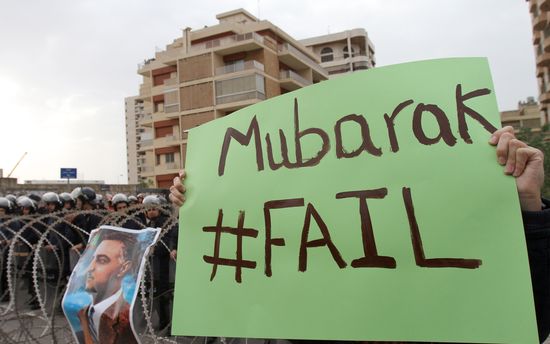
Former aviation minister Ahmad Shafiq is appointed the new prime minister of Egypt and will be responsible for forming new government. 

And:

Head of Egyptian intelligence, Omar Suleiman, is sworn in as vice president. With his military credentials, the powerbroker is known to have significant connections and credibility inside and outside the country.

Ross Chainey asks

Is the appointment of Omar Suleiman designed to ease a handing over of power? This is a popular theory on Twitter, anyway.

Mackey provides important context:
The country has not had a vice president since Hosni Mubarak was elevated to the presidency from that position following the assassination of Anwar Sadat on Oct. 6 1981.

(Photo: Lebanese demonstrators hold up signs near a portrait of former Egyptian president Gamal Abdel Nasser (L) during a protest in Beirut supporting the ouster of Egyptian President Hosni Mubarak, on January 29, 2011 as thousands of anti-regime demonstrators continue to pour onto Cairo's streets, demanding President Hosni Mubarak stand down. By Anwar Amro/AFP/Getty Images)