by Conor Friedersdorf:
Stanley Kurtz:
Ever since 9/11, I’ve been skeptical of plans for what I consider to be overly rapid and naively optimistic American plans to democratize the Middle East. It’s not that I’m against democracy, or even against policies designed to encourage it over the long term. The problem is that what Americans actually mean by democracy is not just elections, but liberal democracy, the broader cultural attitude toward individual liberty that’s necessary to make elections work. Bring elections prematurely to a country with a deeply illiberal culture, and you are asking for trouble. We Americans tend to take our liberal democratic values for granted, and so we’re often slow to recognize that merely giving Middle Easterners the ballot isn’t enough to turn them into liberal democrats.
That’s why the chaos in Egypt concerns me. Broadly speaking, I agree with National Reviews editors. They do a good job of treading the same fine line as President Obama and our other policy-makers. If anything, however, I would stress the danger of a post-Mubarak Egypt even more. There may well be a genuinely democratic opposition in the streets of Egypt right now. Yet broadly speaking, Egypt is bereft of the culture of liberal democracy, and that spells trouble.
Jay Nordlinger:
It seems that a democratic revolution is sweeping the Middle East — spurred, I am sure, by American and allied actions in Iraq. (Our chattering classes will never admit this.)
Victor Davis Hanson:
…while Islamists may eventually hijack the popular outrage against authoritarianism, both secular and Islamic, for now one thing is at least clear. There will probably be no such popular violent unrest in Iraq where an elected and popular government is legitimate and where violence comes from small numbers of anti-democratic forces seeking to impose an intolerant dictatorship of some sort.
Michael Rubin:
George W. Bush was wise to try to cultivate the liberal middle. Alas, after 2005, Secretary of State Condoleezza Rice coordinated a reversal of policy. It was an incredibly short-sighted move. Had we continued to cultivate the liberals, we would have a great deal more leverage than we have now. Obsequiousness to dictators might seem a good short-term strategy, but in the long-term, it undercuts our interests and our moral authority tremendously. That said, Bush should not be credited for much since he did not have the strength of leadership to pursue a policy consistent with his lofty rhetoric.
Leon Hadar:
Last time we’ve tried doing that was in Iran in 1979 with the Shah – Jimmy Carter pressing the Iranian military to desert the Pahlavis. And later on we actually tried to do “regime change” in the region, and ended up helping wacky pro-Iran Shiite groups win elections in Iraq and Lebanon (and then have the Hamas getting elected in Palestine). In all these cases we became responsible — in practical and moral terms — for the election of characters that are not members of our fan club (which is understandable) — but who also hate women, Christians, Jews, gays, etc. and who are as ruthless and corrupt as their predecessors (surprise!). All things considered, if you were member of any of the above groups and others, you would probably rather be in the Shah’s Iran and in Saddam’s Iraq.
But, hey, our Democracy Promoters are so, so certain that the “good guys” will eventually win in Tunisia or Egypt (if they’re so smart, why can’t they tell us who is going win the next presidential election here). And when a Muslim Middle Eastern country does have a free and open election (Turkey), they don’t seem to like the guys who win.
Jim Bovard:
It is great to see so many people with the courage to risk all defying a corrupt, oppressive government. It is great to see the party headquarters of a corrupt regime going up in flames. And it is great to see American politicians squirming as the authoritarian tool they have bankrolled for 30 years totters and looks heading for a fall.
This is one of Al Jazeera’s finest hours. Their English-language coverage is superb (hat tip to Dennis Dale). While much of the American government has derided Al Jazeera for years, that network has actually been more forthright against oppression than has the U.S. government.
Michael Brendan Dougherty:
Four years ago, during some of the headiest days of Bush’s “democracy agenda”, our own State Department officials in Cairo told me that truly liberal parties in Egypt were “interesting to talk to but totally insignificant.” The idea that there is some huge reserve of middle class support for liberal democracy is an untested fantasy.
…The fact, rarely mentioned this past week, is that the United States sends over $800 million in direct economic aid to Egypt along with $1.3 billion a year in military aid. The guns being used to beat protestors this week were bought with American tax dollars. Foreign aid to poor countries like Egypt creates both the impression and the reality that the government is more solicitous of its Ameircan sponsor than of its own people. Foreign aid also makes governments less anxious for domestic prosperity, and Egypt’s chronically high unemployment is a sure sign of that. We send this aid to ensure a stable non-Muslim Brotherhood controlled Egypt that is friendly to the United States and Israel. If the riots and protests lead to the fall of Mubarak’s government, we’ll have neither. Egypt is more likely to turn into a base of operations for Al-Queda than it is a liberal democracy. We’ve been making payments on such a disaster since 1975.
John Hinderaker:
The truth is that what is now happening in the Arab world is not about us. We are spectators. Just as the administration's claim to have been on the case for a long time is bogus, so, in my view, are criticisms of Obama's performance to date. To be fair, we don't know what role the administration has played behind the scenes–if any. If it has in fact supported Mubarak and helped to convince the Egyptian Army to stick with Mubarak but transition to a more open government, that's a good thing.
Peter Wehner:
The core argument Bush made, which is that America must stand firm for the non-negotiable demands of human dignity — the rule of law, limits on the power of the state, respect for women, private property, free speech, equal justice, and religious tolerance — was right. No people on earth long to live in oppression and servitude, as slaves instead of free people, to be kept in chains or experience the lash of the whip.
How this conviction should play itself out in the real world is not self-evident; the success of such a policy depends on the wisdom and prudence of statesmen. Implementing a policy is a good deal harder than proclaiming one. Still, it seems to be that events are vindicating the freedom agenda as a strategy and a moral insight, as even the Obama administration is coming to learn.
Michael Moynihan:
Dictators can flip a switch and shut off the Internet. Dictators control television news, indulging the temptation to ignore stories that cast them in a bad light. But Egypt, entering its 30th year of iron-fisted rule by the toad-like dictator Hosni Mubarak, isn’t a dictatorship, according to Vice President Joe Biden. White House press secretaries don’t need a weatherman to know which way the wind blows, so Robert Gibbs, watching the situation in Cairo unravel, is hedging.
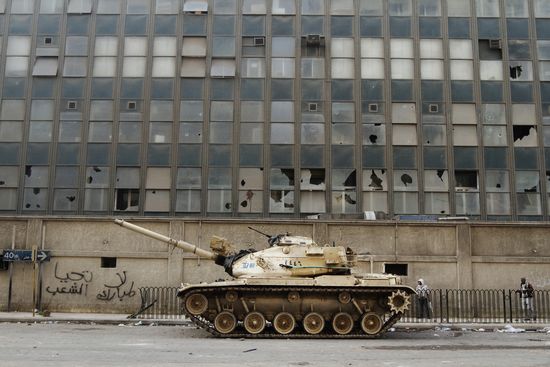
With tanks on the streets, curfew invoked (and roundly ignored, as an Al Jazeera live shot demonstrates; with the conscript army shaking hands, as the careerists in the police force crack heads), planes ferrying various regime stooges and, rumor has it, Mubarak family members out of the country, and ruling party headquarters engulfed in flames, it looks as if this revolution will be more 1989 than 1956 or 1968. And like 1989, there have been sporadic spasms of violence in Suez, Alexandria, and Cairo, though the repressive and widely hated police dare not go full Tiananmen.
Andrew Klavan:
In my frequently hopeful moments, I've often wondered if the rise of Islamic extremism was a literally reactionary movement–the last horrific flame-out of an attempt to stop the reformation we all keep praying for in the in Muslim world. (I keep reminding people that the horrors of the Inquisition and the 30 Years' War were of a piece with Christianity's ultimate reformation.) Is this just my naturally sunshiny disposition talking, or is there any chance that what we're seeing now is the very reformist wave the terrorists feared?


 The Dish