A Sunni Domino?

by Conor Friedersdorf

Fascinating to read this 1999 interview with an Egypt expert today:

What would happen in Egypt — and in the Middle East generally — if Egypt were to, as you say in the book, "go Islamic"? How would such a revolution compare with the Iranian revolution of 1979?

Egypt's "going Islamic" would have far more profound and far-reaching consequences — in the Arab Middle East, of course, but also in the larger Islamist world — because the Iranian revolution was a Shi'ite revolution. The Shi'ites are a minority sect of Islam — most Muslims are Sunnis, and Egypt is very representative of Sunni Islam. It is not only representative; it is the fountainhead of Sunni Islamic thought.

Thus, even among scholars who normally shun domino theories of history, there is a growing concern that if Egypt "goes Islamic," so could much of the Arab world. Egypt is the most populous and the most influential Arab state, and since the 1970s the Islamists there — with growing vigor, in growing numbers, with growing support — have infiltrated the courts, the universities, the schools, the arts. A number of preeminent Egyptian thinkers and ideologues are quite convinced that an Islamic victory in Egypt is inevitable.

If, for example, Hosni Mubarak — who has named no successor — were to die tomorrow, there's no logical person to assume the helm of the Egyptian state. And whoever succeeds Mubarak will have to have the active support of not only the army but also the growing number of Egyptians who have embraced the Islamists' call for the implementation of Islamic law, or Shariah.
A Word Of Caution

by Conor Friedersdorf

As I sit watching CNN coverage from Egypt, I can't help but reflect on the Persian Gulf War, the first conflict that unfolded on cable news. It is worth remembering that the images we saw back then didn't afford an entirely accurate picture of events on the ground.

What follows are quotes from an old MIT symposium [PDF] that examined television coverage of that conflict:

As part of the attempt to “kick” the Vietnam Syndrome during the first Gulf War, the media were denied access to the battlefield, and the public was largely presented U.S. military videos of “smart” weapons hitting their targets… Military tactics such as attaching plows to tanks in order to bury Iraqi soldiers alive in their trenches in the first days of the ground war were not revealed until months afterward… As reported by Seymour Hersh in 2000, on March 2, 1991, two days after President Bush had declared a cease-fire, General Barry McCaffrey’s 24th Division destroyed a retreating tank division, killing soldiers, civilians, and children… few scenes of what happened on the ground were shown in the United States during or immediately after the war. 

Here's another passage:

Given the censorship during the first Gulf War, little media coverage was dedicated to civilian casualties. However, the medical and public health literature has reported a tremendous burden of suffering that occurred during and after the first Gulf War. A U.N. report estimated 5,000 to 15,000 civilian deaths during the first Gulf War, but these estimates represent only a small proportion of the civilian deaths that occurred. An estimated 20,000 died in the civil war that followed, and an additional 15,000 to 30,000 Kurds and other refugees died while fleeing for their safety.

What we're witnessing is different in all sorts of ways from the Gulf War. And there are significant differences between cable news of the early 1990s and what we watch today. I intend no direct analogies or moral judgments about the Gulf War or the current uprising. My only point is that what we see on cable television is but a slice of reality as experienced on the ground. Look back at any breaking news long after the fact and you'll be struck by the significance of factors little or nothing was known about at the time. In Egypt especially, there is no reliable method we have for ascertaining how much we don't know. As a consequence, it is prudent that we remain cautious and modest in our assessments, whatever they may be.

Learning The Basics

by Conor Friedersdorf

In 2007, Ken Silverstein filed this Harper's piece, which is opinionated but useful background if you're reading up on Egypt. Speaking of background, this passage from the Web page at Foggy Bottom is also useful – the first paragraph for it's info (I'll admit I didn't know all that!) and the second paragraph to get a sense for how the US goverment positioned itself:

Egypt is the most populous country in the Arab world and the second-most populous on the African continent. Nearly all of the country's 80 million people live in Cairo and Alexandria; elsewhere on the banks of the Nile; in the Nile delta, which fans out north of Cairo; and along the Suez Canal. These regions are among the world's most densely populated, containing an average of over 3,820 persons per square mile (1,540 per sq. km.), as compared to about 200 persons per sq. mi. for the country as a whole… The literacy rate is about 58% of the adult population. Education is free through university and compulsory from ages six through 15…

On October 6, 1981, Islamic extremists assassinated President Sadat. Hosni Mubarak, Vice President since 1975 and air force commander during the October 1973 war, was elected President later that month. He was subsequently confirmed by popular referendum for four more 6-year terms, most recently in September 2005. Mubarak has maintained Egypt's commitment to the Camp David peace process, while at the same time re-establishing Egypt's position as an Arab leader. Egypt was readmitted to the Arab League in 1989. Egypt also has played a moderating role in such international fora as the UN and the Non-Aligned Movement.

A Momentary Lull

by Chris Bodenner

The first footage of Saturday surfaces on YouTube. A programming note from EA's Scott Lucas indicates that things are relatively calm at the moment:

1245 GMT: We are handing over to live footage from Al Jazeera for the next few hours. We will return about 1615 GMT with a summary of developments.

Al Jazeera is also live-blogging. On that note, the Dish will switch over to weekend content and monitor developments in Egypt as they unfold.

Did The US Help An Egyptian Opposition Figure?

by Conor Friedersdorf

The Telegraph reports:

…leaked documents show the extent to which America was offering support to pro-democracy activists in Egypt while publicly praising Mr Mubarak as an important ally in the Middle East. In a secret diplomatic dispatch, sent on December 30 2008, Margaret Scobey, the US Ambassador to Cairo, recorded that opposition groups had allegedly drawn up secret plans for “regime change” to take place before elections, scheduled for September this year. The memo, which Ambassador Scobey sent to the US Secretary of State in Washington DC, was marked “confidential” and headed: “April 6 activist on his US visit and regime change in Egypt.”

It said the activist claimed “several opposition forces” had “agreed to support an unwritten plan for a transition to a parliamentary democracy, involving a weakened presidency and an empowered prime minister and parliament, before the scheduled 2011 presidential elections”. The embassy’s source said the plan was “so sensitive it cannot be written down”.

Ambassador Scobey questioned whether such an “unrealistic” plot could work, or ever even existed. However, the documents showed that the activist had been approached by US diplomats and received extensive support for his pro-democracy campaign from officials in Washington. The embassy helped the campaigner attend a “summit” for youth activists in New York, which was organised by the US State Department.Cairo embassy officials warned Washington that the activist’s identity must be kept secret because he could face “retribution” when he returned to Egypt.

Interesting, though my gut, looking at the Telegraph's headline, is that they're blowing the story out of proportion. But I could be wrong! Stay tuned.

Tense In Tahrir Square

108511747

by Chris Bodenner

Enduring America notes the latest developments at 1135 GMT:

Reports of growing demonstration in Tahrir Square in Cairo. One observer comments, "The sound of the chanting is deafening. The pictures are amazing." There are reports that protesters and some army officers are holding aloft the Egyptian flag. A participant in Cairo says he has been "joined by thousands in Mohandesin and headed to Dokki trying 2 reach Tahrir".

Meanwhile, Saudi King Abdullah has issued a statement in support of President Mubarak, condemning efforts to "destabilise" Egypt.

1100 GMT: The BBC is reporting an explosion in a state security building in Rafah with a number of casualties.

1040 GMT: The Egyptian Government has officially resigned.

1035 GMT: Hospital sources say 30 bodies were taken to El Damardash hospital in central Cairo overnight, including two children. Suez steel workers are going on strike until President Mubarak resigns.

Elsewhere in Egypt:

1:58pm [local time] A group of Bedouin has attacked state security headquarters in the town of Rafah near Egypt's border with Israel, killing three policemen, witnesses and a security source said.

1:55pm The headquarters of the ruling party in Luxor, Upper Egypt, have been torched. Military tanks are entering the city. …

12:50pm Police in Alexandria are clashing with protesters, using live ammunition to control crowds, witnesses tell Reuters news agency.

And at the flashpoint of Thursday's protests:

In Suez, Al Jazeera's Jamal ElShayyal reported that 1,000-2,000 protesters had gathered, and that the military was not confronting them. ElShayyal quoted a military officer as saying that troops would "not fire a single bullet on Egyptians", regardless of where the orders to do so come from. The officer also said the only solution to the current unrest was "for Mubarak to leave".

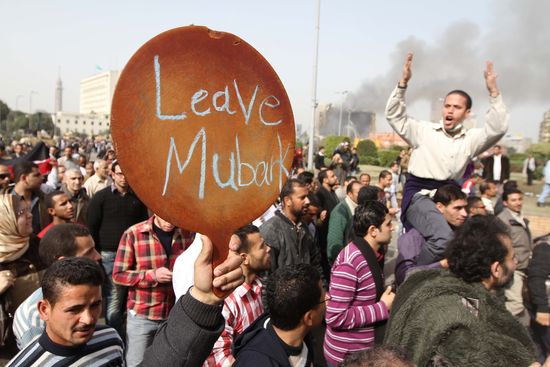
(Photo: Egyptians protest in Cairo's central al-Tahrir square on January 29, 2011 as thousands of anti-regime demonstrators continue to pour onto Cairo's streets, demanding President Hosni Mubarak stand down the day after the veteran leader ordered the army to tackle the deadly protests. By Khaled Desouki/AFP/Getty Images)

Al Jazeera Abetting Zionism!

by Chris Bodenner

At least according to this guy:

The Yemeni President, Ali Abullah Saleh, who is facing unprecedented and growing demonstrations calling for his resignation, has asked the Emir of Qatar to curb the broadcasts of Al Jazeera. Saleh said the channel's approach "serves the goals of Zionism, and terrorist groups from al Qaeda and the enemies of the Arab nation in general, and who have been trying to tear apart the nation and create fissures in its ranks to rob their resources and threaten the existence of future generations".

Someone's getting nervous.

As Dawn Breaks

108501741

by Chris Bodenner

Some early morning updates from Al Jazeera's live-blog:

6:38 am Internet and mobile phone networks are still down in Egypt.

6:30 am The headquarters of the ruling National Democratic Party in Cairo are still on fire.

6:04 am Al Jazeera's Jane Dutton, reporting from Cairo, says the National Museum in the capital has not been damaged by the fire that destroyed the neighboring office of the National Democratic Party last night.  

5:13 am The Egyptian army secured Cairo's famed antiquities museum early on Saturday, protecting thousands of priceless artifacts, including the gold mask of King Tutankhamun, from looters.

4:17am Al Jazeera's Amyman Mohyeldin says the streets of Cairo are "still abuzz" but peaceful. The curfew, which thousands have defied since it came into effect at 6pm yesterday, is in place until 7am.

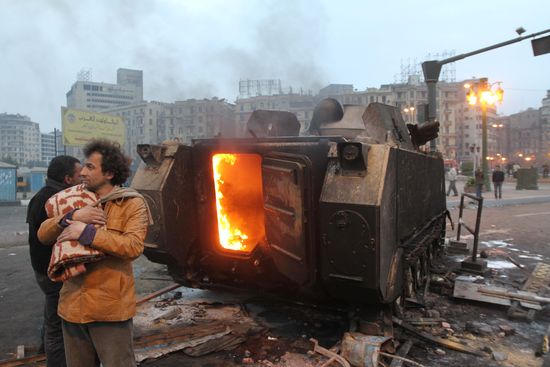
(Photo: An Egyptian man stands in front of a burning armored vehicle in central Cairo on January 29, 2011. Egypt's embattled President Hosni Mubarak addressed the nation for the first time since deadly protests erupted against his regime, vowing reform but showing no sign of relaxing his decades-old grip on power. By Khaled Desouki/AFP/Getty Images)

Al-Jazeera’s Revolution? Ctd

Egypt-al-jazeera

by Chris Bodenner

Robert F. Worth looks at how there is "little doubt" that the network "provided more exhaustive coverage than anyone else":

At one point, a correspondent warned that Egyptian security forces were poised to attack the building where the channel’s reporters were working. Anchors told viewers to switch to another satellite channel, and told them how to do it, in case its transmission was interrupted. …

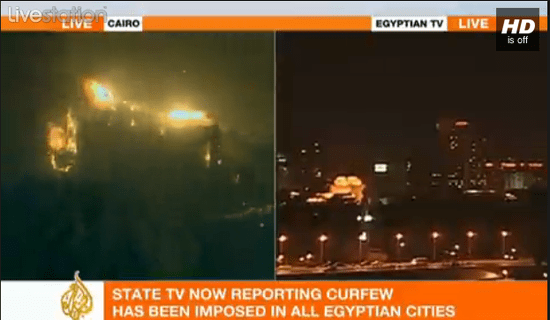
Both the Arabic and the English channel juxtaposed images in ways that undermined the government’s official messages. At one point, the screen was split. On one side was live video of a police van that had been set on fire by protesters defying a curfew, with the sounds of gunfire and explosions. On the other side was the scene being broadcast by state television: a quiet tableau of the night sky in downtown Cairo, with the message that a curfew had been imposed.

(Hat tip: Gregory White)