by Patrick Appel
A protester kisses a police officer.
by Patrick Appel
A protester kisses a police officer.
by Patrick Appel
Heather Hurlburt lists five things to understand about the Egyptian protests:
America can’t stop this revolt. Commentators across the political spectrum can’t seem to keep themselves from implying that Barack Obama and Hillary Clinton, by their choice of adjectives, can “save” President Mubarak. We must disabuse ourselves of the idea that we can determine how this turns out. As Michael Hanna has written on Democracy Arsenal, this is less about the state of our union than “the tattered state of their unions.” We can, however, exert some control over whether we are perceived by the citizenry in Egypt and elsewhere as part of the solution.
Our diplomats and spokespeople are now at pains to prove, in real time, that when we talk about stability, we mean it in a way that favors the governed, and not just the governors. As Shadi Hamid of the Brookings Institution told the Washington Post, our policy options are currently very limited: "The most the U.S. can do in the short run is reorient their rhetoric. … People want moral support; they want to hear words of encouragement. Right now, they don't have that. They feel the world doesn't care and the world is working against them." But, with talk of a negotiated departure for Mubarak shooting around Twitter, there may come a time when the United States has to become even more involved.
by Patrick Appel
EA reports:
The speech by President Hosni Mubarak moments ago has had no effect on the protests. Protesters remain in Cairo, Alexandria, Suez and other cities and still have not be dispersed. Many are continuing their anti-government chants and now directly asking Mubarak to step down.
The main opposition party, the Muslim Brotherhood just told Al Jazeera that Mubarak must step down and that it's time for the military to step in and remove him.
Stratfor's analysis:
The announcement was strategically made in the middle of the night in Egypt to give time for troops to take position.
The military’s interaction with the demonstrators will need to be watched closely. So far, the military has been able to move into the cities and has been welcomed by the protesters without employing the more heavy-handed tactics of the internal security forces. What order they imposed came not from violence but from the perception that they would enable the demonstrators to bring down Mubarak.
If the military is now physically backing the regime, confrontations between demonstrators (whose grievance is ultimately with Mubarak) and the military forces is likely to turn more violent in the hours ahead.
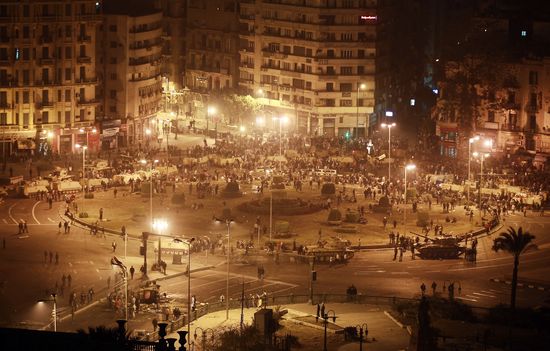
(Photo: Army tanks line up in Tahrir Square on January 29, 2011 in Cairo, Egypt.Thousands of police are on the streets of the capital. Hundreds of arrests have been made in an attempt to quell demonstrations. By Peter Macdiarmid/Getty Images)
by Patrick Appel
A section of the briefing Obama just delivered:
We have been closely monitoring the situation in Egypt. As the situation continues to unfold, our first concern is preventing injury and loss of life, so I call upon the Egyptian authorities to refrain from violence against the protesters. The US will stand up for human rights everywhere.
Those protesting in the streets have a resposibility to express themselves peacefully.
The US has a close partnership with Egypt. But we've also been clear that there must be reform – social, political and economic. In the absence of these [reforms], grievances have built up over time. I just spoke to President Mubarak, after his speech, and told him he has a responsilibilty to give meaning to his words.
Violence will not address the grievances of the Egyptian people.
What's needed is concrete steps that advance the rights of the people. Ultimately, the future of Egypt will be determined by its people, and we believe the people want the same things as we want. The Egyptian people want a future that befits the heirs to a great and ancient civiliaztions. The US is committed to working with the government and the people to achieve the goals.
When I was in Cairo, after I became president, I said that all governments must maintain power through consent, not coercion, and that is how they will achieve the future. The US will continue to stand up to the rights of the Egyptian people, and work with the government to ensure a future that is more hopeful.
by Patrick Appel
A reader asks:
Which would you prefer, assuming these are the choices – a "democratic" upheaval in which a well-organized Muslim Brotherhood emerges as the dominant force, or uneasy preservation of the status quo? I know you will try to duck the issue by saying you "reject" these choices, and that you're holding out for an Arab revolution that supports universal suffrage, gay rights and "pacific" Israel bashing, but that's nonsense.
Lynch speaks contemptuously of "American and Israeli interests." Well, whose interests does he advocate? I don't view the Muslim Brotherhood takeover of Egypt with equanimity, even if "that's what the people decide." How about you?
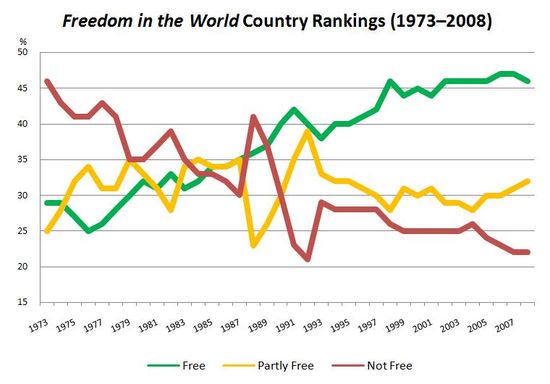
I'd support democracy for the reasons Massie outlines. But the truth is we don't get to pick. If you believe the weak version of the theory that the world is heading towards nearly universal democracy, in fits and starts, then then the autocratic status quo in the Arab world is fundamentally unstable over the long run.
(Chart from Freedom House)
by Zoe Pollock
Steve Coll looks at Egypt's army, and remembers what happened in Tiananmen Square:
The students and the urban workers who had persuaded themselves that they were near victory were also stunned by the Army’s indiscriminate, decisive violence. They seemed to expect until the last hours that the military would stand with them. We can hope, at least, for something better in Egypt during the days ahead. Its Army officers have lived in a much wider world than the P.L.A.’s commanders had known. Many of Egypt’s generals have probably learned by now to think for themselves. They may not be democrats, but they will not likely wish to act merely as bodyguards for a despot.
by Patrick Appel
A reader writes:
Remember that at this point in the Bush presidency, the administration was vilifying al-Jazeera at every opportunity, their reporters were sometimes excluded from American briefings, and the mutual antagonism was so great that some believed the administration had planned attacks against the channel. All while the adminstration pursued a policy intended to democratize the Arab lands.
For all the talk about hashtags and Facebook, al-Jazeera is the primary vector of this democratic infection. Most Tunisians first learned of the early protests in Sidi Bouzid from al-Jazeera. Egyptians watched the overthrow of Ben Ali on al-Jazeera. Al-Jazeera broadcast the Egyptian mass demonstrations to the Yemenis. Social media may be important pathways for secondary infection, but this is an al-Jazeera revolution.
by Chris Bodenner
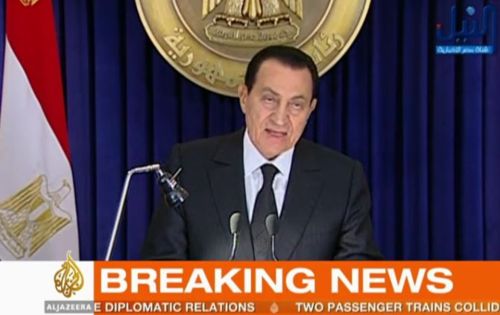
Mr. Mubarak finished his address by saying that he intends to ask the government to resign and will presumably appoint new ministers to run the country. He showed no sign of relenting or resigning himself.
Soon after Mr. Mubarak's address ended, CNN reported loud shouts of protesters on the streets outside their office who appeared to be heading in the direction of the information ministry.
Update: More of his speech from EA:
2226 GMT: Mubarak says incidents of last few days have left "majority" of Egyptians "fearful". He will "shoulder first responsibility" to protect security and will not "let fear grip" citizens and "halt our future".
2225 GMT: Mubarak appealing to his sacrifice in service of Egypt and its citizens. Then he returns to promises of steps to deal with unemployment and low income.
2224 GMT: Mubarak linking economic progress to order and calls on people to resist "plots" that lead to looting and violence.
2220 GMT: Mubarak says he realises "aspirations" of Egyptian people to fight unemployment, poverty, and corruption. He recognises their suffering, but progress cannot come through violence.
Update II:
2229 GMT: Al Jazeera's Ayman Mohyeldin says protesters outside his office in Cairo have resumed chanting, "Down, down, down with Mubarak".
Update III: The Lede:
A live feed of the scene on the street outside CNN's office in central Cairo shows protesters chanting slogans in defiance of the curfew. Frederik Pleitgen, a CNN correspondent in the Egyptian capital, reports that the police are nowhere to be seen and the Egyptian military is apparently not making any attempt to enforce the curfew, just protecting nearby government buildings, like the ministry of information, state television and the national museum.
Mr. Pleitgen also reports that the people on the streets include parents with their children and are not neatly fitting into the profile assigned to them by Mr. Mubarak, of violent thugs bent on destruction.
(Screenshot via soupsoup)
by Chris Bodenner
Jared Keller comments on a photo that's been bouncing around the Web this week:
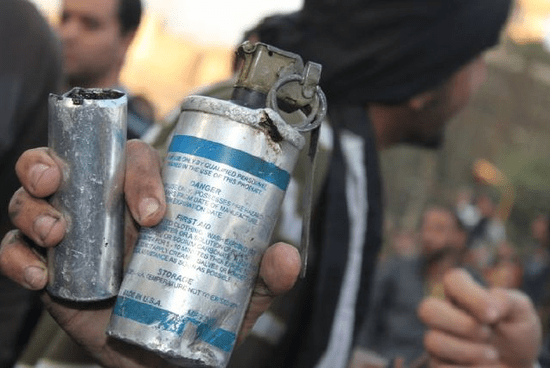
The Associated Press now reports that the Obama administration is “reviewing” its aid to Egypt. That military aid and its meaning in today’s protests are perhaps best summed up by the increasingly common photos of tear gas canisters, used by riot police, stamped with “MADE IN U.S.A.”
By the way, go here to track all the best Egypt content on Tumblr.
by Patrick Appel
"If you support the right of American Tea Partiers to gather together and protest their government, I don’t quite understand why you would deny the average Egyptian the same right. It’s not like angry Egyptians can write a letter to the editor or vote out their representatives to get better results. Even if the protesters are anti-Israeli, want a more Islamist government, and can repeat every bit of anti-American propaganda they’ve ever heard, who are we to say to them, 'You deserve no better than Mubarak'?"- Jim Geraghty, National Review.
 The Dish