Graffiti As Protest

Egypt-graff-05-MED

by Chris Bodenner

Danny Ramadan is in Cairo:

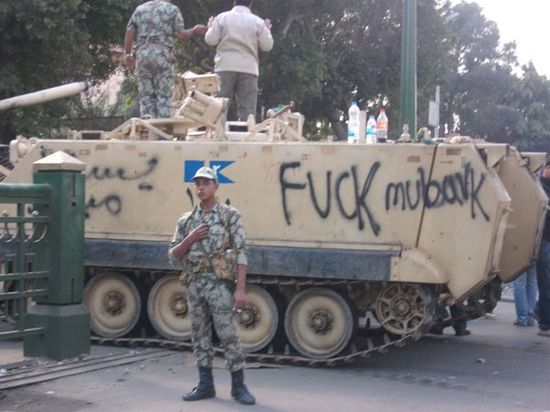
Egyptians might be some of the first graffiti artists in history with their famous hieroglyphics and carvings found everywhere on ancient Egyptian tombs, but this new wave of art is different. Graffiti in Cairo today is dominated by anti-Mubarak messages on city walls, military tanks, and smartly-written signs carried by frustrated people, and it is taking over the streets and being used to protest against the current government. …

The tanks of the military are being used as billboards for graffiti. The clean, yellowish vehicles are now spotted with slogans cursing the current president, asking him to leave the Egyptian people alone, or asking for the support of the army. The f-word was used prominently on one tank and followed by the name of Mubarak; the officers didn’t seem to mind. Everyday people have been standing next to the tanks, or even on the vehicles, and often posing for photos. Sometimes they even ask the officers to take photographs with them.
Vocal Tweets

by Chris Bodenner

Google's response to the new Internet blackout in Egypt:

Over the weekend we came up with the idea of a speak-to-tweet service—the ability for anyone to tweet using just a voice connection.

We worked with a small team of engineers from Twitter, Google and SayNow, a company we acquired last week, to make this idea a reality. It’s already live and anyone can tweet by simply leaving a voicemail on one of these international phone numbers (+16504194196 or +390662207294 or +97316199855) and the service will instantly tweet the message using the hashtag #egypt. No Internet connection is required. People can listen to the messages by dialing the same phone numbers or going to twitter.com/speak2tweet.

Total Internet Blackout

by Chris Bodenner

An ominous sign from the Mubarak regime:

12:15am Al Jazeera correspondents have been tweeting about the near-total media crackdown in Egypy:

"There is no internet in Egypt, none at all. Noor was last standing internet provider but it was shut down as well."

"Rumors of a coming mobile phone crackdown, which would make sense given tmrw is supposed to be a big march & police are back."

Scott Lucas claims:

With Noor's disconnection which follows the disconnection of all the other ISPs in the country, Egypt becomes the first country to be completely shut off from the rest the web by its regime in the history of internet.

Chart Of The Day, Ctd

BlumenthalEgypt

by Patrick Appel

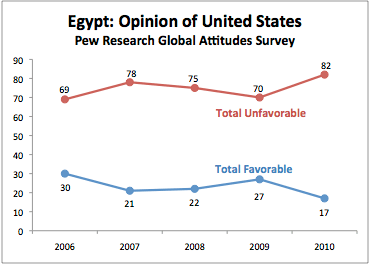
Blumenthal corrects Nate Silver, who wrote that "Egyptian popular opinion toward the United States has substantially improved over the course of the past 2 to 3 years":

Silver may have overlooked a footnote in the report he linked to explaining that the BBC sampled only urban areas of Egypt – specifically Alexandria, Cairo, Giza and Shoubra al-Khaima — that represent only 22 percent of the total national adult population.

More importantly, a more comprehensive survey of Egypt last year produced a very different result. The Global Attitudes Project conducted by the Pew Research Center conducts an annual, in-person survey that samples all but 2 percent of the population (it excluded smaller "Frontier governorates for security reasons"). That survey finds a very different pattern: The favorability rating of the United States among Egyptians has fallen sharply, from 30 percent in 2006 to 17 percent last last year. 

Will The Army Fire? Ctd

by Patrick Appel

Kristof is in Cairo. He reads the mood:

The people I talked to mostly insisted that the army would never open fire on civilians. I hope they're right. To me, the scene here is eerily like that of Tiananmen Square in the first week or so after martial law was declared on May 20, 1989, when soldiers and citizens cooperated closely. But then the Chinese government issued live ammunition and ordered troops to open fire, and on the night of June 3 to 4, they did – and the result was a massacre.

In the past, the army famously refused President Sadat’s order to crack down on bread riots, and maybe they won’t crack down this time.

But I’ve seen this kind of scenario unfolding before in Indonesia, South Korea, Mongolia, Thailand, Taiwan and China, and the truth is that sometimes troops open fire and sometimes they don’t. As far as I can see, Mubarak’s only chance to stay in power is a violent crackdown – otherwise, he has zero chance of remaining president. And he’s a stubborn old guy: he may well choose to crack heads; of course, whether the army would follow orders to do so is very uncertain. The army is one of the few highly regarded institutions in Egyptian society, and massacres would end that forever.

Talks Imminent?

Mubarak-Suleiman-and-Enan-007

by Chris Bodenner

EA:

2048 GMT: The Obama Administration has reportedly despatched Frank G. Wisner a former Ambassador to Egypt, to Cairo for talks with the regime.

2045 GMT: Vice President Omar Suleiman has said that President Hosni Mubarak entrusted him to begin talks with all political factions. Suleiman also said the government will announce several political reforms within days, with the priorities of fighting unemployment and abolishing corruption.

Richard Adams cautions:

Omar Suleiman's offer of dialogue with other political parties is being dismissed as window dressing …. The consensus seems to be that Suleiman's appearance was intended for US consumption.

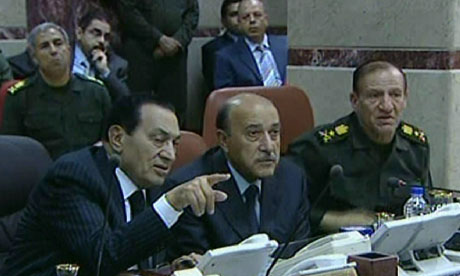
(Photo: From left, Hosni Mubarak, Omar Suleiman and Sami Enan at Egypt's military HQ in Cairo. AFP/Getty Images)

A Tunisian Tsunami? Ctd

by Zoe Pollock

Robert P. Baird looks into talks of an uprising in Uganda:

If the cases of Tunisia and Egypt prove any general rule, it may be that the U.S. is no longer interested or able to protect its autocratic client states at any cost. The Ugandans I’ve spoken to have confessed themselves more resigned than angry at the thought of Museveni’s inevitable reelection, and the prospect of a country-wide popular uprising seems, for the moment, very unlikely. But as Steve Randy Waldman wrote on Twitter yesterday, “Egypt is eroding the inevitability of the status quo, there and everywhere.”

Al-Jazeera’s Revolution? Ctd

by Chris Bodenner

The revolutionaries seem to think so:

2010 GMT: Protesters in Tahrir Square in Cairo have reportedly set up four large screens showing broadcasts of Al Jazeera and Al Jazeera Live, apparently bypassing the Egyptian Government's attempt to block the services.

AJE:

10:57pm One of our web producers on the ground in Cairo heard a protester named Hamza speaking to the crowd gathered at Tahrir Square say, "Long live Al Jazeera … the Arab world is watching Egypt".