As Night Approaches

Alex

by Chris Bodenner

Mackey:

Egyptian state television has reported that a curfew has been put into affect, but live video streaming on the Web site of Al Jazeera from Cairo showed that protesters remain on the streets, and have even attacked a police van in the past few minutes on a bridge in the center of the Egyptian capital. Al Jazeera also reported that Egyptian police officers had arrived at its office in Cairo, from where the network is shooting video of the ongoing protests on the October 6 Bridge.

Weaver/Siddique:

Murabak ordered the military onto the streets, according to al-Jazeera, citing state media. Mubarak is due to address the nation in the next few minutes. Al-Jazeera's offices in Cairo are being raided by police. They are being told to stop broadcasting images of the unrest.

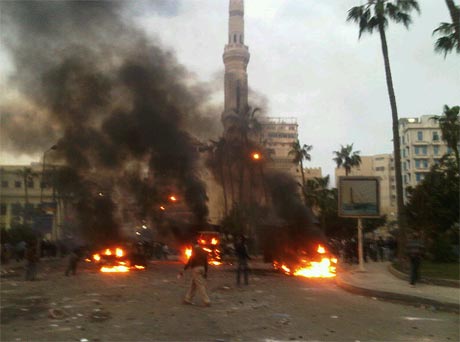
In Alexandria Peter Bouckaert, emergencies director of Human Rights Watch, witnessed four police cars on fire in front of the Siddi Brahim mosque.

Seen above.

Praying As Protest, Ctd

Locals-pray-in-the-street-009

by Chris Bodenner

EA:

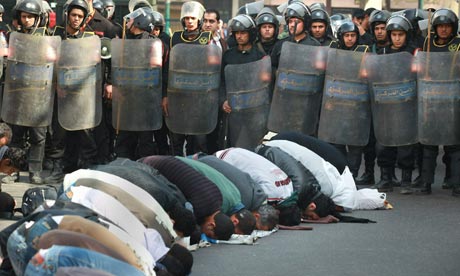
1530 GMT: Live images from Al Jazeera — a protester is approaching the riot police near 6 October Bridge in Cairo so they can organise a "cease-fire" for a prayer.

The Guardian captures a small distant screenshot:

Outside the news organisation's offices, in remarkable scenes, a momentary truce has been called between police and protesters while protesters pray. Just a few moments ago police were throwing teargas cannisters at them and now this.

EA's latest update:

1549 GMT: Police are retreating on 6 October Bridge in Egypt. Protesters, now very close to the security forces, are not throwing stones or committing any violence.

(Photo of a different scene: Locals pray in the street in front of The l-Istiqama Mosque watched by riot police in Giza on January 28, 2011 in Cairo, Egypt. By Peter Macdiarmid/Getty Images)

The Army Arrives, Ctd

by Chris Bodenner

Another intriguing detail about the dynamic between the protesters and military forces:

Following up from the previous update, al-Jazeera just showed pictures of protesters jumping and cheering beside what appeared to be an army armoured vehicle in Cairo with the occupants in the vehicle not responding in any kind of negative fashion. It's too early to get carried away but al-Jazeera was suggesting this could be a sign that the army's allegiance is with the people. Let's just hope the hopes of the people are not misplaced.

Carrying The Fallen

108473188

by Chris Bodenner

Reuters:

Egyptians carried the body of a protester through Suez on Friday after clashes with police who withdrew from central areas of the eastern city leaving some main streets to demonstrators, a Reuters witness said. "They have killed my brother," shouted one of the demonstrators.

Guardian:

Rawya Rageh, for al-Jazeera, says she has seen evidence of a protester killed in Alexandria, a bloody body being held aloft through the streets with people chanting "There is no God but God".

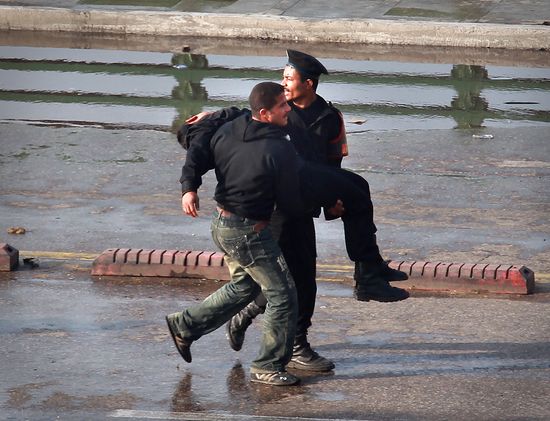
(Photo: Police carry an injured colleague across the Kasr Al Nile Bridge on January 28, 2011 in downtown Cairo, Egypt. By Peter Macdiarmid/Getty Images)

The Army Arrives

by Chris Bodenner

And apparently that's not necessarily a bad thing:

CNN has just broadcast video of soldiers on the streets of Cairo. As armored personal carriers arrived outside a state television building, Ben Wedeman of CNN reported that people on the streets shouted "Allahu Akbar" as the troops arrived. Mr. Wedeman suggested that this could be because the nation's army is more trusted than the police.

EA:

1506 GMT: Al Jazeera Army has live shots of an Egyptian Army armoured vehicle coming near 6 October Bridge. Protesters have run up to greet the soldiers enthusiastically.

Reuters:

Egyptian protesters in Cairo chanted slogans calling for the army to support them, complaining of police violence during clashes on Friday in which security forces fired teargas and rubber bullets. "Where is the army? Come and see what the police is doing to us. We want the army. We want the army," the protesters in one area of central Cairo shouted, shortly before police fired teargas on them.

Fighting Back

108473281

by Chris Bodenner

Updates from EA:

1424 GMT: Al Jazeera Arabic reporting now that protesters have taken control of streets in the strategic town of Suez and burnt at least three armoured vehicles. Meanwhile Al Arabiya reports that protesters have stormed the ruling party's headquarters in the city of Tanta….

1441 GMT: Al Jazeera confirms that protesters have burnt down the ruling NDP party's headquarters in Dumyat. There are now also reports that protesters have burnt down NDP offices in Al-Mansoura, we still have no confirmation. …

1418 GMT: AJE reports that a police station in Mahalla, in the Nile Delta, has been attacked. Meanwhile, Fitch Ratigns Agency has downgraded Egypt's credit rating from 'stable' to 'negative'. …

1415 GMT: In Suez, the center of the city has been abandoned by security forces to be taken over by protesters. …

1335 GMT: The live shots show protesters push back with stones and at least one Molotov cocktail at the armoured vehicle and riot police gathered on the eastern end of 6 October bridge. …

1332 GMT: Jamal Elshayyal of Al Jazeera confirms his earlier reporter that protesters have taken over the centre of Suez, freeing detainees from the police station and burning police vehicles.

Protesters say that security forces escalated the situation by trying to run them over with a fire engine earlier today. Elshayyal also notes that the ban on communications by the regime may have backfired, as people took to the streets for information.

Mackey:

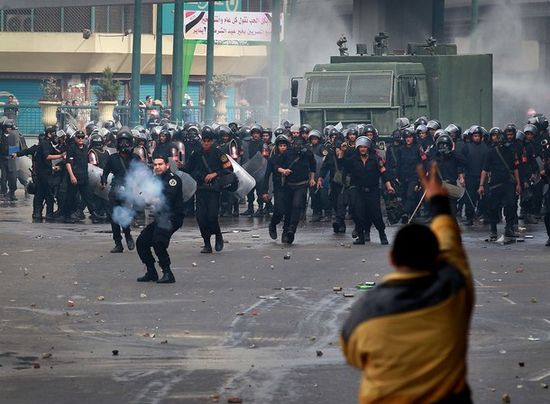
Both Al Jazeera and CNN are transmitting live images of clashes on a bridge in central Cairo between riot police firing tear gas from armored vans and protesters, who are refusing to disperse.

Footage of the bridge here.  Al Jazeera has a live-stream of events as they unfold.

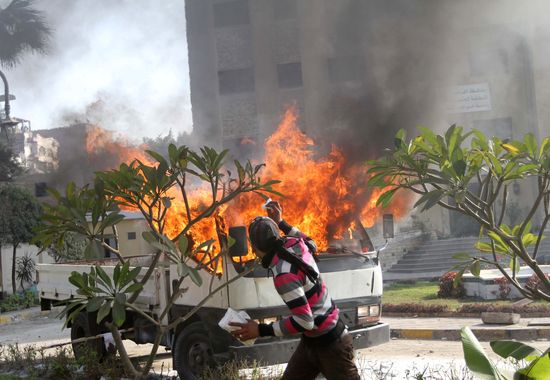
(Photo: A pick up truck catches fire as Egyptian demonstrators confront riot police during demonstrations in Cairo on January 28, 2011, demanding the ouster of President Hosni Mubarak. By Khaled Desouki/AFP/Getty Images)

ElBaradei: “They Are Doomed”

by Chris Bodenner

The NYT's David Kirkpatrick is on the ground in Cairo and reports on the actions of the pro-democracy icon:

Shortly after Midday prayers on Friday, Mohamed ElBaradei made his way through a 231444024crowd to a waiting line of at least hundreds of police in riot gear. The crowd shouted first  for the resignation of President Hosni Mubarak then, as Mr. ElBaradei stood facing the police, the crowd chanted "peacefully, peacefully"
Police beat them with clubs and used water cannons on the protesters, including Mr. ElBaradei, a Nobel laureate and opposition leader, who was drenched as he stood his ground for about 15 minutes.

As the police began to fire tear gas canisters he retreated back inside the mosque, washing gas residue from his face and putting on a mask he recovered.

"This is an indication of a barbaric regime," Mr. ElBaradei said. "They are doomed."

He added: "By doing this they are insuring their destruction is at hand, I have been calling for a peaceful transition now, I think this opportunity is closing."

Choire:

You know what is the worst possible thing the Egyptian government could have done? Detaining just-returned possible opposition candidate Mohamed ElBaradei. That won't inflame protests at all!

Death By Tear Gas

232066234

by Chris Bodenner

Via the Guardian's Matthew Weaver and Haroon Siddique:

Al-Jazeera is showing extraordinary live footage of a police firing teargas cannisters at protesters and protesters throwing them back. Police have cleared one of the main motorway bridges over the Nile. …

"It doesn't show any sign of dying down at the moment," says Peter Beaumont who has been witnessing teargas canisters exchanges on the Kassr Nile bridge. "Having got gassed earlier today, I've got no idea how the protesters are managing to stay in the smoke," he says.

EA:

1330 GMT: Al Masry Al Youm is claiming that police have retaken Qasr al-Nil Bridge, forcing protesters to Opera Square with water cannons at close range as well as rubber bullets and tear gas.

1324 GMT: Al Jazeera is reporting that a woman was killed by tear gas in Tahrir Square in Cairo.

(Photo: Peter Macdiarmid/Getty Images)

What The NY Times Got Right About Wikileaks

by Conor Friedersdorf

Bill Keller, the executive editor of The New York Times, took to the Sunday magazine this week to tell the story of his newspaper's dealings with Wikileaks. It's partly a defense of his news organization – and it includes some bragging too. In fact, I've seldom seen a single essay so effective in making the case for a publication's value.

Let's give Keller's essay a close read, because it provides specific examples that show why the NYT is an important institution worth keeping around, even in the Internet age, and whatever one thinks of its op-ed columnists, its center-left sensibility, or its editorials.

To begin, a description of the impressive team that did its best to responsibly handle the 92,000 documents it was given:

Guided by reporters with extensive experience in the field, we redacted the names of ordinary citizens, local officials, activists, academics and others who had spoken to American soldiers or diplomats. We edited out any details that might reveal ongoing intelligence-gathering operations, military tactics or locations of material that could be used to fashion terrorist weapons.

Three reporters with considerable experience of handling military secrets — Eric Schmitt, Michael Gordon and C. J. Chivers — went over the documents we considered posting. Chivers, an ex-Marine who has reported for us from several battlefields, brought a practiced eye and cautious judgment to the business of redaction. If a dispatch noted that Aircraft A left Location B at a certain time and arrived at Location C at a certain time, Chivers edited it out on the off chance that this could teach enemy forces something useful about the capabilities of that aircraft.

Next an interesting bit about differences in coverage at other newspapers:

If anyone doubted that the three publications operated independently, the articles we posted that day made it clear that we followed our separate muses. The Guardian, which is an openly left-leaning newspaper, used the first War Logs to emphasize civilian casualties in Afghanistan, claiming the documents disclosed that coalition forces killed “hundreds of civilians in unreported incidents,” underscoring the cost of what the paper called a “failing war.”

Our reporters studied the same material but determined that all the major episodes of civilian deaths we found in the War Logs had been reported in The Times, many of them on the front page. (In fact, two of our journalists, Stephen Farrell and Sultan Munadi, were kidnapped by the Taliban while investigating one major episode near Kunduz. Munadi was killed during an ensuing rescue by British paratroopers.) The civilian deaths that had not been previously reported came in ones and twos and did not add up to anywhere near “hundreds.” Moreover, since several were either duplicated or missing from the reports, we concluded that an overall tally would be little better than a guess.

For our purposes, this is noteworthy insofar as it shows an earnest effort to avoid sensationalism when it wasn't warranted by facts, and institutional memory – via previously reported stories and experienced personel – to make an informed judgment.

This next passage concerns power dynamics:

Because of the range of the material and the very nature of diplomacy, the embassy cables were bound to be more explosive than the War Logs. Dean Baquet, our Washington bureau chief, gave the White House an early warning on Nov. 19. The following Tuesday, two days before Thanksgiving, Baquet and two colleagues were invited to a windowless room at the State Department, where they encountered an unsmiling crowd. Representatives from the White House, the State Department, the Office of the Director of National Intelligence, the C.I.A., the Defense Intelligence Agency, the F.B.I. and the Pentagon gathered around a conference table. Others, who never identified themselves, lined the walls. A solitary note-taker tapped away on a computer.

The meeting was off the record, but it is fair to say the mood was tense. Scott Shane, one reporter who participated in the meeting, described “an undertone of suppressed outrage and frustration.”

Suffice it to say that a journalist working for an organization without the institutional clout and attorney power of the New York Times (let alone a freelancer or blogger) would have a much more difficult time sitting before all those government officials without being intimidated. Whatever you think of this story in particular, it's a good thing generally to have a press that can hold its own when the government comes calling.

Finally, a passage that gets things just right:

Although it is our aim to be impartial in our presentation of the news, our attitude toward these issues is far from indifferent. The journalists at The Times have a large and personal stake in the country’s security. We live and work in a city that has been tragically marked as a favorite terrorist target, and in the wake of 9/11 our journalists plunged into the ruins to tell the story of what happened here. Moreover, The Times has nine staff correspondents assigned to the two wars still being waged in the wake of that attack, plus a rotating cast of photographers, visiting writers and scores of local stringers and support staff. They work in this high-risk environment because, while there are many places you can go for opinions about the war, there are few places — and fewer by the day — where you can go to find honest, on-the-scene reporting about what is happening. We take extraordinary precautions to keep them safe, but we have had two of our Iraqi journalists murdered for doing their jobs. We have had four journalists held hostage by the Taliban — two of them for seven months. We had one Afghan journalist killed in a rescue attempt. Last October, while I was in Kabul, we got word that a photographer embedded for us with troops near Kandahar stepped on an improvised mine and lost both his legs.

We are invested in the struggle against murderous extremism in another sense. The virulent hatred espoused by terrorists, judging by their literature, is directed not just against our people and our buildings but also at our values and at our faith in the self-government of an informed electorate. If the freedom of the press makes some Americans uneasy, it is anathema to the ideologists of terror.

So we have no doubts about where our sympathies lie in this clash of values. And yet we cannot let those sympathies transform us into propagandists, even for a system we respect.

This description – and it seems fair and accurate to me – puts the Times in a much different light than is cast by some of its critics, who'd have us believe that the newspaper, which in many ways is establishmentarian (to a fault on occassion), is actually a trangressive, post-national entity with a knee-jerk tenency to blame America first.

I submit that in the matter of Wikileaks, the American people were a lot better off for the involvement of The New York Times than we would've been had the documents been dumped on the Internet without the newspaper's involvement – and that, even if you disagree with some of the decisons they made, which is reasonable enough, their approach to this matter was cogent and defensible.