Focus On Qualified Candidates

by Conor Friedersdorf

For once, I agree with Mark Levin, if only a single line from a long post. He writes:

We conservatives must stay focused.  We must defeat Obama in 2012 by nominating an intelligent, articulate, confident conservative for president.

Keep in mind that Mr. Levin has done more than most on his radio show to elevate Sarah Palin and Christine O'Donnel. If the GOP winds up nominating someone who lacks the chops to be president, odds are that person will have appeared on Levin's show for a softball interview. And will anyone blame him and his talk radio colleagues if that person either loses the election or fails in office? It hasn't happened yet.

This isn't to say that Levin hasn't hosted intelligent conservatives too. But his lack of discernment causes many in his audience to imagine that the Palins and O'Donnels of the world are just as qualified as the stronger available Republicans. Why wouldn't they? He lavishes them with praise as sycophantic. That's going to do a disservice to the right when primary time arrives. So how about tweaking your radio show between now and the election, Mr. Levin. Can you go that long focusing exclusively on guests with the attributes you've mentioned?

The Smithsonian’s Betrayal Of Free Expression, Ctd

by Zoe Pollock

Tyler Green updates the news on Clough's cowardice with a release from another Smithsonian institution, the Hirshhorn Museum:

The attempt by any individual or group to restrict the content-not only artistic, but cultural, historical, and scientific-that may be shown in an institution that serves the public as a whole is counter not only to the founding American principle of freedom of thought and expression, but also to the spirit of inquiry at the core of the Smithsonian’s mission. Hence we are deeply troubled by the precedent the Institution’s leadership has set with its decision.

But, Green adds:

There’s one passage in the statement that bothers me: “This decision raises crucial questions-for us, for our visitors, artists, museum supporters, and colleagues-about the role and responsibility of publicly supported museums to engage with complex and sometimes sensitive topics.“  Gays and lesbians are not a ’sensitive topic.’ They are humans and Americans. That there have been gays and lesbians who have contributed to  our nation’s history and to the history of art is simply part of our story.

Chart Of The Day

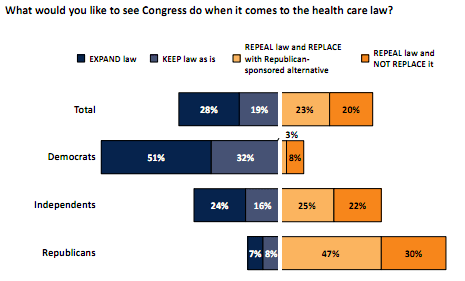
Repealexpandpoll.jpgh

by Patrick Appel

Greg Sargent analyzes:

As always, this doesn't prove that health reform is popular. In fact, the poll finds that the number of Americans who hold an unfavorable view of the law has gone up, and now stands at 50-41. But drill down into public attitudes and there's no sign that this translates directly into support for getting rid of the law. When you offer folks a range of options, support for repeal suddenly drops rather dramatically.

This supports the argument that the case for repeal gets tougher and tougher to make once you begin to talk specifics — and also stands as yet another sign that health reform is here to stay.

Pick One: Fear Of Islamists Or Support For Democracy

by Patrick Appel

Marc Lynch, yesterday:

[W]e must not allow fears of Islamists to short-circuit support for such transitions. … I've long expected that if Egypt got the democratic change which so many in Washington talk about, there would be a rapid and intense backlash as the still powerful Muslim Brotherhood necessarily played a major role and as popular opposition to the Mubarak government's foreign policy jeopardized American and Israeli interests. I'm hoping to be proven wrong.

We're about to get a test: the Muslim Brotherhood will join Friday's protests. NR's editorial makes clear that NR will not welcome the Muslim Brotherhood's role in a reformed Egypt:

One reason that we have to regard the prospect of an Egyptian upheaval with trepidation is that Mubarak has systematically neutered his organized democratic opposition, leaving the Islamists as the most obvious alternative to him — the better to spook us whenever we push him to liberalize.

Their advice isn't bad but it assumes Mubarak will listen to our demands:

It should be made clear to Mubarak — 82 years old and up for election in the fall — that he’s now a transitional figure, and that the days of our easy tolerance for his dictatorial rule are over. We expect him to lift the emergency decree he’s imposed since 1981, liberalize the election laws, and restore the judicial oversight of elections. If he’s not amenable, well, there’s no reason we need to keep shoveling vast amounts of aid his way.

A Letter From Cairo

by Chris Bodenner

A reader yesterday wrote:

I'm a US national studying Arabic at the American University in Cairo, and I live in Abdeen, Downtown Cairo, about three minutes' walk from Tahrir Square and a block from the Interior Ministry. The area has been on a pretty firm lockdown since yesterday morning, with thousands of riot police deployed to blockade every street for a kilometer around the Ministry to foot traffic as well as vehicles.

One can't look at the police here as faceless, jackbooted thugs – they're some of the city's poorer inhabitants, perpetually hungry-looking guys in their twenties that look like they're in their forties. And for the last two days, they've looked scared. Every local I've talked to over the last thirty hours, regardless of their politics, has said the same thing: this is the craziest it's ever been.

The National Democratic Party (that is, the government) has launched a press offensive blaming the protests solely on the Muslim Brotherhood. To be fair, the Alexandria protests were likely more along those lines, but here in Cairo, it's students leading the charge, accompanied by people from all walks of life. The government's position is unsurprising, and speaks to their immense lack of creativity. The Brotherhood has been an extremely useful bogeyman in the past – as long as they remain the democratic favorite and the only viable opposition, it has long been thought that the educated classes wouldn't utter a word of protest even if Mubarak were nailing dissidents to crosses in Tahrir. This protest might begin to suggest otherwise.

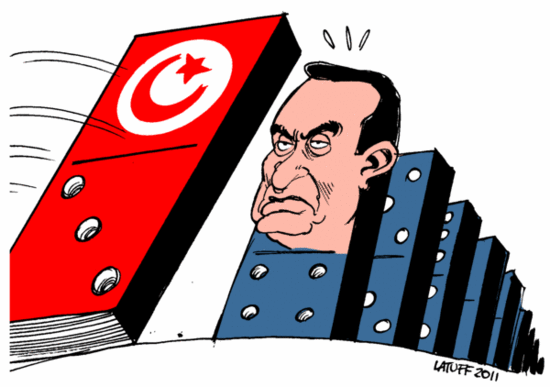
It should be noted, though, that as tempting as it is to conflate these protests with the Tunisian ones, there are several important distinctions between the two countries. The NDP has a wide base of political support spread among all social classes. There's little chance that the military will break with the existing leadership, as was the case in Tunisia. And from the US perspective, it should not be forgotten that there is a great deal of money at stake. Egypt is the second greatest recipient of US military aid, after Israel, to the tune of two billion dollars a year for the last several decades. If that doesn't represent a significant investment in the continued militarization of this country, I'm not sure what would.

Mubarak won't be driven from the country overnight a la Ben Ali. But this does represent a strong challenge to his continued rule.
Escalating In Egypt

108431313

by Chris Bodenner

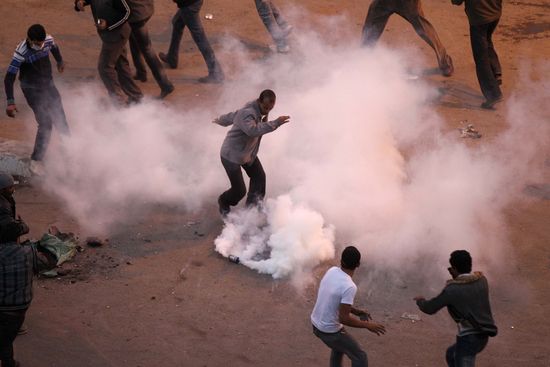
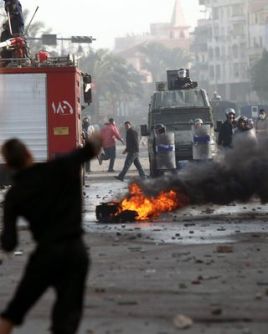
The Guardian posts a round-up of protests, which have spread beyond Suez:

• SHEIKH ZOWEID – Security forces shoot dead a Bedouin demonstrating in a town in Egypt's Sinai region, eyewitnesses and a security source say. Security forces fire tear gas to disperse dozens of protesters.

• SUEZ – Security forces fire rubber 108429362bullets, water cannon and use tear gas to disperse hundreds of protestors. Youths throw rocks and petrol bombs at the police.

• SUEZ – At sunset, hundreds of demonstrators are still on the streets and black smoke hangs over the city. Youths walk around shooting fire extinguishers into the air.

• ISMAILIA – Hundreds of protesters clash with police, who disperse the crowd with tear gas.

• CAIRO – Large groups of riot police keep watch in Cairo and in Giza suburb. Outside the press syndicate in central Cairo, dozens of protesters shout demands for President Hosni Mubarak to resign as police look on.

• CAIRO – State news agency MENA says the security services have released protesters in several parts of the country.

EA has more on the latest death:

1600 GMT: Another protester has been killed today. Mohamed Atef was shot in the head during demonstrations in the town of Sheikh Zowayed in the Sinai peninsula. Atef is the fifth protester to die since Tuesday. Officials say two policemen have also been killed.

(Both photos, from Suez, by Khaled Desouki/AFP/Getty Images)

Palin’s WTF Moment

Tommy Christopher shakes his head at Palin's latest attempt to outwit the president:

Palin’s first mistake (or misdirection, if she’s no idiot) is in misplacing the US’ role in the President’s Sputnik analogy. Palin seems to be cautioning America against launching its own metaphorical Sputnik, a complete misreading of the meaning of “Sputnik moment.”

The Soviet Union’s launch of a satellite that was only slightly more advanced than Balloon Boy 1 is not the model of success to which the President’s speech urges us to aspire, but rather, the flood of research, innovation, and achievement that it spurred in a then-complacent American psyche. The negative consequences of Sputnik to the Soviet Union, then, would only serve to reinforce what the President said.

Even in twisting the meaning of the President’s analogy, though, Palin twists history to suit the view from her front porch.

While it’s tough to pinpoint a single reason for the dissolution of the USSR, the space program isn’t one of them, at least not in the substantive way that Palin imagines. The Cold War arms race is the factor that most closely tracks here, and while the Sputnik 1 launch was a shot across the bow in that war, it was a drop in the arms race bucket.

Palin then goes on to suggest that what America needs is a “Spudnut moment,” explaining that there’s this successful small business in Washington state, and that America needs to do…what? Have lots of successful small businesses? Stop preventing successful businesses like The Spudnut Shop from being successful? Palin never really explains how this is supposed to work, but I think the equation goes something like this: “Sputnik moment” + “Something that sounds like Sputnik but isn’t”=WIN!

Democracy From Within

by Patrick Appel

Elliott Abrams delinks Arab democracy efforts from Israel-Palestine:

Arab affairs reflect the internal crises of Arab countries and regimes and are not built around the Israeli-Palestinian conflict. What has been happening in Tunisia and Egypt is about Tunisia and Egypt. Same for the crisis in Lebanon, recent rioting in Jordan, and other key issues throughout the Arab world (stasis in Algeria, succession in Saudi Arabia, and so on). What unites these events is their relationship to the democracy deficit and to internal social and economic problems, not to Israel.

Greg Scoblete agrees. So do I. But Abrams is countering a point almost no one makes. The position I hear most often is that America's fidelity to Israel damages America's standing in the eyes of the Arab and Persian public. This, the argument goes, lessens America's influence in these countries – which makes it harder for America to form mutually beneficial relationships with these nations. Granted, this argument is often exaggerated and Abrams is certainly correct that events closer to home are much more important.