The Contract With Iowa Caucus Participants

by Conor Friedersdorf

After Newt Gingrich said we shouldn't allow a mosque to be built in lower Manhattan until Saudi Arabia permits a church in mecca, I thought my opinion of the former Speaker of the House couldn't get any lower, but I was wrong:

Former House Speaker Newt Gingrich today dismissed the “big city” critics of corn-based ethanol and suggested the biofuels industry will be able to “stand on its own” without federal subsidies once all autos are “flexible-fuel” vehicles… “If they’re prepared to insist on a flex-fuel vehicle and every car in America’s capable of buying ethanol, I think the industry can stand on its own,” Gingrich said.

Similarly, if there were a rule that everyone had to travel by train whenever possible Amtrak would be able to "stand on its own" without federal subsidies. And if only Israeli-made rickshaws pulled by mortgage-owning tobacco farmers were permitted on America's highways…

Gingrich attacked critics of ethanol, saying a recent Wall Street Journal editorial on the subject was “flat out wrong.” 

“I don’t mind people having an honest argument about ideology, but they ought to at least use facts that are accurate,” Gingrich said. “…This is an interest group fight in which a number of very sophisticated, big interest groups have set up a myth and are busy actively propagating the myth, but the truth is it hurts the farmer.  It hurts rural America and it’s fundamentally unfair to America’s future.”

It's so blatant a lie, so opposite to the truth, that it's insulting.

Gingrich has indicated he will announce by March 1st if he intends to seek the G.O.P.’s 2012 presidential nomination.

Gee, I wonder if he'll get into the race or focus on his totally genuine passion for ethanol subsidies and the interests of Iowa farmers instead.

Scenes From Suez

by Chris Bodenner

Above is footage of tear gas dispersing protesters earlier today. Below is a scene from last night of burning and chanting in the streets:

And from the Guardian's live-blog:

Reuters reports protesters have set fire to a police post in Suez today. I posted video footage of what was said to be a police station on fire at 9.30am. Reuters says:

Egyptians torched a police post in the eastern city of Suez early on Thursday morning over the killing of protesters in anti-government demonstrations earlier in the week, a Reuters witness said. Protesters in Suez had on Wednesday set a government building and another police post on fire, as well as trying to burn down a local office of Egypt's ruling party. Those fires were all put out before they engulfed the buildings. The Reuters witness said police fled the post that was burned on Thursday before the protesters hurled petrol bombs. Dozens more protesters gathered in front of the second police post later on Thursday morning demanding the release of their relatives who were detained in protests.

The aforementioned video:

Financial Shockwaves In Egypt

by Chris Bodenner

Another sign of change to come?

The Egyptian stock market fell another 10.5% on Thursday. The index decreased 6% on Wednesday. Since yesterday afternoon, it has recorded a a loss of 54 billion Egyptian Pounds ($9.2 billion) in trading. The market was suspended for 45 minutes after it fell 6.2% in the first quarter-hour of trading on Thursday. The Egyptian Pound, already at a six-year low, is still sliding against the US dollar.

Choire comments:

According to the FT? "Currency and stocks slide amid more violence"! Which, yes, the Egyptian stock market had a massive tumble, and was suspended, but I'm pretty sure it's not related to "violence" (which has been relatively minor!) but, you know, is perhaps attributable to the sudden, stunning fact that the regime in Egypt is quite possibly not going to remain permanent! Jerks.

Talking To His Generation

by Conor Friedersdorf

This James Poulos post makes an astute point about the SOTU speech:

More than anything, I was struck last night by the generational aspect of the President's address.

Sorry, young people: galvanizing the under-30 set makes great campaign material, but now it's all about helping the aged. You heard it in the feel-your-pain reference to the bygone era of local factory jobs. You heard it in the human-interest stories of heroically repurposed near-retirement-age businessfolk. Above all, you heard it in the surrealistically repurposed Sputnik Moment, which became in Obama's hands a way to get older Americans to imagine that the reliable, stable world of their past was actually a cavalcade of personal reinvention and societal reeducation.

Young Americans? To the extent that we heard anything, we heard that our future is cut and dried: science and math education, because that's what they do in China; a career as a scientist, an engineer, or a science and math teacher, because in South Korea those people are celebrated as "nation builders;" a lifetime of work spent in an economy propped up by spending, subsidies, and a perpetual partnership between big government and big business.

Scenes From Yemen

by Chris Bodenner

So far the mass demonstrations appear peaceful. Robert Mackey is tracking the story and eliciting images from his readers. One of the first videos out of Yemen:

The Dish is also tracking footage released on YouTube. Below is a compilation of scenes fresh off the site:

A tweet from Al Jazeera reporter Dima Khatib:

Demos in Yemen were organised by opposition parties in Sanaa and other cities of Yemen. They have ended now.

“You Can’t Make A Sweet Drink Out Of A Rotten Fish”

by Zoe Pollock

After reporting from Egypt last year, Adam Shatz explains the lead-up to the protests this week:

Leftist militants, reformist politicians, Muslim Brothers and human rights activists had been telling me for the previous two weeks that, for the moment, the regime had been reasonably successful in neutralising dissent, that Egyptians were too caught up in everyday worries to mobilise politically, and that the hopes raised by the Kifaya protests of 2005 had collapsed.

But that was before the murder of Khaled Said, a 28-year-old Alexandrian beaten to death last June by plainclothes officers for asking whether they had a warrant when they searched him. That was before the flagrant rigging of the parliamentary elections in December, which left the Muslim Brotherhood – the country’s largest opposition movement – without a single seat. That was before the New Year’s Day bombing of a Coptic church in Alexandria, in which 23 died, followed by the usual official claims that there are no sectarian tensions in Egypt. And that was before the popular uprising against the regime of Zine Ben-Ali in Tunisia.

He pinpoints what this uprising is all about:

Despite the Mubarak regime’s efforts to invoke the spectre of the Muslim Brotherhood, Egyptians aren’t demonstrating for an Islamic government any more than the Tunisians were; they’re demonstrating for an honest government – one that will improve education and infrastructure, reduce poverty and inflation, end the Emergency Law, stop torturing people in police stations, stop doing the bidding of the US and Israel in Palestine, stop rigging elections, and, above all, stop lying to them. And whatever their differences, they are united in the conviction that neither Mubarak nor his son Gamal, who is being groomed to succeed him, is capable of meeting these demands. As one young activist said to me last year, ‘We need a radical shake-up. We have a saying in Egypt that you can’t make a sweet drink out of a rotten fish.’

Your Role In Egypt

by Conor Friedersdorf

The always thoughtful Claire Berlinski is trying to persuade her readers at Ricochet that unrest there should matter to them:

US military aid to Egypt totals over $1.3 billion annually. Your money, in other words, is keeping Mubarak in power. That government is now doing this to its people. Listen to the audio. It's hard to say just what's happening, given the media blackout, but clearly terrible things are happening in Egypt…. The fact that we are supporting the Mubarak regime may not be immediately obvious to most Americans, but it is the central fact about America to every Egyptian alive–to 83 million people in the heart of the Middle East.

Berlinski would like the United States to intervene in some way on the side of the people, whereas writers like Daniel Larison argue that it's best for the United States to just stay out of the way – especially in that region, American support can undermine protestors. I have no idea what the right approach is in this case.

But I am uncomfortable with that $1.3 billion per year.

Egypt Erupting: A Momentary Lull, Ctd

90794515-375x281

by Chris Bodenner

EA is all over an escalating scene in Suez:

1249 GMT: In Egypt, Cairo is still quiet today. Security forces maintain a heavy presence, although there are fewer in the key point of Tahrir Square. A report is coming in, however, of protests starting in Suez, where there were serious clashes throughout yesterday. Al Masry Al Youm is also carrying the news.

1330 GMT: Fighting is reportedly centred around a police station. Al Jazeera reporter Ayman Mohyeldin estimates 2000 protesters are involved. Reuters is reporting tear gas and rubber bullets have been used; Al Jazeera says tear gas, rubber bullets, and cannon. Neither mention live ammunition.

1415 GMT: Recap from Suez. One police station was burned this morning, and relatives of detainees gathered around a second station. Trouble then escalated, with the reports of clashes involving tear gas, rubber bullets, and water cannon. There are unconfirmed claims of Molotov cocktails and live fire.

1425 GMT: 1st-hand from Suez, "Fire department building on fire. Billows of black smoker rising. Firemen jumping out windows."

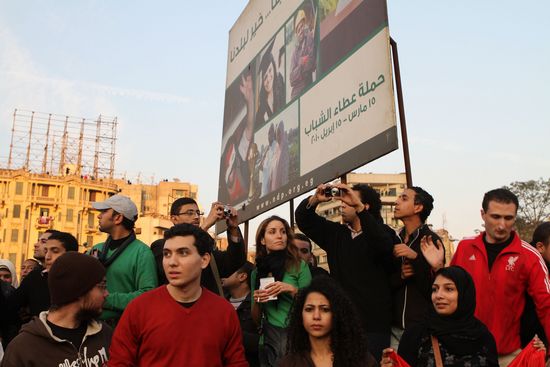
(Photo of rubber-bullet wounds via Amira Al Hussaini, who is collecting Twitter reports from Egypt. Rumblings in the Suez began last night.)

The Millennials Lead

Carr3

by Chris Bodenner

As is wont:

“It was the young people who took the initiative and set the date and decided to go,” Mohamed ElBaradei, the former head of the International Atomic Energy Agency, said Wednesday with some surprise during a telephone interview from his office in Vienna, shortly before rushing home to Cairo to join the revolt.

Even the Muslim Brotherhood may have grown too protective of its own institutions and position to capitalize on the new youth movement, say some analysts and former members. The Brotherhood remains the organization in Egypt with the largest base of support outside the government, but it can no longer claim to be the only entity that can turn masses of people out into the streets.

“The Brotherhood is no longer the most effective player in the political arena,” said Emad Shahin, an Egyptian scholar now at the University of Notre Dame. “If you look at the Tunisian uprising, it’s a youth uprising. It is the youth that knows how to use the media, Internet, Facebook, so there are other players now.”

(Photo by Sarah Carr. More at her Flickr gallery.)

Now Yemen?! Ctd

108287015

by Chris Bodenner

Some context from Global Post:

Yemenis first took to the streets over the past weekend, In response, the president made a number of concessions, including releasing a rights activist from prison, announcing plans to raise the salaries of government employees and military personnel by almost $50, and issuing a public denial that he is grooming his son to take over power.

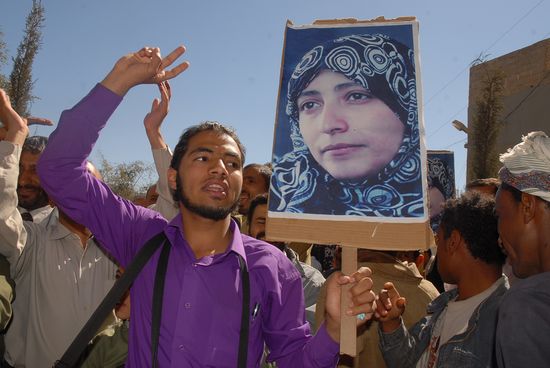
Tensions reached a boiling point in Yemen on Sunday when plain-clothed police officers arrested Tawakul Karman, a female activist responsible for organizing the uprising, in the early hours of the morning while driving home with her husband. Authorities released Karman on Monday with a commitment from her family that “she will no longer offend public order and law.”

More from the BBC:

President Saleh, a Western ally, became leader of North Yemen in 1978, and has ruled the Republic of Yemen since the north and south merged in 1990. He was last re-elected in 2006. Yemenis are angry over parliament's attempts to loosen the rules on presidential term limits, sparking opposition concerns that Mr Saleh might try to appoint himself president for life. Mr Saleh is also accused of wanting to hand power to his eldest son, Ahmed, who heads the elite presidential guard, but he has denied the accusations.

And the Guardian:

Yemen is struggling with soaring unemployment and dwindling oil and water reserves. Almost half its 23 million people live on $2 or less a day, and one-third suffer from chronic hunger. "We are partners in this nation and we won't submit to exclusion," protesters chanted. "Look at Tunis and what it did. Yemen's people are stronger."

Early footage of the mass demonstrations here.

(Photo: Yemeni protesters, holding up pictures of detained political activist Tawakel Karman protest on January 24, 2011 outside the public prosecution headquarters in Sanaa in solidarity her. By Gamal Noman/AFP/Getty Images)