Will Change Come To Egypt?

by Patrick Appel

Steven Cook, who is in Cairo, sounds hopeful:

It’s not clear at all whether they believe them or not, but the Egyptian elite have been telling themselves lies and half truths for years.  Today may have been the day when those lies and half truths caught up with them.  Clearly, the many thousands of people in Tahrir Square today/tonight don’t take the regime’s claims about reform seriously.  The press has focused on economic grievances—perhaps taking their cues from government spokesmen—but the only demands I heard tonight were political.  The young men and (some) women in Tahrir want freedom and liberation from Hosni Mubarak, his family, and the National Democratic Party. 

As an aside, no matter how this thing turns out, it seems far less likely that Gamal Mubarak will succeed his father.

A Tunisian Tsunami? Ctd

108358421

by Chris Bodenner

Despite the developments in Egypt, Stephen Walt stands by his earlier assessment that Tunisia won't lead to similar revolutions:

The main reason was that authoritarian governments would be on their guard against contagion, and would act quickly to snuff out any rising revolutionary tide. Thus far, that's precisely what the Mubarak regime seems to be doing, and they have a lot of practice at this sort of thing.  See here for an eyewitness account. As Juan Cole warns, "Egypt is not Tunisia."

So what do I think now?

It's clear that events in Tunisia have provided a catalyst for Egyptians to express their discontent with the Mubarak regime. (That discontent is not new, of course).  It seems plausible that social media (e.g., the internet, Facebook, Twitter, etc.) may have facilitated some degree of mass mobilization, thereby encouraging larger turnout at demonstrations than one might otherwise have expected. It's hard to know how important this has been, but it could be a change in background conditions that makes this sort of revolutionary contagion more likely. I have an open mind about that subject.

What we don't know yet is whether the popular discontent that is being expressed in the streets will ultimately be able to challenge the government's authority, undermine the cohesion and loyalty of the Egyptian security forces, and render Mubarak's continued rule untenable.  If I had to bet, I'd say not at present. But am as I confident as I was last week? 'Course not.

And for me, the more interesting question is not the short-term possibility of revolutionary contagion, but rather the long-term possibilities for political and social change that these events herald. Even if governments like Mubarak's remain in power today, it is hard for me to believe that the current political order in much of the Arab world can survive unchanged for much longer.

Abigail Hauslohner reinforces a key difference between the two nations in turmoil:

In Tunisia, at a critical turning point, the Army took the side of the protesters in the street: it refused to fire on demonstrators. In Egypt, however, the military stands with Mubarak. The Interior Ministry, which runs the police, stands with Mubarak. Mubarak knows better than to falter on security, Egyptians say. "The government here is stronger than it was in Tunisia – that's why people are scared," says one Cairene citizen.

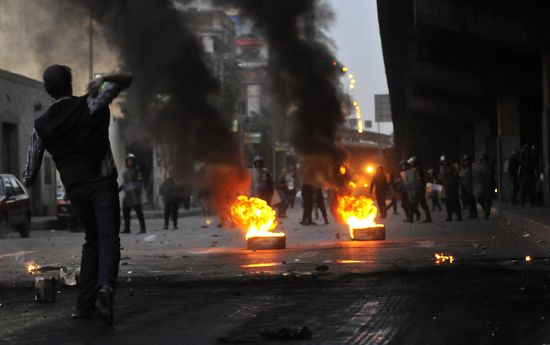
(Photo: Egyptian riot police gather near burning tires as a demonstrator throws an object towards them during a protest demanding the ouster of President Hosni Mubarak and calling for reforms on January 26, 2011 in Cairo. By STR/AFP/Getty Images)

Do Not Disturb

by Conor Friedersdorf

Attention editor of the Harvard Business Review: If you're looking for a flashy cover story to goose newsstand sales, why not take Marriott's decision to get rid of inroom pornography as your starting point, and assign one of the Freakinomics guys to do a case study on whether it results in more calls from hotel rooms to escort services.

I suspect you'll wind up with a story, but on the rare occasions when I travel for business I blow all my discretionary spending on overpriced pitchers of Sapporo at the Alphabet City karaoke bar where I sing Thunder Road and Under Pressure with writer friends, so what do I know?

(The establishment of which I speak, Sing Sing, has these awesome videos that accompany various songs, and when I think about it I'd love nothing more to going singing with A.O. Scott (or Chris Orr!), buy him a pitcher of Sapporo, and pick his brain about the unknown director's fascinating interpretation of Like A Rolling Stone.)

Fewer Choices

by Patrick Appel

Nate Silver makes a basic but important observation:

With Democrats no longer in control of the House of Representatives, Mr. Obama will not be able to pass any major Democratic policy initiatives now, no matter how much political capital he might be willing to stake on them. Meanwhile, the Republicans control only the House, not the Senate. In contrast to Bill Clinton — who faced opposition control of both houses of Congress after his first midterm election — Mr. Obama may never have to use his veto pen.

This is not to suggest, exactly, that Mr. Obama’s job has become easy (the president’s job never is). But surely it has become easier in one regard: he has far fewer choices to make. 


Walmart For Weed

by Zoe Pollock

Josh Harkinson reports on Dhar Mann and Derek Peterson's plans to cash in on California's "green rush":

[Mann decided he would] create "the first honest hydro store," one that didn't perpetuate the charade that its customers are spending thousands of dollars growing amazing tomatoes. When the PR shop that was managing weGrow's grand opening in January 2010 handed him a press release that read "Urban gardening megastore opens by airport," Mann fired the firm and rewrote the release himself: "Marijuana Superstore Opens in East Oakland." …

If everything works out as Peterson and Mann insist it will, GrowOp's projected $2 million in annual profits will give it a $50 to $60 million market cap when it goes public later this year. Together they will own 70 percent of the shares. That's small change compared with a tech IPO, but if it actually happens, it would add to weGrow's legitimacy in the eyes of investors, regulators, and potheads.

You Can’t Handle The Truthiness

by Conor Friedersdorf

Says Roger Ailes:

Tell me who you want to see on the left and I'll hire them. If you give me a big name that's out there, that's floating around and wants work, I'd be happy to hire them. We have Ed Rendell, I mean he was the head of the Democratic party. He's on twice a week. You can't get any bigger than that. I go for people who will get ratings, but I'd be happy to put a bigger name Democrat on if you've got one. Now that probably surprises you and won't get into the story, but it's true. I want people who have marquee value.

I don't even need Ailes to hire anyone – just commit to rebroadcasting the Jon Stewart or Steven Colbert clip of my choice once a week. I suppose if it must be the hire of an on air personality I'd draft Glenn Greenwald.

Why Swallow The Key To The Smoke Filled Room?

by Conor Friedersdorf

Remember back in 1999, when George W. Bush suddenly emerged on the scene as the frontrunner for the GOP nomination with a huge campaign war chest and an air of inevitability? It's what I thought of immediately after reading – via sharp-eyed Jonathan Chait – this passage from Bill Kristol:

We know the superiority of spontaneous order to central planning. But too many GOP bigwigs in Washington who claim to have read Hayek have succumbed to the fatal conceit. They’re meeting nonstop trying to determine for us all now, a year before the first primary—with limited information as to relevant candidate skills and almost no knowledge of next year’s political environment—who the best presidential candidate would be.

Democratic capitalists admire Schumpeter for explaining the virtues of creative destruction. But too many donors to the party of democratic capitalism are huddling in New York this winter figuring out if there isn’t some way to short-circuit this kind of healthy—if messy, to be sure—competition among entrepreneurial candidates testing their skills and their messages.

Who are these big wigs? By what means are they trying to determine the GOP's candidate? Who are they backing? Why?

For God's sake, man, you're a magazine publisher! You employ Matt Labash and Robert Messenger and Jonathan Last, so I know at least part of you appreciates good journalism. So turn someone loose on this story! Spill your secrets! How can you not? Doesn't any part of you ever want to – what's the right expression here – go rogue? Capitalize on your status as an elite DC insider to tell the rest of us regular Americans what's going on? What if I play on your nostalgia: FAX it to me like the old days! Or at least tip me off to the meeting location. Or better yet, tip off Dave Weigel. He's closer.

Apparently you think these people, meeting in secret, are a nefarious influence on the selection process for possibly the next president of the United States. Does this not confer some patriotic obligation to break the story? If not this, then what? What makes you tic, sir? I confess that I do not understand. Once I worked for a man who mistakenly pronounced your last name like the champagne that Jay-Z touted, then boycotted. That always made me laugh. Then you teamed up with Lynn Cheney and Michael Goldfarb to brand lawyers who represented War on Terror detainees "The Al Qaeda 7."

Wouldn't it be more enjoyable to dazzle us with your connections in a penetrating piece of insider journalism that by your logic will increase the odds that the next leader of the free world is well chosen?
The State Of Our Stomachs Is Strong

by Zoe Pollock

Alex Balk interprets the latest lawsuit against Taco Bell's not-quite beef:

The American love of consuming dubious meatstuffs at rock-bottom prices has collided with the American love of suing anyone anywhere for any possible reason. I don't know why your president told you we need to compete more last night: So long as we're filling our bodies with obvious crap and then trying to make a buck out of that obvious crap's obvious crapness, we will be just fine. This is exactly what they talk about when they use the phrase "American exceptionalism."