The Illusion Of Heterosexual Monogamy

by Zoe Pollock

JD mocks it, using the results of an Oregon State University study:

Some 40 percent of the 434 couples surveyed, whose partners were ages 18-25, had differing views on whether their relationships were exclusive or not. And among those couples where both partners agreed to be monogamous? In 30 percent of the relationships, at least one partner cheated. The gays have already found two solutions for this: by eliminating the word "monogamy" from their vernacular all together, or calling bullshit on the concept.

The Animal Testing Rules

by Patrick Appel

A reader writes:

I am a contractor for the federal government. I work in an area where testing guidelines are discussed on a daily basis. Make sure we don't blame the companies for animal testing. They are just following the rules.

Literally every first-world environmental agency mandates a "non rodent sub-chronic toxicity test" for almost every chemical that passes through their doors. They use dogs because they have a similar metabolic rate to humans. The use of dogs (Beagles are assumed at this point), is spelled out in the regulation. You can get around the test by proving via rodent testing that the chemical/product in question is so toxic that performing the test on the Beagles serves no purpose, but that does not happen a majority of the time.

Now, if people do not want the products they use daily (and whose safety they take for granted) tested, then by all means, lobby your gov't official to change the federal laws mandating that these tests be conducted.

The ironic flip side of this is that if a product says "no animal testing" on the label, you can be almost assured that it has has minimal government testing to assure that the chemicals in it are safe.

SOTU Reax

Strongpie

by Patrick Appel

Full text of the speech here. The NYT compares the words used in SOTU speeches since Roosevelt. Nyhan calls the SOTU the "most overcovered event in politics relative to the amount of the news that's made." His take on the spin:

Instant polls of people who watch the speech are meaningless (it's a non-random sample skewed toward the president's supporters, among other problems).

The claim that presidents get a bounce from the speech is a widely debunked myth (most don't).

Legislative seating may matter over the long term, but not for one night.

Drezner:

[T]he percentage of the speech devoted to microeconomic "competitiveness" issues vastly exceeds the amount devoted to long-term macroeconomic policy.  If the federal government really wants to create a better climate for innovation, it needs to send a credible signal that steps are being taken to deal with long-term budgetary problems.  That section of the speech was, er, less solid. 

Alana Goodman:

Obama reaffirms the importance of supporting democracy movements around the world. This type of rhetoric had been toned down during his administration, and so it’s nice to hear him say it so firmly tonight: “And tonight, let us be clear: the United States of America stands with the people of Tunisia, and supports the democratic aspirations of all people.”

Drum is unimpressed by Obama's five-year discretionary spending freeze:

Let's all keep in mind that budgets are set one year at a time, and they're mostly set by Congress. The president has a certain amount of agenda-setting power, but that's about it. Members of Congress will do whatever they want, and next year they'll once again do whatever they want. If that means spending more money, they'll spend more money. Obama could announce a hundred-year discretionary spending freeze and it would mean about as much as a five-year freeze. This is more a PR exercise than anything else and should be evaluated on those terms.

Garance Franke-Ruta:

Tonight is about many things, but one of them, perhaps encouraged by the pressures of the 140-character tweet stream, is KEYWORDS. Ones the White House is emphasizing: innovate, educate, build, reform, responsibility. Ones it is not: "climate; gun; abortion(/choice/women's health); Clinton; Bush; Israel; Egypt; England."

The topic of gun control does not come up in the speech.

Ramesh Ponnuru:

Great: President Obama is open to one of the Republicans’ crummiest ideas. There’s no need for a federal takeover of medical-malpractice rules.

Chait:

The substance of Obama's speech was moderate liberalism — we like business, but government has a role too, neither too much nor too little, etc. It's hard to attach that kind of case-by-case pragmatism to an overarching theme. But I do think Obama pulled it off pretty well. He took a fairly hackneyed idea — the future — and managed to weave it into issue after issue, from infrastructure to energy to deficits to education and even foreign policy.

Pareene:

Oh god he's doing Reagan. The government is so big and complicated, I have a folksy anecdote about fish that illustrates the absurdity of the entire enterprise of managing a massive, wealthy, post-industrial nation. (Obama is also bad at delivering "jokes," his apparently developed sense of irony nothwithstanding.) Oh, now we're done with "wasteful government spending" and on to our on-going fight against al Qaeda abroad. We're going to kill all the terrorists. All of them! Also we're going to leave Afghanistan. Or begin to leave. Begin to start to leave.

Krugman:

Considering the rumors a few weeks ago, which suggested a cave on Social Security, this wasn’t too bad. Obama said that we’re going to do something about Social Security, but unclear what. And in general he at least somewhat stood his ground against the right. In fact, the best thing about the speech was exactly what most of the commentariat is going to condemn: Obama did not surrender to the fiscal austerity now now now types.

Gregg Easterbrook:

In the address there was a lot of talk about jobs and innovation, both obviously important: but issues that no president controls. There was talk of better access to high-speed Internet and of regulatory and tax-loophole reform: not one single person opposes either. There was dream-world talk of high-speed rail and energy in the year 2035. But there were precious few specifics regarding what will be done right now to address runaway federal debt. And runaway federal debt, which suggests the U.S. future may be less bright, is a major issue holding the economy back.

Steve Coll:

This really is a much more mainstream American speech than his last one, which was very New Deal-ish. He supposedly read Lou Cannon's Reagan biography over the holidays. 

Avik Roy:

PPACA’s infamous 1099 rule, which requires individuals and businesses to fill out a separate IRS form for any vendor they spend more than $600 on in a given year, was one of the fiscal devices the law’s authors used in order to improve its CBO score. Repealing it appears to have garnered bipartisan support. If Republicans intend to offset this tax increase with spending cuts or other tax increases, it is strategically important that those offsets are unrelated to PPACA, so as to improve the CBO score for repealing the law at a later time under reconciliation rules.

DiA:

I cannot think of a worse model for future growth than the bygone space-race which was little more than hugely wasteful technological peacocking by cold-war superpowers.

Yglesias:

I thought it was a good speech; an example of trying to govern from the White House. I would say that zero percent of the speech was dedicated to building support in congress for concrete pieces of legislation that the President hopes to sign into law. And it’s too bad that the president’s not in a position to promise to shepherd big bills through congress. But the reality is that he’s not. So he’s wisely floating above the fray, issuing “sounds good but hard to do in practice” calls for smart infrastructure investments, tax reform, less oil subsidies, etc. Most likely none of it will happen. But it will definitely sound good, and if the president’s lucky some of it will happen! 

(Pie chart from Ezra Klein)
Advice To SOTU Watchers

by Patrick Appel

Nate Silver recommends ignoring moments "likely to have any impact on perceptions of Mr. Obama in the near term" but instead to focus on sections that "might hint at the White House’s thinking on some of the more difficult strategic choices it faces over the next 6 to 9 months." Among the topics Silver will be listening for:

How Mr. Obama will try to maneuver against the G.O.P. on the issue on which he might be most vulnerable: the federal budget deficit. Popular approval of Mr. Obama’s handling of the deficit is just 38 percent, according to a CNN poll released yesterday. Major changes to Social Security appear to be off the table — although, considering how unpopular they would be, it is hard to know whether the White House was seriously considering any in the first place. But the White House will need to have some sort of response to Republicans ready on the deficit, particularly since a budget hawk, Paul Ryan of Wisconsin, is set to deliver the Republican rebuttal.

“Taking A Stand”

by Patrick Appel

Larison advises against it:

The [Obama] administration should urge the Egyptian government to avoid violence, and it should be willing to withdraw aid if Mubarak uses excessive force against protesters, but publicly backing the protesters simply contributes to an escalating confrontation that cannot end well for the protesters or the U.S.-Egyptian relationship. 

“An Unusually Unimportant State Of the Union Address”

by Patrick Appel

Sully picked a good SOTU to miss, according to Alex Massie:

[T]his is an unusually unimportant State of the Union address. As Ezra Klein notes, these things rarely make much of a difference (they rarely confirm or reverse any prevailing media "narrative") and, in any case, the White House seems to have prepared the ground quite effectively this year. Plus, the PResident's poll numbers are reasonably healthy and there's some reason anyway to hope that better economic times lie ahead.

Andrew is too sick to live-blog, but I'll be trawling the blogs for SOTU reax – in case Alex is wrong.

Tonight’s Shopping List

by Zoe Pollock

David Frum lays out the ground rules for planning a SOTU:

At the first meetings on the State of the Union in November, somebody — maybe the president himself — will usually say: "We don't want to do just another shopping list." After two, three, sometimes four months of hard work, what emerges is… a shopping list.

And you know what? It turns out that the viewers at home like shopping lists. President Clinton's States of the Union were almost universally condemned by journalists and communications professionals as sloppy monstrosities. Too long, too shapeless, just one damn thing after another. Yet after each, Clinton's numbers would surge. People liked the big formless blob speeches, despite their frightening length: 77 minutes in 1998, 79 minutes in 1999, 85 minutes in 1995, 89 minutes (the all-time record!) in 2000. The longer the speech, after all, the more likely you are to hear something that directly concerns you.

Hating The SOTU

by Patrick Appel

Joe Klein confesses:

I especially hate the day before the State of the Union message because….every last interest group in Christendom, including the Jewish and Islamic ones, sends out e-missions about what the President really should say about everything from junk food to oil subsidies. And the New York Times inevitably collects a dozen of the usual suspects to make modest suggestions about themes the President should strike, which inevitably are their own entirely predictable hobby horses. And people like me talk about what the President has to do in his speech in order to thrive politically; we are almost invariably wrong, so I've pretty much stopped doing it.

Faces Of The Day

108305299

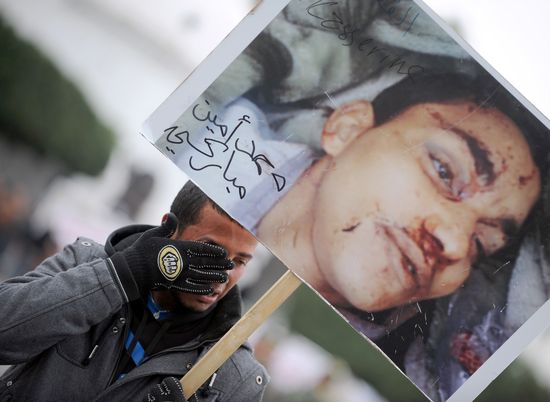
A resident of Kasserine, central Tunisia, demonstrates in front of the Government palace in Tunis on January 25, 2011 as he holds a portrait of his brother Mohamed Mbarki, who was killed during clashes with Tunisian security force in December. The brothers came from a poverty-stricken rural region where the crackdown against a wave of social protests in the final days of ousted president Zine El Abidine Ben Ali's regime was at its harshest. In defiance of a curfew and state of emergency, they travelled through the night in a ragtag line of cars, trucks and motorcycles from towns across the rocky region far from Tunisia's luxurious Mediterranean resorts. By Fethi Belaid/AFP/Getty Images.