Egypt In The SOTU?

by Patrick Appel

Larison guesses not:

I would be surprised if the word Egypt appears anywhere in the State of the Union tonight. For one thing, if he mentions Egypt he will almost certainly feel compelled to mention his Cairo speech, and a lot of administration policy matches up pretty badly with many of the statements in the Cairo speech (and that’s not necessarily a bad thing!). Probably everyone in attendance knows that Obama has not made a priority of human rights or political reform in his dealings with Mubarak, so what does Obama say about the protests? When it has had to choose between not inserting itself into a foreign political crisis and “speaking out,” the administration has more or less consistently chosen the former. That was the right decision regarding Iran in 2009, and it was the right decision on Tunisia this winter. 
Obama’s Cairo Narrative

by Chris Bodenner

Charles Mudede updates it in light of today's events:

I locate Obama's speech in Cairo "A New Beginning". From this point radiates these recent turbulence in the Arab world. Yes, Tunisia caught the State Department completely by surprise. But what Obama did was precisely lessen the tension between the Arab nations and the US, and this in turn meant, for the subjects of Arab nations and also Iran, more anger could be committed to local rather than international matters. None of this would be happening if George W. Bush were in power. All he could do was intensify Arab nationalism, and this nationalism benefited the rulers, kept them in power, kept attention away from their dark doings.

This is only a rough theory. More information will, of course, change this theory. Egypt is a complicated country.

The Coming Crackdown

108307708

by Patrick Appel

Babak Dehghanpisheh and Mandi Fahmy look ahead:

Will Mubarak soon be joining Tunisia’s Ben Ali in Saudi Arabia (as some protesters were chanting today)? For the moment, that seems unlikely. Egypt’s vast security apparatus is widely viewed as being much more brutal than its counterpart in Tunisia, and has managed to keep Mubarak in place for nearly 30 years. Wire agencies reported a handful of protesters being killed in today’s demonstrations. If the protests continue, the casualties will surely mount. “The regime is going to come back very strongly,” says Hamid, of Brookings. “Unlike their Tunisian counterparts, they’ll be more ruthless. They’re not going to simply sit back and let this protest movement grow.”

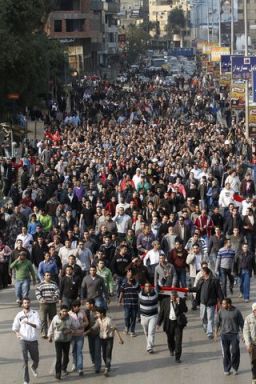
(Photo: Egyptian demonstrators protest near Egyptian police to demand the ouster of President Hosni Mubarak and calling for reforms on January 25, 2011. The protesters, carrying flags and chanting slogans against the government, rallied in a protest inspired by the uprising in Tunisia which led to the ouster of Zine El Abidine Ben Ali. By Mohammed Abed/AFP/Getty Images)

Why Egypt Isn’t Tunisia

by Patrick Appel

Shadi Hamid sized up the America's dilemma earlier today:

Tunisia, as far as U.S. interests are concerned, was expendable. The revolt was spontaneous and leaderless. Islamists – mostly in prison or in London – were nowhere to be seen on the streets of Tunis or Sidi Bouzid. But if Egypt is lost, it will be lost to an uprising that includes some of the most anti-American opposition groups in the region, including the Muslim Brotherhood – by far the largest opposition force in the country.

The U.S. is – at least in the short term – stuck.

For those reasons, Allahpundit isn't cheering for the opposition:

Remember, Tunisia’s uprising was big news not only because it’s an unprecedented case of an Arab populace removing its own tyrant but because, at least in theory, Tunisians are well positioned to form something resembling an Arab liberal democracy. The public is well educated, women have equal rights, and Islamists don’t have a foothold (yet?) thanks to the since-departed dictator’s crackdown on opposition elements. In Egypt, by contrast, the Muslim Brotherhood has been a major opposition movement for decades, pushing democracy as a means to their end of installing an Islamist government, rescinding the country’s treaty with Israel, and unleashing whatever plans it has for the country’s huge Coptic Christian population. Needless to say, if you think Hamas’s election win in Gaza a few years ago was a big deal to Muslim fundies, imagine the encouragement they’d get from watching Mubarak replaced by the Ikhwan.

Egypt In Motion

by Patrick Appel

Lynch is hopeful that the protests in Egypt are part of a larger wave:

It is too soon to know how much impact these protests will have in the short term, given that protests are not novel in Egypt and there has long been a much freer and more contentious media than in Tunisia. Like many people, I have been skeptical about the ability of the Egyptian opposition to overcome their internal divisions or a well-prepared regime focused intensely on not becoming the next Ben Ali. We've watched wave after wave of protest be crushed by the Egyptian regime. But I'm certainly hoping that this time they can capture momentum and change the game in Egypt. There seems to be a renewed energy and sense of possibility, one which is clearly being understood by Egyptians as part of a broader Arab narrative of a collective popular uprising against economic conditions, political repression, and corruption.

More broadly, it's astonishing how much is now in motion in Arab politics after such a long period of seeming stagnation. There's a vivid sense of an era coming to a close and an uncertain new vista opening.

Social Networking Strikes Again, Ctd

by Chris Bodenner

Gordon Reynolds narrates a riveting account of his role – and that of Twitter – in today's protests:

There had been tweets that protests would be staged in Tahrir Square and in the downtown neighborhood of Mohandeseen. These tweets were received by Egyptian authorities monitoring the hashtag #jan25, and they deployed a massive security 108307120 presence to deter any demonstrations. Officers stood in groups of 6 to 8, on nearly every street corner. They blockaded the entrance to the parliament building. The teams stood quietly with folded arms watching the empty streets as the sun rose over the Nile. …Not a demonstrator was in sight, and sensing this protest had ended before would begin, I went home.

When I arrived, the Twitter hash #jan25 lit up. Someone said that earlier tweets had been deliberately planted as decoys to mislead authorities. Now, in dozens of real locations throughout the city, protesters had begun to mobilize. I ran out the door and took the subway back to Tahrir Square.

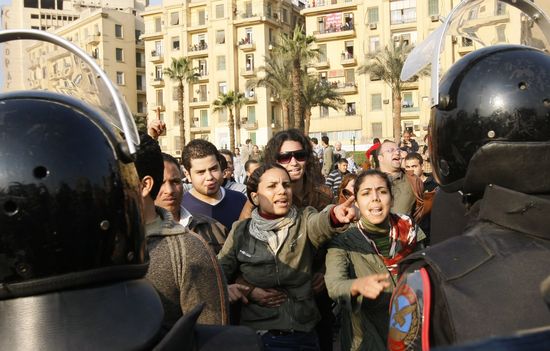
When I arrived, the protest had begun. In the street a group of close to 200 Egyptians, mostly men, were standing, chanting and waving flags. Blocking both sides of the street were lines of police in riot gear. Immediately surrounding them, outnumbering the protesters, were older Egyptian men and young women.

Continued here. Photo by Mohammed Abed/AFP/Getty Images.

Physical Health Break Update

Just a note of deep regret I won't be able to live-blog the SOTU tonight. I haven't missed one here for years, but what are you going to do? It's just a severe mix of asthma and bronchitis and some unexpected medication side-effects that also affected my lungs, making everything worse. The docs want total bedrest and no work until I'm better.

I know it's weird telling total strangers about your health but that's the price of being a 24/7 blogger. I have nowhere to hide when I get sick. So apologies for TMI. But it's nothing that serious and I'll be back as soon as I'm able to breathe right. Meanwhile, the Dish is in the ablest hands. See you soon and many many thanks for the many kind emails. — Andrew

Al Jazeera AWOL

by Chris Bodenner

Marc Lynch scratches his head over the network's slow response to today's historic protests in Egypt:

Al Jazeera has played a vital, instrumental role in framing this popular narrative by its intense, innovative coverage of Tunisia and its explicit broadening of that experience to the region. Its coverage today has been frankly baffling, though. During the key period when the protests were picking up steam, Al Jazeera aired a documentary cultural program on a very nice seeming Egyptian novelist and musical groups, and then to sports. Now (10:30am EST) it is finally covering the protests in depth, but its early lack of coverage may hurt its credibility. I can't remember another case of Al Jazeera simply punting on a major story in a political space which it has owned.

Some speculation from Angry Arab:

Many Egyptians are furious that Aljazeera has not been covering the massive protests in Egypt today. Explanation?  Mubarak visited Emir of Qatar last month and basically reached an agreement to reduce Aljazeera's critical coverage of Egypt and Mubarak's tyranny.

Tunisia Still Smoldering

by Chris Bodenner

A key cluster of updates from Enduring America:

1610 GMT: The Anonymous collective has knocked the website of Egypt's Ministry of Interior off-line.

1600 GMT: A fireman in Oum El Bouaghi in eastern Algeria has tried to commit suicide by pouring lighter fuel on himself and setting it on fire. He is in stable condition in hospital. On 16 January, a civil protection officer attempted self-immolation in the same barracks.

1555 GMT: Lest we forget, given all the excitement in Egypt, there is still a volatile situation in Tunisia…. Hundreds of protesters in Tunisia continued to demonstrate outside Prime Minister Mohamed Ghannouchi's office today, maintaining the pressure to force out Cabinet members linked to the former ruling party RCD.

Scott Lucas captions the above video:

General Rachid Ammar, the head of Tunisia's Army, speaks on Monday to protesters in Tunis (see updates and analysis for details)