by Patrick Appel
Balko flags a trailer for a documentary on wrongful imprisonment:
MISSISSIPPI INNOCENCE – Trailer from Joe York on Vimeo.
by Patrick Appel
Balko flags a trailer for a documentary on wrongful imprisonment:
MISSISSIPPI INNOCENCE – Trailer from Joe York on Vimeo.
by Patrick Appel
Leslie Gelb fears the Muslim Brotherhood:
The [Muslim Brotherhood (MB)] supports Hamas and other terrorist groups, makes friendly noises to Iranian dictators and torturers, would be uncertain landlords of the critical Suez Canal, and opposes the Egyptian-Israeli agreement of 1979, widely regarded as the foundation of peace in the Mideast. Above all, the MB would endanger counterterrorism efforts in the region and worldwide. That is a very big deal.
Goldblog, as Chris noted earlier, is less skittish:
The Muslim Brotherhood might not end up in power; just as in Pakistan, the Islamists in Egypt represent only a minority of citizens. Which is not to say that the Brotherhood couldn't wind up in power, but it's too early to call the rise of the Brotherhood inevitable. If the Brothers do end up in power, then the Israeli-Egyptian peace treaty, which is responsible for 30 years of stability in the eastern Mediterranean, would be in mortal danger, but even if Egypt were to break relations with Israel, this does not mean that war would necessarily follow. And what is more likely is that the Egyptian Army continues to play an important and stabilizing role, and the Egyptian Army, of course, depends on the United States for much of its budget, and it does not want to lose access to American-made weapons systems, which is what might happen if Egypt were to abrogate the peace treaty.
by Patrick Appel
Contrary to persistent rumors, a new statement:
Claims are circulating, citing Al Jazeera and Al Arabiya, that the Egyptian military has issued a statement saying it recognises protesters' demands as "legitimate" and it will not shoot upon protesters.
The Guardian warns:
As always it's worth taking this sort of news with a large pinch of salt. And wait and see what actually happens.
Along the same lines, Max Fisher relays Ashraf Khalil's worries:
Even on Friday evening, when army tanks first deployed in the streets of Cairo, there were already scattered signs of friction. That night, I witnessed protesters openly berating and shoving soldiers — who once again showed impressive patience. A few protesters behaved so aggressively toward the soldiers, without achieving a reaction, that I could only conclude the soldiers were under direct orders not to retaliate. But the longer the military is deployed in the streets, surrounded by hothead protesters, the greater the chances of the situation spiraling out of control.
by Patrick Appel
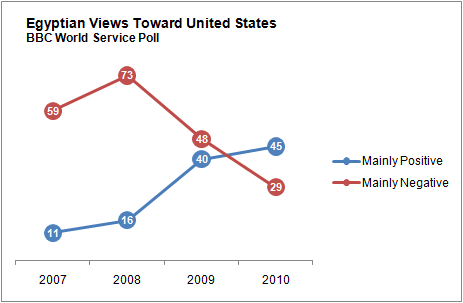
From Nate Silver:
Egyptian popular opinion toward the United States has substantially improved over the course of the past 2 to 3 years, to the point that a new leader would probably not gain any points by expressing anti-American sentiment.
Also of note:
Who doesn’t the Egyptian public like? Israel. In the 2010 poll, just 3 percent of Egyptians had a positive opinion about it versus 92 percent unfavorable; these were the worst grades for Israel of any country included in the survey.
by Conor Friedersdorf
Earnest as many Tea Partiers are in wanting a smaller, less intrusive government, it's going to be difficult to take their movement seriously if they keep insisting that the Republican Party is the only choice for liberty-minded individuals, as this CNET story shows:
The House Republicans’ first major technology initiative is about to be unveiled: a push to force Internet companies to keep track of what their users are doing. A House panel chaired by Rep. F. James Sensenbrenner of Wisconsin is scheduled to hold a hearing tomorrow morning to discuss forcing Internet providers, and perhaps Web companies as well, to store records of their users’ activities for later review by police.
One focus will be on reviving a dormant proposal for data retention that would require companies to store Internet Protocol (IP) addresses for two years, CNET has learned. Tomorrow’s data retention hearing is juxtaposed against the recent trend to protect Internet users’ privacy by storing less data. Last month, the Federal Trade Commission called for “limited retention” of user data on privacy grounds, and in the last 24 hours, both Mozilla and Google have announced do-not-track technology.
Via Glenn Reynolds, who notes, "They call it the stupid party for a reason." With President Obama continuing his awful record on civil liberties – without much objection from elected Democratic officials – and the GOP reminding us why liberty-minded people loathed their prior stint running Congress, there's basically nowhere left for libertarians to turn. I don't begrudge anyone for thinking they're better off aligning with the Republicans or the Democrats. But I can't stand folks who pretend that advocates of overweening government are all on one side, or that the right thing to do at the ballot box is obvious.
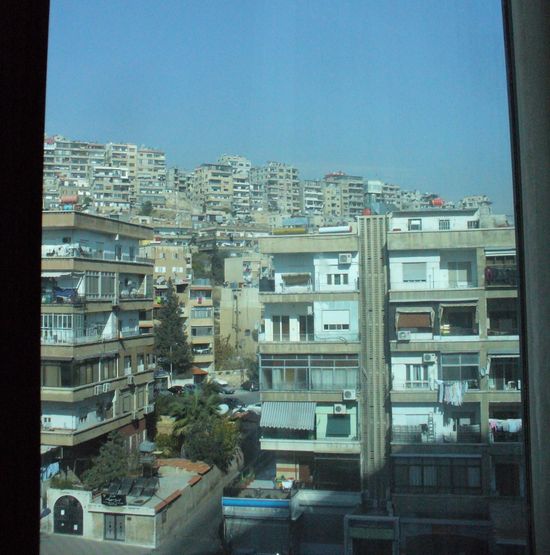
Damascus, Syria, 7 am
by Zoe Pollock
Joe Klein argues if not for Egypt this story would be front-page news. He summarizes:
The losses at Kabul Bank, first reported to be several hundred million in the Times last summer, are actually in the neighborhood of $900 million. Apparently, the bank directors–perhaps including Hamid Karzai's brother Mahmoud–took a substantial portion of the assets, leveraged them and invested in Dubai real estate, which promptly crashed. The Afghan government does most of its business through Kabul Bank; if it fails, the government won't be able to pay its civil servants–and a fair amount of international aid, deposited in the bank, may be washed out as well.
The question now is: bail out Kabul Bank or let the Karzai government collapse? The answer, I think, is bail out Kabul Bank, but only if Karzai steps aside in favor of Abdullah Abdullah, who finished second in the rigged presidential election–or a respected technocrat like Ashraf Ghani, who could lead a caretaker government until new elections are held.
Dexter Filkins has the full story:
Nine years into the American-led war, it’s no longer enough to say that corruption permeates the Afghan state. Corruption, by and large, is the Afghan state. On many days, it appears to exist for no other purpose than to enrich itself. Graft infests nearly every interaction between the Afghan state and its citizens, from the police officers who demand afghani notes to let cars pass through checkpoints to the members of Karzai’s government who were given land in the once empty quarter of Sherpur, now a neighborhood of grandiose splendor, where homes sell for hundreds of thousands of dollars. Bribes feed bribes: if an Afghan aspires to be a district police officer, he must often pay a significant amount, around fifty thousand dollars, to his boss, who is often the provincial police chief. He needs to earn back the money; hence the shakedown of ordinary Afghans. In this way, the Afghan government does not so much serve the people as it preys on them.
by Chris Bodenner
A reader writes:
I was in a bike crash last summer that put me face-first into the pavement at 20 mph. I lost four teeth, broke my neck and that little bone in my throat (the hyoid), and nearly had my lower lip ripped off. I could have been killed or paralyzed, but wasn't, and recovered well. The hospital bill was in excess of $35k and included emergency facial surgery, where my lip was sewn back onto the base of my gums and asphalt fragments were scraped out of my lower jaw (yikes, that was the worst!). My insurance paid 90% of it, since I have a solid benefits plan through my well-funded startup company.
Now there was the matter of those four teeth.
I first had to wait until the swelling went down, the sutures were removed, and my gums were healed. Then one of my several dentists cut into the scarred gum tissue, applied a bone graft, and put more sutures in the same tissue. As you might guess, my dental insurance (Delta Dental) will hardly cover anything – about 10% of an amount nearly the same as my hospital bill. I only get that much because my care will span two years, so I can claim the annual maximum coverage twice.
My story is about a single accident, not a disease of the teeth or gums that might have wider implications for health. It's about essentially the same small area of flesh and bone being cut into by two sets of doctors, one of whose costs can be insured against and another whose have to be borne directly. According to one of my several dentists, it's basically pointless to argue with a health insurer about a case like mine. Whether they paid for those first sutures in my broken face or not, if teeth are involved, the second set of sutures are not insured. He's heard of only one patient winning partial reimbursement from a health insurer, after years of trying.
I'm lucky: I had good insurance, a good job, a supportive family. But not having an option for catastrophic dental coverage wiped out my savings. If I were unlucky, it could have completely thrown my life off course.
by Chris Bodenner
He updated us last night.
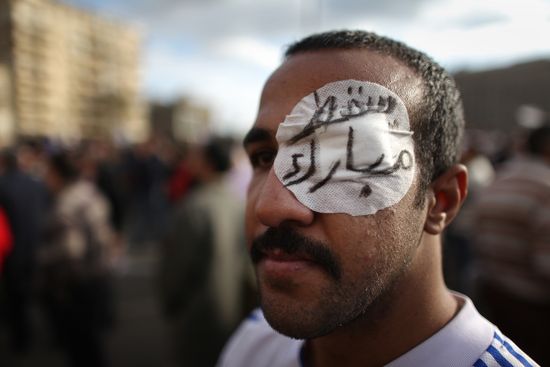
A protestor with an eye bandage saying 'Go Mubarak' in Arabic stands in Tahrir Square on January 31, 2011 in Cairo, Egypt. By Peter Macdiarmid/Getty Images.
 The Dish