Government Via Bloomberg L.P.

by Zoe Pollock

John H. Richardson investigates the political implications of a man like Bloomberg:

He's talking about his latest push to improve the habits of New Yorkers, this time by making it illegal to buy sugary drinks with food stamps. If passed, this rule will join the rule about no smoking in restaurants and bars and the rule about requiring that homeless people have saving accounts if they want to stay in city shelters and the rule about — this is a man who spent half his autobiography listing his rules for conducting business and donating to charity with barely a page left over for his wife and children.

He seems happiest when he runs through the data — more than 50 percent of adults are overweight, 40 percent of children, 6 percent of food stamps go to sugary drinks, $75 to $135 million is wasted, obesity-related illnesses cost $770 a year per New York household, poor adults get diabetes at twice the rate of the wealthy. There is strength in numbers, and he is strong. He's Bloomberg the man and also Bloomberg L.P., the limited-liability partnership that made him a billionaire. He will fix things if we let him. "Let's try it for a period of two years. We'll measure the results and see if it works." …

Mike Bloomberg has become important because he represents a great American dream, not the one about owning a home or becoming more successful than your father but the one beneath all of those, the foundational American dream — the dream of freedom from politics.

Freedom from the ugliness and corruption and compromise of democracy, with its raised voices and perpetual fights over who is more equal than the others. Bloomberg is the ultimate independent, the calm modern technocrat rooted in metrics and cleansed of ideology, come to drain the swamps of government with his amazing modern business-management techniques … unless he's actually just an old-fashioned autocrat looking down on us from above and tinkering with our lives like a science experiment, stripping our noisy polis of all its native poetry. Unless the messiness we want to get rid of is actually our soul.

Affirmation In Tens And Twenties

EscortGetty

by Patrick Appel

Charlotte Shane, the pen name of a prostitute and blogger, writes a letter to the girls who envy her life. She insists that "envying someone for prostituting is like envying someone for eating at McDonald's" because there "are no bars to entry":

There's something profoundly human about wanting to be sexually valued, and it transcends genders. More than one young man has told me he envies my life, too. I suspect these young men are hinting at the same longing for affirmation as the young women who e-mail me. We all want to know that we matter, and being paid is one way of knowing we have value. It may be inelegant and often impersonal, but because money is quantifiable, its message is indisputable. Where do you go for reassurance if you doubt your physical and sexual desirability? Talk is cheap, so you take cash instead.

Her blog is worth a read.

(Photo: Nikki, a teenage prostitute, waits for customers in the red light area of Bradford, England on May 27, 2010. By Christopher Furlong/Getty Images)

Fake Facebooks; Real China

by Zoe Pollock

April Rabkin gets the 411 on China's social networks:

Sites like Renren and Kaixin001 are microcosms of today's changing China — they copy from the West, but then adjust, add, and, yes, even innovate at a world-class level, ultimately creating something unquestionably modern and distinctly Chinese. It would not be too grand to say that these social networks both enable and reflect profound generational changes, especially among Chinese born in the 1980s and 1990s. In a society where the collective has long been emphasized over the individual, first thanks to Confucian values and then because of communism, these sites have created fundamentally new platforms for self-expression. They allow for nonconformity and for opportunities to speak freely that would be unusual, if not impossible, offline. In fact, these platforms might even be the basis for a new culture. "A good culture is about equality, acceptance, and affection," says Han Taiyang, 19, a psychology major at Tsinghua University who uses Renren constantly. "Traditional thinking restrains one's fundamental personality. One must escape."

Put another way, a lot of people in China have needs — and one of them is a place to be whoever they want to be.

Rush Limbaugh, Birther?

by Conor Friedersdorf

It's come to this:

Do you think if this was me and they were trying to prove that I wasn't an American and I insisted that I was, but I couldn't produce a birth certificate or wouldn't, and yet the governor of Missouri says, "Oh, yeah, there's a little notification, somebody wrote down Limbaugh was born here."  Do you think that would fly?

After a long segment speculating about whether Obama is actually a foreigner, or engaged in an elaborate conspiracy to head fake the right, Limbaugh takes a call:

CALLER:  It's a pleasure to speak to you.  The reason I was calling, I was listening to the program earlier, and I heard you say something about something doesn't smell right with this whole birth certificate business in Hawaii.

RUSH:  Right, it doesn't, because the director of health out there says he's seen the birth certificate.  The governor says he wants to release it but he can't find it.  Now, something's not anywhere near right here.

CALLER:  Well, I'm sure that Obama and the left would like nothing more than to get talk radio, you and Hannity and Beck and all the rest, talking about all this stuff going on in Hawaii, sounding like a bunch of birthers, and then come back and attempt to discredit you, as if they could, just before the election —

RUSH:  Yeah, I know.

CALLER:  — and say you're just a bunch of nut bags out there complaining and whining and all the rest.

That sums it up, doesn't it? A bunch of nut bags whining and complaining. Even the callers are starting to catch on.

“Bad Medicine”

by Patrick Appel

Last week PZ Myers responded to the crimes of Dr. Kermit Gosnell. Myers dismissed the "triumphant mail from anti-choice people claiming vindication":

Gosnell is precisely the kind of butcher the pro-choice movement opposes. No one endorses bad medicine and unrestricted, unregulated, cowboy surgery like Gosnell practiced — what he represents is the kind of back-alley deadly hackery that the anti-choice movement would have as the only possible recourse, if they had their way. If anything, the Gosnell case is an argument for legal abortion.

Michelle Goldberg is in the same ballpark:

While Gosnell’s clinic was an anomaly, it wasn’t entirely unique; the stigma and secrecy around abortion has long attracted the occasional criminal to the field. In her book Dispatches From the Abortion Wars, the sociologist Carole Joffe wrote about what she called “rogue clinics.” “These clinics—or in some cases individual doctors—typically prey on women in low-income immigrant communities.” She described a case in 2008 in which two sisters, Berta and Raquel Bugarin, were arrested for practicing medicine without a license at a string of clinics in Southern California and sued for causing injury and wrongful death. “That such clinics can flourish until the inevitable disaster occurs strikes me as a ‘perfect storm’ caused by the marginalization of abortion care from mainstream medicine, the lack of universal health care in the United States, and the particular difficulties facing undocumented immigrants in obtaining health care in the United States,” she wrote.

Rachael Larimore pushes back against pro-choice blogger Amanda Marcotte who claims that "shady abortion providers [getting] patients at all is something we can safely blame the anti-choice movement for": 

I’m sorry, but blaming the pro-life movement for Kermit Gonsell makes about as much sense as blaming the Tea Party for Jared Loughner.  If there were only more abortion clinics (how many would be enough? Should they be as ubiquitous as Starbucks?); if only it weren’t for that nasty Hyde Amendment (because it’s fair that families who face a heartbreaking struggle to conceive or spend tens of thousands of dollars to adopt should also have to have their tax dollars paying for someone else to have an abortion?).

I'm pro-choice for libertarian reasons but, on a personal level, I find abortion a moral gray area highly dependent on specific circumstances – a position supported by the Dish's "It's So Personal" series. Even though I think abortion should be legal, blaming a rogue abortion doctor on the pro-life movement deeply unsettles me.

Pre-Writing Giffords’ Miracle Recovery

Giffordsflowersgetty

by Zoe Pollock

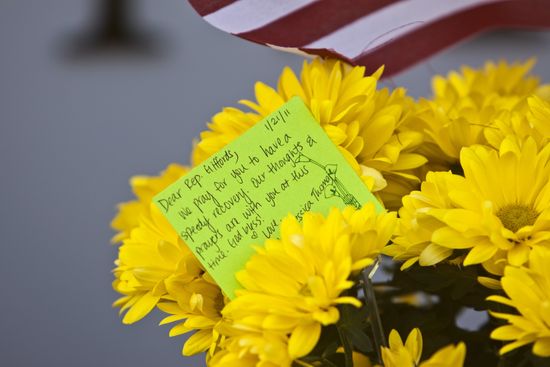
Chris Rovzar urges caution in the media's coverage:

 In the absence of up-to-date images, we've been treated to the same stock images of Giffords's perky, smiling face … Even with the proper preparation, seeing what she looks like even halfway through her rehab could come as a shock.

It is still very possible that Gabrielle Giffords will make a full recovery. She has the support of family, colleagues, and a now-enraptured American public. But it would be an additional, needless tragedy if the breathless coverage of her rehabilitation eventually turned sour, or if the inevitable setbacks and delays made her already amazing recovery seem any less like a miracle. Hopefully, in rehab, she'll be able to recover away from the scrutiny of the 24-hour news cycle, and when she does emerge, we will still be surprised by something wonderful.

(Photo:  A handwritten note sits in flowers outside the Texas Institute of Rehabilitation and Research for their newest patient U.S. Rep. Gabriel Giffords (D-AZ) on January 21, 2011 in Houston, Texas. By Eric Kayne/Getty Images)

Shallower Than They Need To Be

by Conor Friedersdorf

In the middle of this deeply weird David Brooks piece – I say that as someone who is very much a fan of the man's work – we get a wonderfully insightful paragraph:

Many members of this class, like many Americans generally, have a vague sense that their lives have been distorted by a giant cultural bias. They live in a society that prizes the development of career skills but is inarticulate when it comes to the things that matter most. The young achievers are tutored in every soccer technique and calculus problem, but when it comes to their most important decisions—whom to marry and whom to befriend, what to love and what to despise—they are on their own. Nor, for all their striving, do they understand the qualities that lead to the highest achievement. Intelligence, academic performance, and prestigious schools don’t correlate well with fulfillment, or even with outstanding accomplishment. The traits that do make a difference are poorly understood, and can’t be taught in a classroom, no matter what the tuition: the ability to understand and inspire people; to read situations and discern the underlying patterns; to build trusting relationships; to recognize and correct one’s shortcomings; to imagine alternate futures. In short, these achievers have a sense that they are shallower than they need to be.

If I might gently critique the balance of the piece: there is limited utility in taking the wealthiest one percent of the population, identifying a particular subculture within that class, and generalizing at length about it. A keen eye is best used elsewhere.

That brings me to the piece I'd like to see David Brooks write. Here's the pitch: "Rebelling Against The Organization." A followup to The Organization Kid in which the author spends time with and writes about twentysomethings who had within their grasp everything the organization kid is taught to seek… and chose to do something different. What led them to unexpectedly jump on that bus? How many of these kids wound up disappointed? Among the happy ones, what did they do right? How did their friends in the meritocratic elite respond?

Does Facebook Have An Obligation To Political Activists?

Zuckerberg_sign-thumb-600x429-40780

by Zoe Pollock

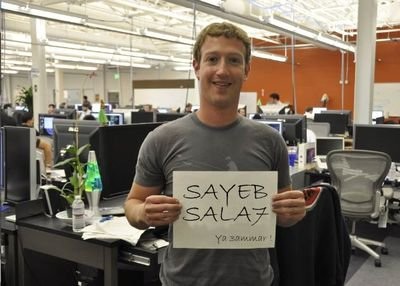
Alexis gets the inside scoop on how the Jasmine Revolution was aided by Facebook, and seriously compromised when the country's Internet service providers ran "a malicious piece of code that was recording users' login information when they went to sites like Facebook." Alexis spoke with Facebook's Chief Security Officer Joe Sullivan about their fix and the larger implications:

"We get requests all the time in a few different contexts where people would like to impersonate someone else. Police wanting to go undercover or human rights activists, say," Sullivan said. "And we, just based on our core mission and core product, don't want to allow that. That's just not what Facebook is. Facebook is a place where people connect with real people in their lives using their real identities." …

Facebook certainly [doesn't] seem to be under any obligations to provide special treatment. But if Facebook really is becoming the public sphere — and wants to remain central to people's real sociopolitically embedded lives — maybe they're going to have to think beyond the situational technical fix. Facebook needs to own its position as a part of The Way the World Works and provide protections for political speech and actors.

(Photo from July 2010, when "bloggers Photoshopped a picture of Mark Zuckerberg to show him holding up a sign that read, "Sayeb Sala7, ya 3ammar," the slogan for a freedom of expression campaign late in 2010.")