Is Obamacare Here To Stay?

by Conor Friedersdorf

That's a subject of disagreement on the right. Here's Matt Continetti:

Now, one chamber of Congress has voted for repeal, more than half the states are challenging the constitutionality of Obamacare’s individual health insurance mandate, and the law remains unpopular. Health care spending and premiums continue to rise, and the president’s claim that the law allows you to keep your health plan has been proven false. Can somebody remind us why the law’s supporters continue to think they have the winning hand?

The truth is that if Republicans in the 112th Congress spent the next two years doing nothing but debating the health care law, beginning to dismantle it, and offering alternatives, they would have real momentum heading into the 2012 election.

And here's Reihan Salam:

Realistically, it is hard to see PPACA vanishing from the face of the earth. This means that Republicans and Democrats will have to work to fix the subsidy regime, to replace community rating with a cheaper form of risk adjustment, and return to the drawing board on Medicaid. The one silver lining is that PPACA did secure a notional commitment to reducing Medicare expenditures, though it didn't provide a reliable mechanism for doing so. An optimist could say that while the last Congress did a great deal of damage, it did take a serious political hit that might make it easier for future legislators to put Medicare on a sustainable footing.

I continue to be skeptical that Obamacare will significantly improve our health care system, and ambivalent about whether we get where we need to be via "repeal and replace" or amendment. I know a lot of Daily Dish readers supported the president's bill, and I'm glad it expands access to insurance and ends recission. But I just don't see how it fixes many of the problems discussed here, here, here and here. If you take a look at those links – and whatever your take on health care, they're all exceptional pieces of journalism – you'll get a good sense of what I'd do differently. Also recommended: this piece on end of life care by Atul Gawade. That is the conversation we ought to be having, not this nonsense about "death panels."
Teach Like A Novice

by Zoe Pollock

Ed Yong gleans a larger lesson about teaching from a new study by Elizabeth Bonawitz:

Through two experiments with pre-schoolers, Bonawitz has found that teaching can be a “double-edge sword”. When teachers provided specific instructions about a new toy, children learned how to play with it more efficiently. But the lessons also curtailed their exploratory streak. They were less likely to play with the toy in new ways. Ultimately, they failed to find all of its secrets. …

Context clearly matters. When the apparently knowledgeable teachers in the experiments provide a seemingly complete lesson about the toy, the children deduce that there is no more to learn. If the lesson is interrupted, or if the instructor seems like a novice, the child deduces that there is more to discover. Bonawitz thinks that these abilities start from a very early age, when children are still in pre-school or kindergarten.

An Obama Speech From A Bush Speechwriter

by Patrick Appel

As an exercise, David Frum wrote an imaginary SOTU speech for Obama. One strong passage:

When my administration arrived in office in January 2009, we confronted the worst economic collapse since the 1930s. We did our best to estimate the depth of the crisis ahead. We got it wrong. As bad as we thought the recession would be, it was worse. We prepared for a fifty-year flood. We got a hundred-year flood. We thought our measures would cap unemployment at about 8 percent. Despite our measures, unemployment has reached almost 10 percent. Unemployment remains almost 10 percent.

The economists tell us that the recovery measures instituted by this administration have achieved dramatic results. Two of America's most esteemed researchers — one an advisor to John McCain's presidential campaign, the other formerly a top advisor to President Clinton — have crunched the numbers. They agree that our recovery plan stopped the free fall in the U. S. economy, saved the world from a new Great Depression, and added 2.7 million new jobs.

These are powerfully positive results. But not positive enough. So we need to do more — and we need Congress to join with this administration as partners in the all-important mission of economic recovery.

Reasonable Torture Doesn’t Exist

Agabuse

by Zoe Pollock

Scott Horton interviewed father and son Charles and Gregory Fried about their book, Because It Is Wrong—Torture, Privacy and Presidential Power in the Age of Terror. Horton asked why they paired torture with privacy and surveillance:

[After 9/11] the general public, and even the informed public, reacted as if both transgressions were equally serious and equally deserving of condemnation. Indeed, there may have been a markedly greater tolerance of torture than of surveillance—maybe because few of us expect to undergo torture, but all feel our phones or Internet may be tapped into. This gets things exactly wrong. It is morally obtuse, an example of law fetishism, to equate the two just because they are both illegal. Torture is illegal because it is wrong and electronic surveillance is wrong—when it is—because it is illegal.

“If You Don’t Have It, Flaunt It”

by Zoe Pollock

Roger Ebert receives a prosthetic chin and comes to terms with his lack of a real one:

I will wear the prosthesis on the new television show. That's not to fool anyone, because my appearance is widely known. It will be used in a medium shot of me working in my office, and will be a pleasant reminder of the person I was for 64 years. …

At the beginning of this process I assumed I would wear the new prosthesis whenever I left the house, so that "nobody would know." But everybody knows. The photograph of me that appeared in Esquire even found its way onto billboards in China. And something else has happened since that day in the hospital: I accept the way I look. Lord knows I paid the dues.

Your Friends Are Probably More Popular Than You

by Patrick Appel

The reason why:

There doesn’t seem to be any obvious reason to suppose this is true, but it probably is. We are all more likely to become friends with someone who has a lot of friends than we are to befriend someone with few friends. It’s not that we avoid those with few friends; rather it’s more probable that we will be among a popular person’s friends simply because he or she has a larger number of them.

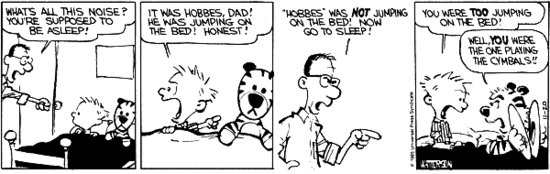
I Am Jack’s Stuffed Tiger, Ctd

19851120

by Chris Bodenner

A reader writes:

I thought since you were on the subject you might want to hear the interpretation out of the mouth of God himself, Bill Watterson.  From "The Calvin and Hobbes Tenth Anniversary Book":

The so called 'gimmick' of my strip–the two versions of Hobbes–is sometimes misunderstood. I don't think of Hobbes as a doll that miraculously comes to life when Calvin's around. Neither do I think of Hobbes as the product of Calvin's imagination.  The nature of Hobbes' reality doesn't interest me, and each story goes out of its way to avoid resolving the issue. Calvin sees Hobbes one way, and everyone else sees Hobbes another way. I show two versions of reality, and each makes complete sense to the participant who sees it. I think that's how life works. None of us sees the world in exactly the same way, and I just draw that literally in the strip. Hobbes is more about the subjective nature of reality than about dolls coming to life.

Last year Watterson gave his first interview in 15 years to the Cleveland Plain Dealer. Money quote:

It's always better to leave the party early. If I had rolled along with the strip's popularity and repeated myself for another five, 10 or 20 years, the people now "grieving" for "Calvin and Hobbes" would be wishing me dead and cursing newspapers for running tedious, ancient strips like mine instead of acquiring fresher, livelier talent. And I'd be agreeing with them.

Palin Turns Texas Purple

by Patrick Appel

2012 polls are fairly meaningless at this point in the cycle, but this is still remarkable:

There are vast differences in how the various different potential GOP contenders fare against Barack Obama in Texas. Mike Huckabee is very popular in the state and would defeat Obama by 16 points, a more lopsided victory than John McCain had there in 2008. Mitt Romney is also pretty well liked and has a 7 point advantage over the President in an early hypothetical contest, a closer margin than the state had last time around but still a pretty healthy lead. A plurality of voters have an unfavorable opinion of Newt Gingrich but he would lead Obama by a 5 point margin nonetheless. It's a whole different story with Palin though. A majority of Texas voters have an unfavorable opinion of her and she leads the President by just a single point in a hypothetical contest.

Freezing The Press

by Chris Bodenner

A troubling sign out of Tunisia:

Tunisia’s interim government abruptly shut down the country’s oldest and most popular private television network on Sunday evening, in an apparent violation of its pledges to respect freedom of expression after the ouster of the authoritarian president Zine el-Abidine Ben Ali.

But the Hannibal network, founded about five years ago, was better known for conflict than coziness with the former government, losing certain soccer broadcast rights to state television or the right to broadcast a talk show too similar to one on state television. And since Mr. Ben Ali’s ouster, its news and political program has hardly celebrated the former president, but rather echoed the widespread calls to eradicate the old ruling party from the interim government.

Physical Health Break

I've been battling a brutal bout of bronchitis for some time now, and I'm finally going to have to take a day or so of total bedrest to get the better of it. I'll do all I can to live-blog the SOTU Tuesday night, but Patrick, Chris, Zoe and Conor will be holding down the fort until then. Apologies. But working with the pair of lungs I've got right now isn't terribly wise at this point. — Andrew.