Iran’s Cultural Memory

Abbas Milani recounts the resilient cultural history of Iran:

More than once in Iran’s history, after the country was vanquished by outsiders—from Arabs to Mongols—the culture of the conquered survived and eventually molded the customs of the victors to its own pattern. It is hard to imagine that the 1979 revolution will be an exception to this enduring reality. …

In Tehran alone, 3 million people marched in remarkable discipline to demand their democratic rights. Their slogan pithily captured in a mere four words the hundred-year-old dream of modernity and democracy in Iran. Using thugs and guns, prison and torture, the ayatollah has so far succeeded in intimidating the people back into their homes. But a critical look at the past shows the bleak future of Khamenei and other champions of despotism. Violence can only delay but not destroy the rights of man in a nation that has embraced the cultural ethos of modernity. The hushed, brutalized quiet of today is at best a prelude to the liberating storms of tomorrow.
When Seeing Isn’t Believing

Robert Krulwich marvels at the visual tricks of Kokichi Sugihara:

Sugihara uses no editing tricks. His props are cardboard and glue, no special effects. All he does is find the precise angle where our brain assumes an impossible act. In this case, he chooses the angle that makes down-sloping planes look like up-sloping planes. Then he changes the angle and you see how he did it. (Or more correctly, how you did it.)

The Poppy Problem

Robert Draper reports on Afghanistan's drug trade:

"We have two forms of money here: poppy, and American dollars," says a beardless 33-year-old Helmand farmer named Rehmatou as he leaves the Marine base with his fertilizer. "This is our economy. The Taliban aren't pressuring me—that's just a story you see on TV. I grow for myself. I smuggle for myself. The Taliban are not the reason. Poverty is the reason. And they'll keep growing poppies here—unless they're forced not to. Force is the solution for everything. As we say in Pashtu, 'Power can flatten mountains.'

Mental Supermen

Dan Ariely wonders why we accept our physical limitations but don't want to account for our cognitive ones:

Imagine that you’re in charge of designing highways, and you plan them under the assumption that all people drive perfectly. What would such rational road designs look like? Certainly, there would be no paved margins on the side of the road. Why would we lay concrete and asphalt on a part of the road where no one is supposed to drive on? Second, we would not have cut lines on the side of the road that make a brrrrrr sound when you drive over them, because all people are expected to drive perfectly straight down the middle of the lane. …

What I find amazing is that when it comes to designing the mental and cognitive realm, we somehow assume that human beings are without bounds. 

Our Inherent Brokenness

Spurred by a Michael Kinsley column, Douthat mulls our fallen nature:

However wrongheaded you believe your ideological opponents to be, laying “all that ails the world” at their feet represents an absurd politicization of human affairs, and a spur to the most self-deluding sort of utopianism. After all, what ultimately ails the world is its inherent imperfectibility — its fallen character, if you’re a Christian; its irreducible complexity and tendency toward entropy and dissolution, if you’re a strict materialist.

This is true on all the great issues of the day. No matter how many lives may be saved or lost because of health care policy, no lives will be saved forever, and every gain will be an infinitely modest hedge against the wasting power of disease and death. No matter the wisdom of our politicians or the sagacity of their economic advisors, no policy course can guarantee universal wealth or permanent economic growth. And no matter the temperature of our discourse, the state of our gun laws, or the quality of our mental health care, nothing human beings do can prevent the occasional madman from shooting up a crowded parking lot.

“And They Call This Coexistence”

Ferrah Merali shines a light on Palestinian rap:

Rap in Israel-Palestine is its own animal, tied up in all the complexities of the region’s larger conflict—including, for example, discrimination against Palestinians from Arab countries. The Middle East’s Arab nations have historically been loath to allow Palestinians to settle on their soil, in an effort to force Israel to recognize the refugees’ right of return to their ancestral lands. Arab-Israeli artists complain of another prejudice: Middle Eastern record companies won’t sign them because they hold blue Israeli identity cards and passports.

“Living in occupied Palestine, having the blue ID, we feel like we don’t have an identity,” says Safa Hathoot of Arapiat, the first all-woman Palestinian hip hop act. “Here in Israel people treat us like a Palestinian, and outside Israel, they treat us as Israeli.”

Happy Characters Are Real Too

Brett McCracken praises Mike Leigh's new film, Another Year:

We live in a time when “authenticity” is equated with those things or those people who are forthright in their brokenness and messiness, while stable, happy people are sometimes looked upon with skepticism, as if their lack of apparent problems makes them phony or untrustworthy. Our jadedness leads us to a sort of self-reinforcing stasis of raw brokenness, because this is what we believe. This is what we know. But what we really need are models of goodness & virtue in our lives… figures of hope who can motivate us out of the cycle of dreary cynicism.

Another Year offers a great example of such people–a happily married, flourishing couple who love people in need but don’t pander to them. They stand firm in their principles without condescending to those struggling around them…

Face Of The Day

108184806

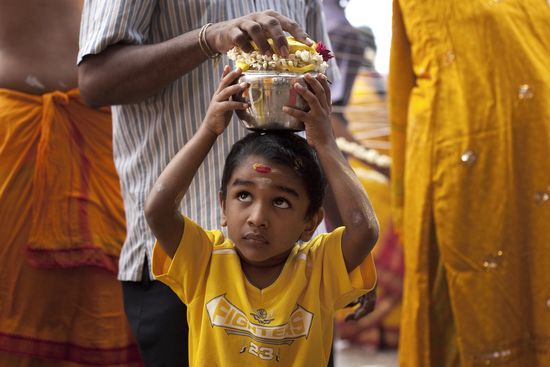
A young boy holds a milk pot on his head before taking part in the Thaipusam procession on January 20, 2011 in Singapore. Thaipusam is a Hindu festival celebrated mostly by the Tamil community. Devotees will pray and make vows when the prayers are answered. They fulfill the vows by piercing parts of their body such as their cheeks, tongues, and backs before carrying a 'Kavadi' on a four kilometre journey of faith. By Chris McGrath/Getty Images.