The Irony Of Multiculturalism

Kenan Malik critiques it:

There are two ways over the past half-century in which we've stopped treating people as citizens. One is through racism. The racist says "you're not a citizen, you don't have full rights in this society because you have a different skin colour, you are foreign", etc. The second is multiculturalism. The multiculturalist says: "we treat you not as an individual citizen, but as a Muslim or a Hindu or a Sikh or a black". The irony is that multiculturalism developed as an attempt to combat the problems created by racism. But it has recreated many of the problems by treating people not as citizens but as members of groups, and by formulating public policy in relation to those groups and not in relation to the needs of individual citizens.

(Hat tip: 3QD)
A Poem For Sunday

  Brain

"Life" by John Masefield first appeared in The Atlantic in January 1916:

What am I, Life? A thing of watery salt
Held in cohesion by unresting cells
Which work they know not why, which never halt;
Myself unwitting where their Master dwells.
I do not bid them, yet they toil, they spin
A world which uses me as I use them.
Nor do I know which end or which begin,
Nor which to praise, which pamper, which condemn.

So like a marvel in a marvel set,
I answer to the vast, as wave by wave
The sea of air goes over, dry or wet,
Or the full moon comes swimming from her cave
Or the great sun comes north; this myriad I
Tingle, not knowing how, yet wondering why.

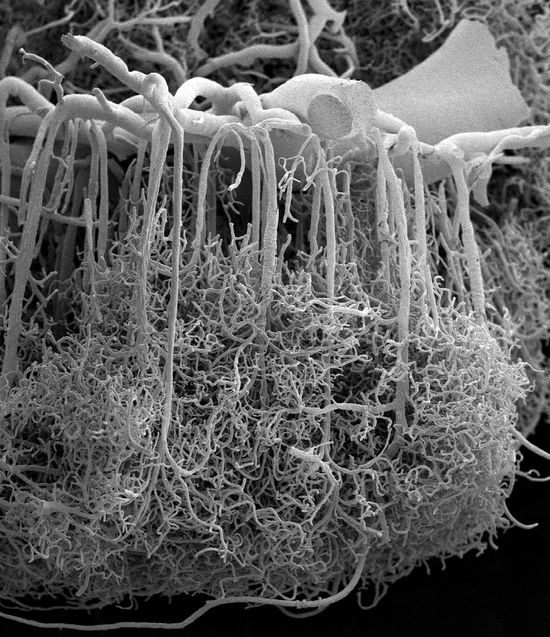
(Photomicrograph of "the microscopic blood vessels that carry nutrients to neurons in the brain, obtained with a scanning electron microscope, by Alfonso Rodríguez-Baeza and Marisa Ortega-Sánchez, collected in the new book Portraits of the Mind: Visualizing the Brain From Antiquity to the 21st Century)

A Father’s Heart

From Tony Woodlief's heartfelt meditation on fatherhood:

Lately I have wrestled with bouts of panic. I fear I am too far behind, already, in this father’s race. I am apart from them more than I want. This is how our lives will be for the next several years. They used to ask when my traveling will be done, and now they don’t. They have been fishing more with other fathers than with me. They have been to Boy Scouts with other fathers, but not with me. This is our life into any future I can foresee, not that I have ever seen the future well.

Sometimes I panic, and then I despair. Your life stretching out before you holds a series of choices, and what you don’t realize until you are older is how quickly those choices can accumulate and choke off possible futures. If you are not care-filled and prayer-filled and intentional, your days may pile up with more regret than hope.

Mindfulness

Jeff Mason mulls its meaning:

It is thinking of nothing in the sense of not categorizing things or making calculations about them. It is neither having abstract truths before one’s imagination, contemplating symbols or images, nor attending to sensations. ‘Single-minded’ mindfulness is neither engaged in the world, nor apart from it. It does not tell itself stories, valuing or negating, wishing or hoping, but receives and accepts whatever is going on as long as it continues; allowing thoughts and feelings, words and images, to exist as soon as they arise and to let them go as soon as they are ready to leave.

Quote For The Day

OlderCouple

"With the death of that person everything was gone. You are alone then. First you also want to die. Then you search. You had turned all the people you also had in life into something less important during your life. Then you're alone. You have to cope," – Thomas Bernhard, Austria's postwar writer, on losing his "Lebensmensch" or "life companion."

A new book, My Prizes, collects "the background and circumstances of reception of nine literary prizes that Bernhard was awarded between 1963 and 1980, followed by some of the speeches he delivered on those occasions."

(Photo by Flickrite Candida.Performa)

“People Don’t Want The Meaning Of Life, They Want The Experience Of Life”

Adam Frank distills the "spirituality vs science" debate:

Spirituality, at its best, points us away from easy codifications when it shows us how to immerse ourselves in the simple, inescapable act of being.  Science at its root is also an expression of reverence and awe for the endless varied, resonantly beautiful experience we can find ourselves immersed in.  … So, can we stop thinking that discussions about science and religion have to focus on who has the best set of facts?

When it comes to the natural world, it's hard to see how science is not going win the "facts" war hands down. But if we broaden our view to see being as the central issue, then connections between science and spiritual longing might be seen in an entirely different light.

The Purpose Of Winter

Morgan Meis picks apart the opening lines of Richard III, "Now is the winter of our discontent / Made glorious summer by this son of York":

Maybe the discontent that comes to us in winter is in the realization that every moment of joy is but a brief resting point on the greater journey toward oblivion. Or maybe that's too grand. Maybe the discontent in winter is the discontent about the fleeting quality of the present. Nothing holds still for very long, after all. Nothing that feels good stays good for very long. Even in Los Angeles, the perfect sunny day turns to night; a feeling of contentment is replaced by anxiety somewhere along the line.

If there is a greater contentment to be found, then, it is in the contentment of discontent. It is in the willingness, maybe, to have your winters and to have them in their dreariness and decay, neither surrendering completely to that discontent nor pretending to solve it.

“A Glorious Contingency”

Michael Shermer, publisher of Skeptic magazine, thinks it's beside the point whether the "universe has a purpose":

Life began with the most basic purpose of all: survival and reproduction. For 3.5 billion years organisms have survived and reproduced in a lineal descent from the pre-Cambrian to us, an unbroken continuity that has endured countless terrestrial and extraterrestrial assaults and five mass extinctions (six if you count the one we may be causing). This fact alone imbues us with a sense of cosmic purpose. Add to it the innumerable evolutionary steps from bacteria to big brains, and the countless points along the journey in which our lineage could have easily been erased, and we arrive at the conclusion that we are a glorious contingency in the history of life. As Charles Darwin wrote in the penultimate paragraph of his 1859 masterpiece On the Origin of Species: “When I view all beings not as special creations, but as the lineal descendants of some few beings which lived long before the first bed of the Silurian system was deposited, they seem to me to become ennobled.”