The New Yorkiest Book Of All Time

Sam Anderson nominates an unlikely contender: Edith Wharton’s The Age of Innocence:

It builds itself, obsessively, out of all the essential New York themes. …The shiny lure of fantasy versus the sharp hook of reality. The giant shell game of phoniness and authenticity. The existential strain of distinction versus assimilation—that yearning to be free (one of Wharton’s keywords) but also to belong to a social tribe (another of her keywords). The agonizing, paradoxical struggle to feel like a special individual in a city of millions. 

Score One For The Phonies

J.D. Salinger's estate recently barred Frederik Colting, an obscure Swedish writer, from publishing his novel in North America because it uses Salinger and Holden Caulfield as characters. W.W. at Prospero scoffs:

Given the all-too-successful legal and legislative efforts of Disney, the recording industry and artists like Salinger, the prevailing model of copyright has come to appear as yet one more way in which our political economy is rigged to protect privilege. This shift in perception can be explained by a bigger shift in our creative culture. The rise of the arts of the sample, the remix and the mashup alongside the emergence of the open-source software movement has engendered a growing sense that creative work both draws from and adds to a common pool of shared culture.

This change in the mood and tools of the creative class has made Salinger's legal aggression against biographers, filmmakers and inferior writers seem less like charming New Hampshire get-off-my-lawn curmudgeonism and more like a contemptible failure of generosity. A decent man does not shoot at kids taking a shortcut across his back forty. But Salinger, again and again, lawyered up, aimed carefully, and fired.

A Poem For Saturday

108109631

"Progress" by Leonard Cochran appeared in The Atlantic in October, 2004:

Battling cascading
steam, my ancient

neighbor would face
his fogged mirror,

cutthroat razor
mowing down, up,

piratical blade
making every

stroke a page torn
from a life story

told the hard way,
because "Someone,

by God, has to keep
the old skills alive."

(Photo of a barber shaving a client in the streets of the Medina in central Tunis. By Martin Bureau / AFP/Getty Images)

The Human Library

Theo Schell-Lambert looks into an experiment at Toronto's Public Library:

For 30 minutes each, visitors could “check out” and glean stories from volunteers, who were selected for their compelling backgrounds. … "Books" on the shelf ranged from a Buddhist monk to a quadriplegic journalist to a gang member-turned-doctor to a formerly homeless businessman (apparently, the curators’ tastes skewed to realist epics over comedies of manners). And, even as the concept of human texts playfully undermines some sacred library traditions—card catalogue searches; shushing—the program does seem to hit on the discovery experience, even the literary populism, at the core of a great library.

The View From Your Window Contest

Vfyw-contest_1-22

You have until noon on Tuesday to guess it. City and/or state first, then country. Please put the location in the subject heading, along with any description within the email. If no one guesses the exact location, proximity counts.  Be sure to email entries to VFYWcontest@theatlantic.com. Winner gets a free The View From Your Window book. Have at it.

The Women’s Section

Kim Voss mourns the end of Salon's feminist blog, Broadsheet. Voss places its shuttering in context:

Most newspapers had a separate women’s section for decades. Much of the content consisted of fashion, food, weddings and club news. Yet, starting in the 1950s and the 1960s, content we would recognize today as feminist began to pop up in the women’s pages. Sprinkled among the traditional content were stories about domestic violence, pay inequity and the need for daycare.

In the 1970?s, women’s liberation movement leaders called for the end of the women’s pages, arguing that women’s news should be on the front pages and in the news sections. It was a great idea in theory but it failed in practice. Newspapers responded by replacing women’s pages with lifestyle or entertainment sections, but they didn’t increase coverage of women’s issues.

You can follow the work of Broadsheet's latest and greatest blogger, Tracy Clark-Flory, here.

One Reason We’re Still Making Bad Decisions

Stephen Walt runs through the historical record:

[W]henever it becomes politically dangerous to challenge prevailing orthodoxies, misplaced policies are more likely to go unquestioned and uncorrected. Wouldn't it have been better if more well-placed people had objected to the U.S. decision to build massive nuclear overkill (including 30,000-plus nuclear warheads) during the Cold War, questioned the enduring fears of "monolithic communism" and Soviet military superiority, or challenged the wisdom of three decades of financial deregulation? Some did express such qualms, of course, but doing so loudly and persistently was a good way to find oneself excluded from the political mainstream and certainly from the highest corridors of power.

Ruin Porn

2694765397_34a9a3305e_b

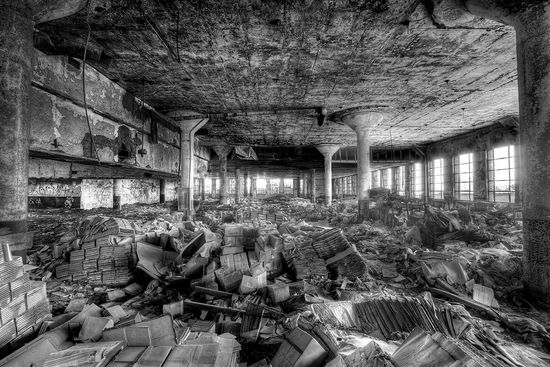
John Patrick Leary explores our fixation with urban ruins – namely their current mecca, Detroit:

So much ruin photography and ruin film aestheticizes poverty without inquiring of its origins, dramatizes spaces but never seeks out the people that inhabit and transform them, and romanticizes isolated acts of resistance without acknowledging the massive political and social forces aligned against the real transformation, and not just stubborn survival, of the city. And to see oneself portrayed in this way, as a curiosity to be lamented or studied, is jarring for any Detroiter, who is of course also an American, with all the sense of self-confidence and native-born privilege that we’re taught to associate with the United States.

Rob Horning has his own hypothesis:

Ruin photos speak to our desperate desire to have our world re-enchanted. We want the banal structures and scenes of our everyday life dignified by the patina of decay, so that we can imagine ourselves as noble, mythic Greeks and Romans to a later age and, more important, so that we can better tolerate the frequently shoddy and trite material culture that consumerism foists on us, see it once again as capable of mystery. …We become larger than this life, than these dentist’s offices and deserted boardrooms Leary notes in the photos. We will survive it all, we will outlast the mediocrity that made us.

(Photo by Flickrite Shane Gorski)

Ferris Bueller Econ 101

Caleb Crain analyzes the "pernicious" ideology of money and class in Ferris Bueller’s Day Off:

[T]he Ferrari represents capital. Cameron’s father, a miser, has accumulated it and doesn’t want to let it go. His son expects to drive it someday and resents having to wait. When the son anticipates and takes it for the day, he faces the problem of what to do with something so valuable that he could never replace it. Once the children bring the Ferrari to downtown Chicago, they sensibly park it in a garage—that is, they place the capital in a bank.

But capital doesn’t stay in the bank where it’s deposited. No sooner does a depositor walk out the door than his money, too, leaves the building, in the hands of someone in need of a loan. While Ferris, Cameron, and Ferris’s girlfriend aren’t looking, the Ferrari is driven off for a joyride by the somewhat Hispanic-looking garage attendant and his black coworker, ethnicity here serving as a marker of socioeconomic class, as so often in movies. Why put your capital in a bank, why invest it in business, when the interest you earn is so low? the movie asks. Such an investment is tantamount to loaning your money to the middle and working classes for their mere pleasure. Why not just take it for a joyride yourself? Spend your capital instead of investing it. Why not take all the pleasure you can out of its destruction?

Thus the totaling of a Ferrari comes to be understood as an act of self-expression.

The Intellectual Technologies

Big Think interviews Nicholas Carr:

So we become, after the arrival of the printing press in general, more attentive more attuned to contemplative ways of thinking. And that’s a very unnatural way of using our mind. You know, paying attention, filtering out distractions. So the book, I think, like the map before it, like the clock, created or help create a revolution in the human mind in the way our habits of mind and ultimately the way we use our brains.