As a commentary on biotechnology and sustainability, Miriam Simun makes cheese from human breastmilk she purchased online. Presenting City Funk:
The human-goat blend – light on the goat, heavy on the human – is soft and spreadable, imparting a complex funk somewhere in between butter, yellow taxi cabs and wafting wavers of street cart smells.
Today on the Dish, Andrew scoffed at the Republican budget cut suggestions and named its ultimatum on Obama's SOTU. Ezra Klein spied a Tea party/ GOP battle on cuts, Steve Bell envisioned the shuttered hospital cancer wings that would ensue, while Exum uncovered one area that Republicans did want to trim on defense. Steven A. Cook connected Ben Ali's neglected army to the uprising, Mark Steyn showered Britain with exceptional love, Foreign Policy lured Dan Savage on to Berlusconi, and Will Wilkinson stood up for Western individualism.
Andrew pegged the Palin-Free February to the Beltway's incompetence and naivete, America had to fight its morbid curiosity about her, Pence stepped up to the plate, and Palin would speak to her "fellow" hunters. Steve Clemons fought back against anti-Semitic neocon charges, Megan lobbed a Loughner complaint at Andrew, and Pawlenty's books couldn't sell. Cheney's latest Big Lie amazed Andrew, especially since the dynamic Bush-Cheney duo failed the last decade's employment numbers. DADT cost Americans $200 million over five years, Skip Oliva nerded out on the House Speaker, and more of the Smithsonian's betrayal came to light. Some organizations escaped the ObamaCare's mandates, and Mankiw's ObamaCare math came under attack.
Andrew ceded some ground to John Allen on the church scandal, and Andrew weighed in on Santorum's abortion/ slavery metaphor. Aid helpers can't help doers become autonomous, and Goldman gamed the system. Readers hated on Apple, but Andrew came to its defense, Ann Friedman examined gendered friendships, Hobbes may or may not have had more reason and independence than Tyler from Fight Club, and musical ties don't make for credible debates. Beards enhanced performance, and voting offered pretty good lottery odds.
Dish cloud here, email of the day here, cool ad watch here, VFYW here, Malkin award here, dissent of the day here, Fox poison watch here, Limbaugh poison watch here, chart of the day here, mental health break here, and FOTD here.
Thursday on the Dish, Andrew debated the past and future of marriage with James Poulos, and came down hard on John Paul II for the church's handling of abuse. Bernstein expected more of the same from the GOP on marriage equality in 2012, and Andrew backed Goldberg's outrage at the Smithsonian's betrayal of their curators. Larison and Max Boot assessed the role the US did or didn't play in interferring in Tunisia, and Steven Heydeman compiled a checklist for the Jasmine Revolution. Noah Millman weighed in on the wealth and democracy overlap, and the revolution's pictures are here. We rounded up the debate over a destroyed Afghan village, and the legacy of torture still reverberated around the world.
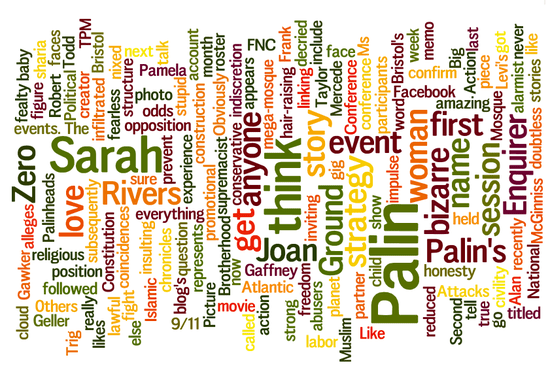
Andrew served up a nice helping of Palin crack, and Howard Kurtz profiled Palin's id. Josh Marshall defended TPM's Palin coverage, and a word cloud of her labor experience with Trig here. We tracked the fake success of the fake repeal, Frum boiled down the GOP's healthcare dilemma, and the party needed an infusion of new blood. CPAC's conservative freedom featured stopping a mosque, and we trained our eyes on Texas for a debt-minded Tea Party. Libertarianism hit its stride, and Obama's coup could last. Tyler Cowen and Jayme Lemke feared an era of high unemployment, but that didn't mean the US should force its companies to act like China's just for the thrill of it. The antics of Arizona's worst sheriff spotlights the ridiculous politics of the Dupnik recall, and one Supreme Court Chief Justice hid some relevant family ties. Demographers followed the flow of college grads, and aerial spy photos didn't impress Gregg Easterbrook. PZ Myers poked holes in Bering's evolutionary defenses against rape thesis, and Breitbart didn't mind a little PubicCoke, as long as he gets a raise. Fight Club paralleled Calvin & Hobbes, we treasured another classic case of Washington scorn, and air sex is safe but not easy.
VFYW here, Moore award here, Apple accolades here and here, Malkin award here, dissents of the day here, FOTD here, and MHB here.
Wednesday on the Dish, Andrew lambasted Limbaugh's latest poison, and crushed the major myths about the Tea Party. Tea partiers booed freedom in the form of decriminalization, and Andrew solidified Obama's bump by insisting he embrace Bowles-Simpson. Palin's blood libel against Assange mirrored her own, and Andrew wasn't placated by her low favorability ratings. On the conservative media front, Roger Ailes experimented with propaganda, Hugh Hewitt masqueraded as a journalist, and readers delved into the right's rhetoric on past shootings. James Wolcott embalmed Beltway consensus, opposites don't attract, and Michael Lind opted out of Regressive politics.
Robert Mackey profiled the Tunisian blogger turned government worker, Jennifer Rubin defended herself and Bush, and Beinart discounted American influence, since democracy was better off without it. US unemployment climbed higher than the world average, and language barriers persisted between China and the US.
Larison grimaced at 2012 wild card Kain's hawkishness, Chait guessed what Lieberman was thinking, Scott Stossel eulogized Sargent Shriver and his view of public service, and California's boomers fleeced the state. The US government could fight drugs with its uncoolness, Howard Gleckman patted down the healthcare mandate, Austin Frakt proposed a repeal related to the deficit, and a reader argued PTSD could be a normal response to trauma. Oklahoma City's memorial didn't change our rhetoric, and some wounds from Tuscon won't heal. Robin Handson believed in digital brains, readers joined Andrew in defending the pure style and functionality of Apple, and Starbucks could explode your stomach.
Christianism watch here, Yglesias award here, VFYW here, marriage equality index here, quote for the day here, MHB here, creepy ad watch here, and FOTD here.
By Prakash Mathema/AFP/Getty Images.
Tuesday on the Dish, Andrew urged Obama to call the GOP's bluff on spending, and Pawlenty pandered to the far right to Andrew's dismay. The Big Lie parroted by the right seeped into American opinion, and Andrew saw a secular hope in Apple's vision of the future. Freddie de Boer charged the blogosphere with being anti-leftist, Ryan Avent questioned de Boer's union love, and the GOP needed the middle but still didn't want to take the civil route. Nate Silver showed Douthat the stats on Palin's pull, and Andrew couldn't imagine Frum's Huckabee victory. Journalists fabricated turning points for narratives, and Herman Cain could add a touch of crazy to 2012.
Jennifer Rubin got trounced for giving neocons credit for Tunisia, while Scoblete defended her. Josef Joffe pinned Tunisia's revolution on being rich, Scott Lucas chronicled the new government's concessions, and the immolation trend in Egypt was getting out of control.
Andrew Cohen parsed the rocky road ahead for DOMA, Ezra Klein previewed the real showdown in healthcare revisions, and PTSD spread to civilian professionals. Loughner's ideology didn't fully square up with Nietzsche's, Jim Sleeper compared him to 1993's Colin Ferguson, and Gabrielle Giffords' husband kept grace alive. Sedentary screen time kills us, Gary Sick questioned the Stuxnet worm, the Twittering machine shrieked, and cigarettes got cropped from stamps. The police state lived, the enthusiasm gap evaporated, and Ike's last bested JFK's first speech. Julia Sherman traced the international hair trade, marriage evolved, and America reinvented herself. Irin Carmon defended casual sex, karate slippers used to get you into the club, and LBJ talked about his junk.
Chart of the day here, FOTD here, MHB here, VFYW here, and the VFYW contest winner #33 here.
Tunis, Tunisia, 6 pm
Monday on the Dish, Andrew picked apart Tony Blair's legacy, and revealed his blogging philosophy of "generous anger." Balko raged against the paranoid style of some bloggers on the right, and Chabon happily returned to being a novelist. Andrew rebutted Douthat with some Palin hathos, and rejected Rich Lowry's argument on Loughner's disturbed mind. Tunisia's spark kept smoldering, and Egypt got in line. Koplow focused on the revolution's secular nature, we kept at the Twitter connections, and we looked at implications for the rest of the Arab world, with more analysis here.
The Labor party in Israel split, Brooklyn jumped the shark, and the love hormone oxytocin also caused racism. We honored MLK, and Akim Reinhardt argued the real abolitionists were considered lunatics on the fringe. Maud Newton interviewed Misha Angrist on a Gattaca-lite future, Scott Rosenberg wanted us to figure out Twitter retractions now, and bounty hunters were smart economics. Alan Jacobs saluted Wikipedia, Louis Menand unraveled the Feminine Mystique, and loyalty survived. Andrew revealed his take on Freud and cuddly rabbis, the gay fish lived, and Canada was cold.
If your vote is decisive, it will make a difference for 300 million people. If you think your preferred candidate could bring the equivalent of a $50 improvement in the quality of life to the average American–not an implausible hope, given the size of the Federal budget and the impact of decisions in foreign policy, health, the courts, and other areas–you're now buying a $1.5 billion lottery ticket. With this payoff, a 1 in 10 million chance of being decisive isn't bad odds.
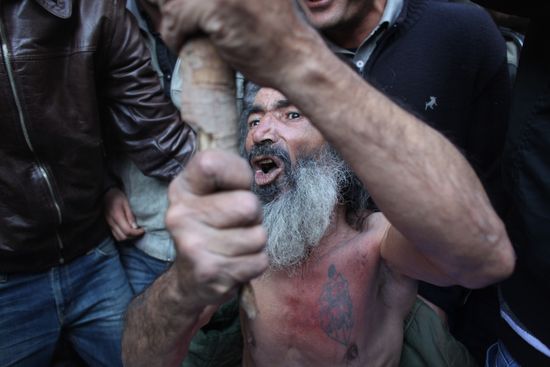
A man believed to have been tortured is pushed in his wheelchair by demonstrators during a protest on January 21, 2011 in Tunis, Tunisia. Tunisians have begun three days of mourning in respect of the people who died during the 'Jasmine Revolution' to oust president Zine al-Abidine Ben Ali, who fled the country a week ago. By Christopher Furlong/Getty Images.
GOP strategists Myra Adams and Mark McKinnon are betting that Obama will win re-election. Among their reasons:
Forty percent of Americans now see the president as a moderate. That’s up 10 percentage points from a year ago. More importantly, 44 percent of independents now call Obama a moderate, up from 28 percent a year ago. If congressional Republicans are viewed as strident and over-reaching, Obama will be well positioned as a moderating force—with or without any Clintonian triangulation.
The reason why Republicans want to entirely defund USAID but avoid touching a hair on the defense budget is that they see every single matter of foreign affairs as a nail, and so they don't understand why we should be spending money on anything other than hammers.
Larison, not a big fan of foreign policy hammers, takes issue with labeling aid a part of defense:
Republicans didn’t vote to cut defense. To claim that they support “defense” cuts because they want to de-fund USAID is to abuse the phrase “defense spending” even more than hawks already do. The RSC supported cutting foreign aid spending because they don’t think of most foreign aid as having any importance for national security policies, and to the extent that they acknowledge that foreign aid funding is directed to Afghanistan and Pakistan they would probably point to this as one of the problems with “Af-Pak” policy.
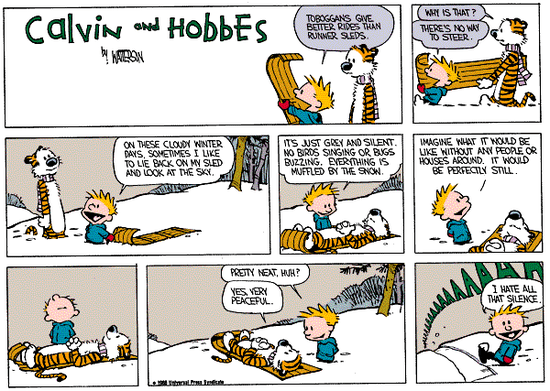
I feel compelled to respond to your reader's critique of the Calvin & Hobbes/Fight Club connection, in which the reader claimed a) that Hobbes was essentially independent from Calvin, whereas Tyler is totally dependent on Jack, and b) that Hobbes was the voice of reason, whereas Tyler is not.
To answer the first, is Hobbes truly independent of Calvin? Superficially, he is obviously not: he is part of Calvin's imagination. Watterson treated Hobbes as a totally separate and unique character from Calvin, but he did so because he wanted to present the world the way Calvin sees it. To Calvin, Hobbes is a totally separate entity, so that's how the audience sees Hobbes. But in reality (within the strip, that is), Hobbes is "just" a stuffed tiger. The parallels to Jack and Tyler are therefore obvious. For the first 3/4s of the movie, Tyler is presented to the audience as a totally separate entity from Jack, because that is how Jack sees him. Tyler never actually exists, but the audience believes he does because Tyler believes it. Hobbes and Tyler are both presented to the audience as separate characters, when in fact they are simply part of Calvin and Jack.
The only significant difference is that after the reveal in Fight Club, the movie accepts the "reality" that Tyler is part of Jack. But in Calvin & Hobbes, the strip never accepts the "reality" that Hobbes is part of Calvin. Even when other characters are shown to believe that Hobbes is just a stuffed tiger, Hobbes stays real and separate for Calvin and the audience. The presentation of Hobbes/Tyler varies, but their true nature stays the same.
As for the second point: it's worth noting that the premise here is that Calvin buried Hobbes deep in his psyche when he reached adolescence. So Tyler is Hobbes after he's stewed in Calvin's subconscious for a decade. It's safe to assume that this process will twist and distort Hobbes; he'll still be the voice of reason, but it'll be a twisted form of reason. And in Fight Club, Tyler is still entirely rational; he doesn't change Jack by threatening him or scaring him; he changes Jack by appealing to his mind and presenting evidence that makes Jack think about the world in a different way. We may recognize that Tyler's brand of logic is twisted and nihilistic, but he's still presenting it to Jack as rational and true; he's appealing to Jack's mind. Take Hobbes, bury him in the dark for 10 years with the snippets of Nietzsche that Calvin/Jack read in college, and voila! Tyler Durden.
One last possibility: what if Calvin is the personality that had to be buried, and that eventually bubbled up as Tyler? What if, when forced (probably by his father, it should be noted) to discard the Hobbes illusion, the Hobbes personality stayed on the surface and grew up into Jack, while Calvin was buried and stewed until it became Tyler?
Another writes:
The difference from the Fight Club setup is that Tyler represents some sort of id (want) to the other Jack's ego (can) and superego (should), while the "real" character in the comic strip, because he is a small energetic child, is the id to Hobbes' ego and superego. It's Hobbes who usually understands the real-world danger of rocketing down a hill on a sled at uncontrolled speed. And it's Hobbes who understands the broader social repercussions of Calvin's schemes. In some ways, I think Hobbes foreshadows the older adolescent/adult that Calvin will become. Hobbes often seems smitten with Susie Derkins, who Calvin hates so much he must kind of like her. Hobbes reassures us that Calvin won't turn into a juvenile delinquent – he'll turn into Hobbes.
Since my kids discovered our old Calvin & Hobbes collections, the strip has been on my mind more than it had been for years.
A final reader's thoughts:
I think your reader is mistaken to say that Hobbes isn't controlled or limited by Calvin's imagination. I think to really understand the identity of Hobbes, you need to place him in the proper context of an intelligent, immature and precocious six year old. If Tyler Durden is a projection of all the qualities that Jack wants to be, Hobbes is a projection of the qualities of emerging maturity that Calvin resists and therefore projects on to an imagined other.
Where Calvin is impulsive and unconstrained, Hobbes is temperate and wise. Where Calvin is ego-centric, imagining himself as a character of unparalleled importance in the world, Hobbes shows acceptance and contentment with normal life. Where Calvin hates girls and forms a club to publicly express his hatred of girls as loudly as he can, Hobbes is openly sexual – meaning that Hobbes can act on the quasi-romantic feelings that Calvin has for Susie that Calvin can only express through teasing and harassment.
Therefore I don't think it's true that Hobbes is "smarter" than Calvin; I would say that Hobbes represents Calvin's emerging wisdom that Calvin understands, but is not yet willing to incorporate into his own persona. That is, I think the best way to understand the conversations between Calvin and Hobbes about God, gender, morality, and so on is as a visual way of presenting the interior conversations of a single individual. Watterson himself clearly values solitude, nature, and personal meditations on profound subjects; I suspect that the personas of Calvin and Hobbes ultimately grow out of two different kind of voices that he has in his head when he goes walking through the woods, or tobogganing through the snow.
For other superfans of the series, don't miss the Calvin and Hobbes search engine, created by Michael "Bing" Yingling. (If you have trouble reading the above comic, go here.)
Will Wilkinson reflects on the resilient differences:
…Most liberals remain pretty hostile to these common libertarian ideas:
Democracy sucks.
Unions hurt more than they help.
Campaign spending is political speech.
Economic inequality does not undermine democracy or democracy’s role in establishing and protecting equal liberty.
Economic rights are as important as political and civil rights, and should be just as vigilantly protected, even if that leads to huge inequalities, which do not, by the way, threaten democracy or the value of political and civil rights.
Taxation is coercive but imprisoning the guy who nicked your lawn gnome isn’t.
He concludes that "some of these ideas are correct, some incorrect," and that "together they amount to a towering impediment to joyous liberal-libertarian comity."
Prompted by Jared Loughner's crimes, Room For Debate asks who does, and who should, qualify for an insanity plea. Here's Dr. Beatriz Luna, "the director of the Laboratory of Neurocognitive Development, where she uses neuroimaging methods to understand the development of voluntary control":
Jared Loughner’s criminal act appears to have involved careful planning that required voluntary and well-thought out steps. However, the aim of this planned behavior may reflect a disordered, diseased state. Neuroimaging studies could show that such a criminal engages brain systems to support voluntary acts in a similar way as the normal population. However they could also show abnormalities in brain processes that support the ability to have empathy and control over anger, or show that reported hallucinations recruit brain processes that support real sensory experiences. Although such a person would be able to operate in a voluntary planned manner, their acts would reflect brain abnormalities that contribute to their urge to commit crimes.
Should such a disorder be an excuse for their voluntary behavior? Probably not, but it might provide extenuating circumstances that could influence sentencing.
Pawlenty has done a really excellent job of setting mid-to-low expectations — for crowds, money, sales, charisma — and modestly exceeding them, a kind of dexterity that will serve him will in primary season — for a while. At some point, though, one stops grading on a curve.


 The Dish