Assad Frightened Into Reform

by Chris Bodenner

The WSJ gets a rare interview with the Syrian strongman:

Syrian President Bashar al-Assad, who inherited a regime that has held power for four decades, said he will push for more political reforms in his country, in a sign of how Egypt's violent revolt is forcing leaders across the region to rethink their approaches.

Turnabout Is A Terrible Idea

by Conor Friedersdorf

Would the left benefit if it had its own Fox News, its own talk radio, and more of its own bazooka-wielding talking heads inveighing on behalf of progressivism? Many Dish readers think so, including a lot of Keith Olbermann fans who are upset by his departure. It's a useful reminder that there are a lot of thoughtful people who don't share my taste in political discourse. I stand by my comments about the utility of angry rhetoric. But I want to acknowledge some sound points made by readers. It's true that segments on Fox News sometimes influence public discourse beyond that network's audience by influencing other media outlets and driving or influencing certain stories. The high volume of RINO hunters makes it seem as if the GOP has more folks on its right-wing than its center. And I've long thought that the conservative movement succeeds in spreading information that misleads the public – to cite one example, it scared the country into thinking it would be dangerous to house Gitmo detainees in a supermax prison. Some short term political victories are won that way.

The right and the left aren't mirrors of one another. The strengths and flaws of both sides are different, as are the people who make up the ideological coalitions. For this reason, I very much doubt that the left is capable of building its own talk radio empire or Fox style news channel even if it wanted to do so. But I want to explain at greater length why liberals shouldn't envy the right for its blowhards.

Alongside their benefits, let's examine the costs.

These are inseparable from the success of Fox News and Rush Limbaugh's status as the right's most popular entertainer. Foremost is the echo chamber effect: a bubble where the Iraq War was always going swimmingly, patriotism seemed to require support for torture, and the Bush Administration's domestic agenda never lacked for defenders happy to obscure the manifold ways that it violated even the principles of conservatism. The conservative media isn't wholly responsible for 8 years of Republican rule that left the right exceptionally unhappy. But it acted as a consistent enabler of policies that did long term damage to the country and brought about an electoral flameout that handed progressives their biggest opportunity in years. 

Fox News, Rush Limbaugh, Glenn Beck and friends have also succeeded in dumbing down the right's ideas. How could it be otherwise when they traffic in absurd conspiracy theories that many prominent conservatives are afraid to directly contradict? If you only trust right-leaning media sources – that is true of many conservatives – who is pushing back against the notion that Barack Obama is a Kenyan anti-colonialist, or that all liberals are power-hungry statists bent on spreading tyranny as their preferred end? Perhaps there are instances when these sorts of lies produce a short term political advantage. In the long run, it is never worth the extra distance put between the right and an accurate grasp of reality.

Do you still want your own Fox News, your own Rush Limbaugh? If the left resembled the right in that way, what would become of your next generation of young thinkers? Someone high up at MSNBC once told me that Ezra Klein was blacklisted from the network for a time because he criticized Keith Olbermann. Would it be better if that sort of thing happend more often? If there were more talking heads liberals never criticized for fear of losing TV spots and book deals? Or is it preferable that an honest guy like Chris Hayes is getting get hosting gigs at MSNBC, while writers like Adam Serwer at a progressive magazine like The American Prospect is free to speak his mind when he disagrees with an ideological ally? Is there anyone a writer at Tapped coul criticize that would result in as much of a backlash as when Rush Limbaugh or Mark Levin is criticized at The Corner? Do you wish there were?

If the left better resembled the right, surely Matthew Yglesias would've stayed at The Atlantic rather than going to the Center For American Progress in the alternative universe where the move included the intellectual strait-jacket The Heritage Foundation's bloggers wear. Would that have been good for liberals?

Or take Matthew Continetti, an exceptionally smart, talented young writer who has produced a book and many magazine articles that are to be admired. Due to the incentive system on the right, it made sense for him to write a book called "The Persecution of Sarah Palin." Is that a win for conservatives who want to advance smaller government or any other policy goal? Where I'm sitting, it seems like a waste for an ideological project when one of its best young writers labors over a book whose subject is a polarizing one-term governor's supposedly unique victimization. Do you think the left is capable of having the equivalent of Fox News and talk radio without ever ending up with its own Sarah Palin, and its own Matthew Continetti to squander precious time acting as her apologist?

The left has its own malign influences on public discourse. Some are rich and successful. It no more makes sense for liberals to envy the right it's talk radio hosts than it makes sense for the right to envy the left for Al Sharpton, Jeremiah Wright, or Michael Moore, which isn't to say these people are perfect analogues – they're certainly they're less influential among liberals than Limbaugh is among conservatives, and it would be wrong to draw a false equivalence. But these figures were successful in gathering followers and driving stories. In the realm of politics, the pathologies that came as part of the package still resulted in a net loss.

The antidote for Fox News isn't Keith Olbermann. It's Jon Stewart. It isn't a new left-leaning host who turns Glenn Beck-style destructive absurdity to different ideological ends – it's someone who effectively demosntrates the absudity of blowhards.

Cross-ideological envy does make sense sometimes. But I insist that everything would turn out a lot better for our country if we tried to emulate the best of what the other side has to offer – if the right envied The New York Times for its unparalleled news gathering operation and cultural influence, and tried to emulate it. Or if the left envied the right for the tranformative impact City Journal had on New York City's governance, or the Tea Party's impressive ability to get its members out to rallies to demonstrate its numbers, or the steadfastness of those evangelicals who refuse to compromise their deeply held principles even when pragmatically their battles are lost. Even if you object to these specific examples, one needn't agree with the other side to see its many admiral qualities.

But it's a lot easier to copy the other side's least attractive qualities, and imagine that when you've benefitted from the attendant power, everything will turn out better. That isn't how things work. And deep down most people know it.

The Friday Of Departure

DieForSomethingGetty
by Patrick Appel

Mackey flags a statement from protesters in Al-Masry Al-Youm, an Egyptian newspaper: 

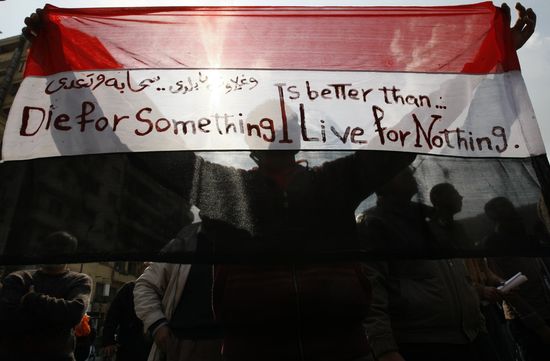
Tahrir Square protesters say they plan to march Friday to the presidential palace in Heliopolis unless the army makes its stance clear. Youth-led groups issued a statement calling for all Egyptians to march on the palace, the People's Assembly and the television building, in what they are calling the "Friday of Departure."

They say the army must choose which side they are on: That of the people, or the regime.

(Image: An Egyptian demonstrator takes part in a protest against President Hosni Mubarak's regime at Tahrir Square in Cairo on January 30, 2011. By Mohammed Abed/AFP/Getty Images)

How History Unfolds Unpredictably

by Conor Friedersdorf

In as fine a column as I've seen on the Egyptian uprising, Ross Douthat argues that despite being an American ally, Hosni Mubarack's rule helped bring about the conditions that led to the September 11 terrorist attacks:

In “The Looming Tower,” his history of Al Qaeda, Lawrence Wright raises the possibility that “America’s tragedy on September 11 was born in the prisons of Egypt.” By visiting imprisonment, torture and exile upon Egypt’s Muslim Brotherhood, Mubarak foreclosed any possibility of an Islamic revolution in his own country. But he also helped radicalize and internationalize his country’s Islamists, pushing men like Ayman Al-ZawahiriOsama bin Laden’s chief lieutenant, and arguably the real brains behind Al Qaeda — out of Egyptian politics and into the global jihad.

At the same time, Mubarak’s relationship with Washington has offered constant vindication for the jihadi worldview. Under his rule, Egypt received more American dollars than any country besides Israel. For many young Egyptians, restless amid political and economic stagnation, it’s been a short leap from hating their dictator to hating his patrons in the United States. One of the men who made this leap was an architecture student named Mohamed Atta, who was at the cockpit when American Airlines Flight 11 hit the World Trade Center.

Lest you draw conclusions from that excerpt, note that the point he's actually making is much more subtle than any one take on the uprising. In his conclusion, he gives voice to a thought I've struggled and failed to articulate:

There are devils behind every door.

Americans don’t like to admit this. We take refuge in foreign policy systems: liberal internationalism or realpolitik, neoconservatism or noninterventionism. We have theories, and expect the facts to fall into line behind them. Support democracy, and stability will take care of itself. Don’t meddle, and nobody will meddle with you. International institutions will keep the peace. No, balance-of-power politics will do it.

But history makes fools of us all.

To me, this inability to predict how foreign policy will play out should bias us in favor of non-intervention in most cases, and definitively against Washington DC players who talk of pivots, domino theories, fly-paper, seeds of democracy, and any other theory that makes it seem as if they can game things out far into the future.

The Chicken Leg Trade

3037397032_6020447713_b

by Zoe Pollock

Nadia Arumugam charts the odd machinations of America's obsession with white meat:

Once Americans signaled a clear preference for breast meat in the '60s and '70s, producers needed an outlet for the dark meat that wasn't selling domestically. They knew that foreign markets, notably in Asia, prized the moist, succulent, and richly flavored leg meat. (In Asia, it's the breasts that end up in bargain buckets.) And so they worked to convert a domestic waste product into a profitable export.

American chicken legs were purchased eagerly by Asian importers, and for a while a happy equilibrium was struck. Yet in the 1980s chicken consumption in the United States. increased at a phenomenal rate (in 1970 the average American was consuming 36 pounds of chicken; by 1985 this increased to 51 pounds), and the poultry industry needed new outlets to absorb the growing numbers of discarded legs.

It was most fortuitous, then, that the Soviet Union collapsed in 1991, resulting in the relaxation of trade restrictions that had hindered commerce with the formerly Communist state. U.S. chicken exporters, eager to exploit this fresh market, were able to underprice virtually all other animal protein produced in Russia, and American dark meat flooded the country. The chicken legs became so popular that locals endearingly nicknamed them "Bush legs," after President Bush Sr.

(Photo by Flickr user Kevin Bluer)

How Egypt Is Playing In Iran

by Patrick Appel

Tehran Bureau reports:

Reza, a professor of philosophy, told Tehran Bureau, "Mubarak is repeating the Shah's mistakes." The Iranian state media apparatus encourages this analogy, or any other that draws parallels between the Shah and Mubarak. The logic is simple. "If Mubarak is the Shah, then Egyptians' revolution can be portrayed as Iran's Islamic Revolution," explains Reza.

But that's not the only narrative: 

"Like us, Egyptians are voicing their anger at a regime they consider corrupt and illegitimately in power," says Maryam, 27, from central Tehran. She does not remember the nights of 32 years ago. Her memory is filled with images from summer 2009. The fact that international observers regard the most recent election in Egypt as rigged only adds to her sympathy for ordinary Egyptians. "They are demanding democracy, which we wanted and want." The way she looks at the events, Mubarak is another "dictator, unpopular and unelected. It is Egyptians' right to get rid of him." In this analogy, the present Iranian opposition has much in common with the people of Egypt and the Iranian government is assigned a role similar to that of Mubarak's regime. 

Where Are The Michael Pollans For Clothing?

by Zoe Pollock

Andy Selsberg asks for one:

Fashion has parallels to food: most clothing is too cheap, that cheapness has tragic costs, clothing is an agricultural product, and we consume too much of it. … As a recovering bargain-hunter, I would like to know what a reasonable price is for a men’s dress shirt. Not a good deal, but a fair deal. A price that hasn’t factored in extraordinary human pain and economic distress and environmental destruction. …

Before the price tag, there was more haggling, which required more knowledge about the market and what you were buying. And this buying and selling were generally done within a community—so if you screwed somebody from either side of the counter, it’d come back to haunt you.

But it’s hard now to be deeply knowledgeable about clothing. We’re specialized, and the clothing industry is opaque. You can plant a tomato or raise a chicken, but most of us can’t grow and process enough cotton to make sweaters, or become boot makers by reading a few articles.

As a huge proponent of both vintage and clothing exchanges, I think he raises some interesting points. The Uniform Project tapped into just those ideas about sustainability and fashion, and apparently founder Sheena Matheiken just gave a TED talk.

Army Nabs Al Jazeera

Screen shot 2011-01-31 at 7.40.03 AM

by Chris Bodenner

EA:

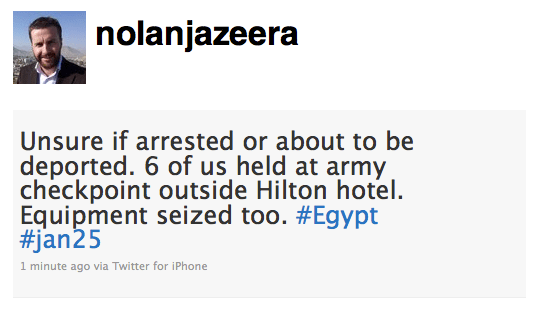
1225 GMT: Al Jazeera reports a sixth member of its staff has been arrested. Equipment has been seized, as the six journalists and crew are held at an army checkpoint outside the Hilton Hotel next to Al Jazeera English's bureau.

One of the detained reporters, Dan Nolan, is still tweeting. Update:

1346 GMT: Al Jazeera reports now that six of its journalists that were arrested have now been released. Their equipment, however, has been kept.

Quote For The Day

by Conor Friedersdorf

"I'm lucky to have been in the last cohort of American children to grow up with the living fear of total nuclear annihilation. That 'the world's fastest computer' now chugs away in China hardly leaves fourth-graders contemplating the futility of ducking under their desks as a widening ball of atomic fire races to melt their helpless flesh. Nor does the swiftness of Chinese microprocessors excite my competitive spirit. It makes me eager to buy a new ThinkPad," – Will Wilkinson