Nancy F. Cott chronicles the evolution of marriage. Her bottom line:
Features of marriage that once seemed essential and indispensable proved otherwise. The ending of coverture, the elimination of racial barriers to choice of partner, the expansion of grounds for divorce—though fiercely resisted by many when first introduced—have strengthened marriage rather than undermining it. The adaptability of marriage has preserved it.
After the Huck Finn censorship debacle, Iconic Photos culled some visual counterparts:
But I believe when we see a picture of someone famous — Churchill, Pollock or Freud — we admire them for their abilities and genius, not for their smoking. Whether a cigarette, cigar or any other fumigant is present or not, we see beyond them to witness in those photos men of talent; our focus is not on the cigarette, unless specific attention is called for by its inexplicable absence. Cigarette censorship opens a debate where such a debate was not necessary, where such a debate could only detract from the images and where such a debate would never have existed without the censorship itself.
The market for human hair is generally limited to places with impoverished populations willing to sell a two-foot ponytail — the product of two years of growth — for twenty dollars. Dark hair comes primarily from South America, India, and Mongolia. Helene says that the ample selection of hair colors and textures in South America — the result of more than twenty-five generations of intermarriage between Europeans and indigenous people — make it the ideal source region.
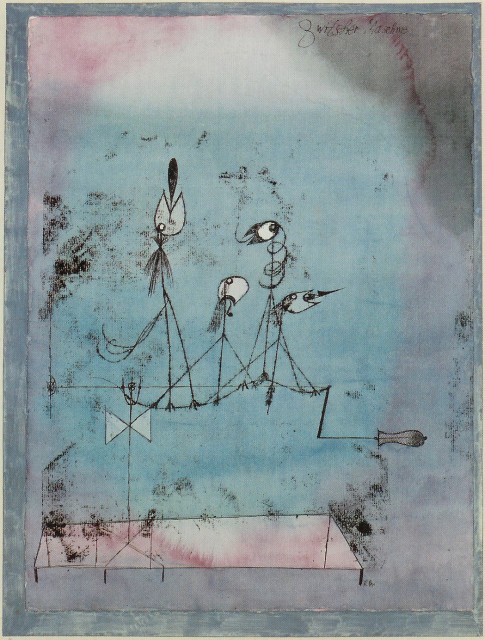
Derek White applies MoMA's description of Paul Klee’s Twittering Machine (1922) to Twitter Inc:
The hand crank conjures up the idea that this “machine” is a music box, where the birds function as bait to lure victims to the pit over which the machine hovers. We can imagine the fiendish cacophony made by the shrieking birds, their legs drawn thin and taut as they strain against the machine to which they are fused.
Scott Lucas chronicles the concessions being made by the new government in Tunisia:
The inclusion of the former opposition leaders — Ahmed Najib Chebbi (PDP), Ahmed Ibrahim (Ettajdid), and Mostafa Mohammad Najar (Union of Freedom and Labour) — may also deal with the second demand of protesters: representation of all parties in Tunisian politics. The Government also lifted the ban on political parties on Monday, so on paper at least, Tunisia has moved with days from an autocratic, one-party regime to an open, multi-party system.
Ghannouchi also announced … the release of all political detainees, and the free functioning of unions and syndicates. The Ministry of Communication has been abolished, while new committees will be established for political reform, accountability for recent incidents, and fact-finding into corruption and bribery. … Prominent blogger Slim Amamou, who was detained a week before the fall of President Ben Ali and released after the collapse of the regime, will be Minister of Youth.
Global Voices rounds up reaction to the blogger appointment.
Steve Malanga takes an alarming look at various state budgets and the imprudent behavior of state officials. Some concrete ideas for reform:
One is for states to switch from yearly budgets to balanced multiyear plans, so that legislators won’t be able to employ tricks one year and ignore their consequences the next. Another is for states to tighten restrictions on borrowing to include debt issued by quasi-governmental entities and authorities. States can also increase the amount of money that their reserve accounts must hold during good economic times, which would both restrain the growth of government during the good times and provide a cushion against severe revenue falloffs in recessions.
The authors of the Stuxnet Worm were willing to risk some major escalatory consequences by firing this shot. There is no doubt that this collaboration reduced the likelihood of any Israeli unilateral action against Iran. It was, however, a significant gamble. Did they think it through? Did they consider the day after? Does Iran, in its somewhat chaotic political state, have the will, or more importantly the ability, to respond?
Today on the Dish, Andrew picked apart Tony Blair's legacy, and revealed his blogging philosophy of "generous anger." Balko raged against the paranoid style of some bloggers on the right, and Chabon happily returned to being a novelist. Andrew rebutted Douthat with some Palin hathos, and rejected Rich Lowry's argument on Loughner's disturbed mind. Tunisia's spark kept smoldering, and Egypt got in line. Koplow focused on the revolution's secular nature, we kept at the Twitter connections, and we looked at implications for the rest of the Arab world, with more analysis here.
The Labor party in Israel split, Brooklyn jumped the shark, and the love hormone oxytocin also caused racism. We honored MLK, and Akim Reinhardt argued the real abolitionists were considered lunatics on the fringe. Maud Newton interviewed Misha Angrist on a Gattaca-lite future, Scott Rosenberg wanted us to figure out Twitter retractions now, and bounty hunters were smart economics. Alan Jacobs saluted Wikipedia, Louis Menand unraveled the Feminine Mystique, and loyalty survived. Andrew revealed his take on Freud and cuddly rabbis, the gay fish lived, and Canada was cold.
Shadi Hamid and Issandr El Amrani debate the outcome of the Ben Ali coup and make predictions over what regimes could fall next. Stephen Walt is very skeptical of further uprisings in the Arab world:
First, as Timur Kuran and others have shown, the actual revolutionary potential of any society is very difficult to read in advance, and a rising revolutionary wave often depends on very particular preferences and information effects within society. Put differently, whether a genuine upheaval breaks out and gathers steam is a highly contingent process.
Second, Tunisia is an obvious warning sign to other Arab dictatorships, and they are bound to be especially vigilant in the months ahead, lest some sort of similar revolutionary wave begin to emerge. Third, Tunisia's experience may not look very attractive over the next few weeks or months, especially if the collapse of the government leads to widespread anarchy, violence and economic hardship. If that is the case, then restive populations elsewhere may be less inclined to challenge unpopular leaders, reasoning that "hey, our government sucks, but it's better than no government at all."
The direction other authoritarian governments take toward any incipient protest movements will be instructive. Ben Ali began to toss out concession after rapid concession before he ended up on the tarmac. Do the region's other autocrats think it was a case of too little too late and move to accommodation, or do they opt for more brutal suppression?
One large ripple: 3,000 Jordanians, inspired by events in Tunisia, took to the streets in Amman yesterday.


 The Dish