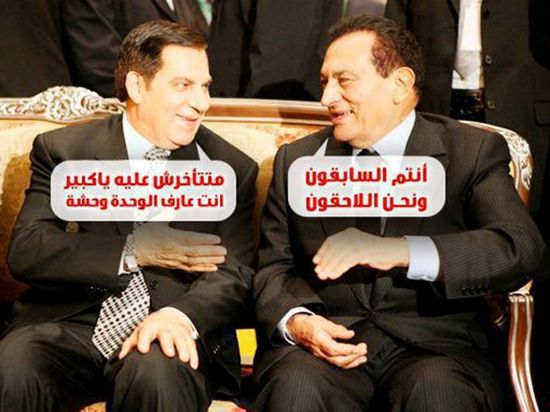
First Tunisia, Then Egypt?

BEN ALI MUBARAK

Bruce Riedel says the "joke in Cairo this weekend was whether Ben Ali's plane would stop in Cairo to pick up Mubarak":

The stakes are enormous for America in Egypt. Transit through the Suez Canal is vital to our navy and our wars in Iraq and Afghanistan. The peace Sadat made with Israel is vital to Jerusalem, which every Israeli leader knows. A stable pro-Western Egypt has been the bed rock of our Middle East policy since Henry Kissinger. U.S. assistance—both economic and military—has averaged about $2 billion a year since 1979.

Barack Obama's challenge in Egypt will be to avoid tying America to Mubarak and trying to hold back the winds of change that are coming while not destabilizing a critical ally. The United States has a poor track record of pulling off that difficult balance. In Pakistan, George Bush hung by his man Pervez Musharraf far too long. The result is that Pakistanis hate America.

Eric Trager reports on the scene in Cairo. Scott Lucas translates the above image, "which is making the rounds by e-mail":

Former President Ben Ali of Tunisia on left: "Don't be late, it gets lonely." President Hosni Mubarak on right: "You're first, we're next." (h/t Sultan Al Qassemi)

The Wandering Ex-Statesman

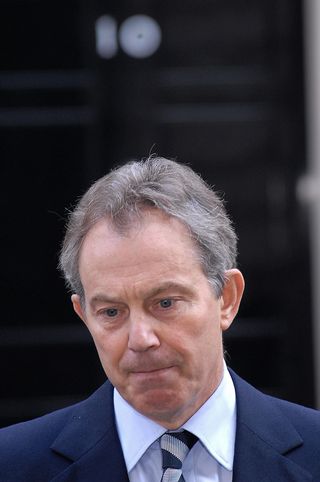
Hitch takes the long view on Tony Blair:

He now operates under the somehow touching name of the Tony Blair Faith Foundation, which can sound rather like a body set up to express faith in Tony Blair. BLAIRBertrandLangloisAFP:Getty His principal day job is to serve as mediator for the “Quartet” of powers that supervise the Israeli-Palestinian “peace process.” This means regular efforts to reconcile Muslims, Jews, and Christians in the Holy Land. Cheer up, I want to tell him. At least it's a job for life. …
When Tony Blair took office, Slobodan Miloševic' was cleansing and raping the republics of the former Yugoslavia. Mullah Omar was lending Osama bin Laden the hinterland of a failed and rogue state. Charles Taylor of Liberia was leading a hand-lopping militia of enslaved children across the frontier of Sierra Leone, threatening a blood-diamond version of Rwanda in West Africa. And the wealth and people of Iraq were the abused private property of Saddam Hussein and his crime family.

Today, all of these Caligula figures are at least out of power, and at the best either dead or on trial. How can anybody with a sense of history not grant Blair some portion of credit for this? And how can anybody with a tincture of moral sense go into a paroxysm and yell that it is he who is the war criminal? It is as if all the civilians murdered by al-Qaeda and the Taliban in Iraq and Afghanistan are to be charged to his account. This is the chaotic mentality of Julian Assange and his groupies.

We don't know what his complicity was in the torture of human beings, and so the term "war criminal" cannot be applied as of this moment. (It is, anyway, a technical legal term, not some kind of insult. Under international law, George W. Bush is a war criminal. There is no dispute about that outside a tiny coterie of legal mediocrities and political hacks and a general public as yet unable to grasp that their ex-president should be in jail.)

And how does the Catholic convert Blair react to the fact that Iraq is now cleansing and murdering its once considerable Christian population, as Moqtada al Sadr increasingly calls the shots in the new government and as torture appears to be routine in the criminal justice system in that country? He is understandably quiet.

I don't doubt Blair's good intentions. It's the unintended consequences of good intentions that I'm talking about, and the ability to own up to them. But then one notices a small fact such as this detail brought to my attention by Geoffrey Wheatcroft's brilliant recent review of Blair's book in the NYRB. Blair wrote in the preface to the now famous Downing Street dodgy dossier on Saddam's WMDs the following sentence:

The document discloses that [Saddam’s] military planning allows for some of the WMD to be ready within 45 minutes of an order to use them.

Untrue. A lie? Well, the BBC subsequently claimed it was a wild exaggeration, and one of the BBC's sources, David Kelly, was a very respected government official and authority on WMDs and Iraq. In the furious campaign to discredit the BBC's claim, Kelly's name surfaced – and he was pummeled by a parliamentary committee. Kelly subsequently killed himself, a reclusive scientist who couldn't handle being the public object of a government's smear-job. When a journalist asked Blair

“Why did you authorise the naming of David Kelly?” he answered, “That is completely untrue,” and repeated, “Emphatically not. Nobody was authorised to name David Kelly.”

Untrue. A lie? This time: yes. The highly respected British political reporter Andrew Rawnsley did the groundwork:

Rawnsley has now firmly established that on July 8, less than three weeks before those words [- "Nobody was authorised to name David Kelly" -] were spoken, there was a small secret meeting at Downing Street where it was decided that Kelly’s identity must be revealed. The meeting was chaired by the prime minister, Tony Blair.

One lone victim. Hundreds of thousands after him. One small lie. How many bigger ones?
King On International Freedom

Will Inboden connects King's legacy with the uprising in Tunisia in advance of Obama's upcoming visit with the president of China:

Though King's primary devotion in his too-short life was to the civil rights struggle in the United States, he constantly connected this effort with the universal aspirations of all human beings to realize in fact this liberty and dignity. And as he spoke out against the human rights depredations of communist governments, he also condemned the hypocrisy of his beloved America in fighting against communism abroad while denying basic rights at home to a class of its own citizens.

Juan Cole sees a lesson for Iraq. 

The More We Know

Rich Lowry cites the following in exonerating the far right from any influence on Jared Loughner's disturbed mind:

He became intrigued by antigovernment conspiracy theories, including that the Sept. 11 attacks were perpetrated by the government and that the country’s central banking system was enslaving its citizens. His anger would well up at the sight of President George W. Bush, or in discussing what he considered to be the nefarious designs of government.

I hate to point this out, but this doesn't seem to buttress Rich's case. 9/11 Truthers are as ubiquitous on the far right as the far left, where government conspiracy theories thrive. But to a great extent, only the far right is obsessed with the central banking system.

Notice also a shift in the goal-posts. Like Chris Caldwell, Lowry is now pretending that almost all of those who raised the issue of the political climate in Arizona in the wake of an assassination of a congresswoman – a completely logical and legitimate line of inquiry – did not state that this was a hit-job on the part of some Tea Party functionary. In fact, this general early discussion was concerned that crazy people like Loughner could latch on to violent rhetoric that sane people could more easily handle. Going back to my live-blogging, responding to a reader who diagnosed schizophrenia, I wrote:

I have no expertise in this at all, but my impression of his writings and web presence does indeed suggest to me that some mental illness is probably a key part of this. But this does not exonerate violent or excessive rhetoric from the far right or far left: it's precisely the disturbed who can seize on those kinds of statements and act on them. The danger of violent rhetoric, especially involving gun violence, is its interaction with the disturbed. That was Pelosi's message last year.

Note that this concern is premised on the notion that Loughner is mentally ill: that's what makes him particularly dangerous in that kind of rhetorically extreme climate. Note that I also raised the specter of possible far left influence as well (and took pains to present evidence that he was a lefty). So Lowry's argument, it seems to me, is with an almost entirely straw man. But even as the details emerged, I noted some strands that, as I said, gave me pause before dismissing this as entirely apolitical. The main themes that leapt out at me were those about the Fed and the currency, staples of far right paranoia. And the more we find out, the more those themes seem to resonate:

The officer, Dana Mattocks, read the letter aloud, detailing a litany of troubled and disruptive behavior, including the recent posting of an unsettling video titled “Pima Community College School — Genocide/Scam — Free Education — Broken United States Constitution.”

A few days later, during a meeting with a school administrator, Mr. Loughner said that he had paid for his courses illegally because, “I did not pay with gold and silver” — a standard position among right-wing extremist groups.

It was not just his appearance — the pale shaved head and eyebrows — that unnerved them. It was also the aggressive, often sexist things that he said, including asserting that women should not be allowed to hold positions of power or authority.

My italics. My point here is not that Loughner was a far right ideologue. It is that he was a paranoid, mentally ill, gun-obsessed loner who had picked up shards of far right ideology – on currency, the constitution, gender roles – that need to be recognized for what they are. It's muddled up in an addled mind and diseased soul into something unique. Ron Paul bears no more direct responsibility for this madman than Sarah Palin does. But that Loughner was affected in some small part by far right conspiracy theories seems indisputable at this point. And the massive insistence on the right that politics and political culture tells us nothing about this man's mind is not borne out by the evidence we have so far.

A Rape Roll Call, Ctd

A reader writes:

The obvious and sensible reform is to put the accused's status on the same footing as the accuser's. In the Duke lacrosse case, the accused men's names were all over the national media as probable rapists months before anyone had heard of Crystal Mangum. You think it's terrible being known as a rape victim? Try living as a rape suspect – even the proven-innocent kind.

Another writes:

The whole argument is outdated because of social media.

Just the other day there was a teenage suicide in my town. The local media wouldn't name the kid, I guess until relatives were notified, and the announcement given to the students the next morning was similarly sanitized. But my daughter reports that EVERY SINGLE STUDENT at the school already knew the name of the student before the official announcement, because it was posted on everybody's Facebook page.

The forum website run by the local newspaper was running a rearguard action, deleting or censoring forum posts that mentioned the name of the student. But it's an old mindset from the days when the conventional media had a monopoly on information distribution. No more. The same applies to rape victims; they're going to be outed anyway.

The Beginning Of The End

Josh Marshall signals it for the Labor party in Israel, which essentially founded the country and led it for its first thirty years. Today Ehud Barak, former Prime Minister and current head of Labor, has left Labor to form a new party:

If you're an Israeli who wants to vote for a potential governing party which is at least in principle in favor of a two-state solution, Kadima seems like your obvious choice. If you want a more clearly left pro-peace process party, you'll probably want to vote for Meretz, another party with historic ties to the Labor tradition in the country. Somewhat like the British Labour party, Labor has institutional ties to the Israeli labor movement which may help keep it afloat as a political party. But in the current situation, why you would vote for Labor for reasons behind its historic legacy or habit is not clear.

Evelyn Gordon calls it a revolution.

What Blogging Is About

In his final post as a guest blogger, Michael Chabon admits he didn’t get any writing done on his novel while pinch hitting for TNC, and offers parting reflections on the format:

Novelist time is reptile time; novelists tend to be ruminant and brooding, nursers of ancient grievances, second-guessers, Tuesday afternoon quarterbacks, retrospectators, endlessly, like slumping hitters, studying the film of their old whiffs …  Blogging, I think, is largely about seizing opportunities, about pouncing, about grabbing hold of hours, events, days and nights as they are happening, sizing them up and putting them into play with language, like a juggler catching and working into his flow whatever the audience has in its pockets.

Then there’s that whole business of the Comments.

Hell, it’s bad enough when a book’s coming out, and you open wide, and dig your nails into the arms of the chair, and wait for the stink of charred enamel to rise from the reviewers’ whirring drills. The pleasure of a favorable notice lasts about three hours and twenty-four minutes; the sting of a bad one settles down to a dull ache that can endure for decades (Up yours, John Skow!). Bad enough, like I say, but man, that daily assessment down there in Disqusland—even when it was mostly, even entirely, sweet and thoughtful and respectful, it was weirdly tough. Tough to withstand, tough to resist. And sometimes, today, tough to read. Maybe after a while a blogger hardens to it, I don’t know. But there is so much wit, poignance, and good writing in the Comments, you would be kind of a fool not to spend some time there every day, if you were a blogger, seeing what people had to say about what you had to say. You might even learn something.