A Rape Roll Call

Katha Pollitt disagrees with Naomi Wolf's argument that the press should print the names of rape victims:

If Wolf has really spent as much time with rape victims as she claims, I can't believe she doesn't know how ready people are to attack the credibility of just about anyone who brings a charge of rape, including, often, the accuser's own friends and family. Disproving her own thesis, Wolf is quite willing to assume the worst about the Assange accusers, based on Internet rumors, early misreportings and spin from Assange and his lawyer.

Elsewhere Jesse Bering presents four studies that show women have evolved to protect themselves from rape, including:

When threatened by sexual assault, ovulating women display a measurable increase in physical strength.
“The Open Road Still Softly Calls”

Damewse transforms Michael Marantz's original video with its beautiful Carl Sagan reading, into a stunning PSA for NASA:

NASA is the most fascinating, adventurous, epic institution ever devised by human beings, and their media sucks. Seriously. None of their brilliant scientists appear to know how to connect with the social media crowd, which is now more important than ever. In fact, NASA is an institution whose funding directly depends on how the public views them.

Eisenhower Was Right

William D. Hartung fears Lockheed Martin:

[T]he company receives one of every 14 dollars doled out by the Pentagon. In fact, its government contracts, thought about another way, amount to a “Lockheed Martin tax” of $260 per taxpaying household in the United States, and no weapons contractor has more power or money to wield to defend its turf. 

A Poem For Sunday

108025159

"Gethsemane," by Kelly Cherry appeared in The Atlantic in April, 1988:

On a hill backlit by twilight,
the disciples gather like crows
for the night.

This is their down time, time to browse
among the olive branches, Christ with them,
their apostolic flight slowed at last to a head-nodding drowse,

to a flutter of tattered cloak, the unraveling hem
dragging in the dirt like a hurt wing.
They flock momentarily around him,

then settle down, safe in the soft swing
of wind that rises and then falls back
with the deepening evening

into the distance, and sleep, while Christ's black
feathers burn in his father's fist,
plucked by God before by Judas kissed.

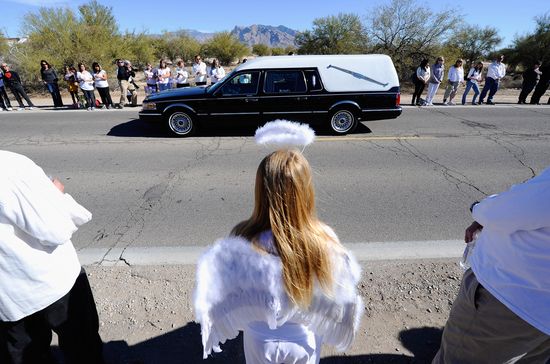
(Photo of Lindsey Lummus, 10, watching as the funeral hearse carrying the casket of nine-year-old Christina Taylor Green arrives at St. Elizabeth Ann Seton church in Tucson, Arizona. By Kevork Djansezian/Getty Images.)

Fighting Over Paradise

A history of the Wikipedia back-and-forth over the word:

The battles over Paradise begin in earnest in 2004. After a few minor and often redundant additions and corrections by various early sources, the first volley is fired by a man with the username Mani1, a clear reference to a valiant and ancient Iranian prophet. Rather than inserting an additional meaning or word, Mani1, a resident of Tehran, Iran, starts right at the top.

“Paradise,” he writes, “is a Persian loanword into English (from the Persian word Pardis). This word has the following usages in English…”, after which the previous list of meanings and places, including the American paradises, follow unaltered. It is made clear that every meaning that follows or can possibly follow, including heaven itself, which by now has turned into “the heaven of bliss,” along with all the paradises of America, issue from the Persian seed word. Before all else, Paradise is Persian. We can say that at that moment, 21:35, August 6, 2004, on Wikipedia, Paradise was politicized.

The Urban Dweller’s Relationship To Nature

Stefany Anne Golberg considers the urban farmer trend:

Certainly, many urban gardeners are interested in the environmental (i.e. moral) consequences of city growing. The eco-ethical dream of those like Folke Günther is that urban gardening could move beyond aesthetic concerns and really help feed the world’s urban poor. For now, though, the movement outside my window is not subsistence farming. No one in Brooklyn is going to starve without urban gardens. Even so, urban gardeners are earnest in their agricultural pursuits. I think most commercial farmers would be pretty surprised to see how much children in Prospect Park have learned about irrigation techniques. What’s surely exciting is that urban gardeners have us imagining cities as we’ve never seen them, that move beyond public parks and designated green zones: rooftop apple-picking, gardens in school cafeterias, skyscrapers that emerge out of forests. The modern city as the new Hanging Gardens of Babylon. Gardens — and still Babylon, too

When Confidence Does And Doesn’t Work

James Fowler's makes a distinction:

We can predict … that overconfidence is most likely to help in “evolutionarily salient” contexts that are similar to the adaptive challenges of our past, such as individual combat like boxing. It is least likely to help in “evolutionarily novel” contexts—such as sitting at a desk in a bank guessing the behavior of 100 million strangers, or commanding thousands of invisible troops from an underground bunker. … The big decisions of today are dependent on multiple and complex interacting bureaucracies and stakeholders, in which accurate assessments and painstaking planning may be boring but are critical to success—an evolutionary novelty we are not “designed” for.