Conscience vs Compromise

CivilWar

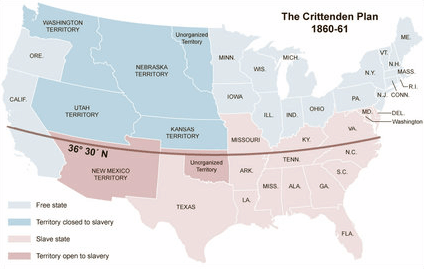
Susan Schulten recalls the Crittenden Compromise, which hoped to avoid civil war "through a geographical and constitutional 'solution' to the slavery crisis." Seth Masket ponders the counterfactual:

It's interesting to imagine, though, what would have happened if [the compromise] had succeeded and actually prevented war. Lincoln surely would have been pilloried by the abolitionists but praised by whomever the 1860 equivalent of David Broder was. And, no doubt, Lincoln's refusal to compromise was, in some sense, reckless, hastening war. But 150 years later, Lincoln's partisanship and obstinance seem like the proper course; bipartisanship would have been immoral.

Our Publics

Jeff Jarvis maps out the four stages in our public evolution – culminating in the Internet age:

Rather than being forced into a public not of our own making, we now define ourselves and our publics. The new vision of the public may look chaotic, but then change always does. The critical difference today—the next step in the evolution of the idea—is that a public is no longer a one-way entity, flowing from the powerful—king, politician, publisher, or performer—to an audience. Now through our conversation and collaboration, ignoring old boundaries, we define our publics.

A Poem For Saturday

108035786

"In a Word, a World" by C.D. Wright:

I love them all.

I love that a handful, a mouthful gets you by, a satchelful can land you a job, a well-chosen clutch of them could get you laid, and that a solitary word can initiate a stampede, and therefore can be formally outlawed—even by a liberal court bent on defending a constitution guaranteeing unimpeded utterance. I love that the Argentine gaucho has over two hundred words for the coloration of horses and the Eskimo a flurry of words for snow. More than the pristine, I love the filthy ones for their descriptive talent as well as transgressive nature. I love the dirty ones more than the minced, in that I respect extravagant expression more than reserved. I admire reserve, especially when taken to an ascetic nth. I love the particular lexicons of particular occupations. The substrate of those activities. The nomenclatures within nomenclatures. I am of the unaccredited school that believes animals did not exist until Adam assigned them names. My relationship to the word is anything but scientific, it is a matter of faith on my part, that the word endows material substance, by setting the thing named apart from all else. Horse, then, unhorses what is not horse.

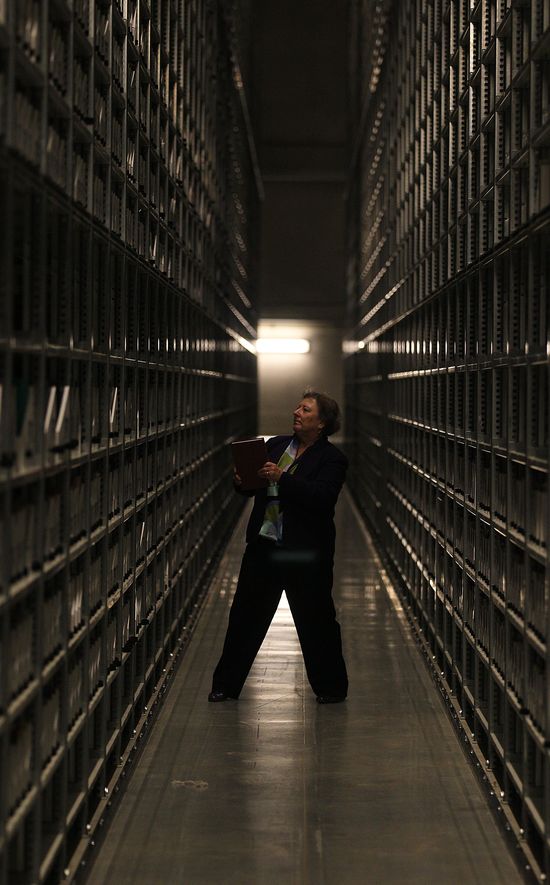
(Photo of librarian Dr. Sarah Thomas placing a book on a shelf following the arrival of the one millionth book at the Bodleian Book Storage Facility in Swindon, England. Comprising 154 miles of shelving the purpose built facility which opened three months ago to house items from the University of Oxford's Bodleian library will eventually hold over 6.5 million volumes. Photo by Matt Cardy/Getty Images)
3-Dumb

Meredith Blake seconds Ta-Nehisi's criticism of the 3-D Great Gatsby adaptation. Austin Carr bemoans Hollywood's total 3-D addiction:

What other films will be made or converted into 3-D once the technology officially becomes the bankable technique? Wouldn't True Grit and The Social Network have been SO MUCH better if filmed in 3-D? And shouldn't Michael Moore and Steven Spielberg re-release Fahrenheit 9/11 and Schindler's List–in 3-D?

Economics In One Human Breath

Stephen T. Ziliak explains how economics can benefit from the haiku:

I’m an economist. Yet poetry is my first stop on the way to invention—discovery of metaphors. No matter the audience, a model is a metaphor. Not every economist understands that. Poetry can fill the gap between reason and emotion, adding feelings to economics.

How Coulter Begat Palin

It's the methodology of never regretting anything and never acknowledging error that brings it home. And Coulter, of course, got it from Limbaugh. I'm thinking of Coulter's quote from a while back:

“My only regret with Timothy McVeigh is he did not go to the New York Times Building.”

She was then given an opportunity just to say she regretted the outburst. This is what she came up with:

RE: McVeigh quote. Of course I regret it. I should have added, “after everyone had left the building except the editors and reporters.”

Now think of Bush's inability to think of a single mistake he had ever made – after launching a war on false pretenses and authorizing torture as a legal tool. It's the mindset of constant attack. Politics becomes impossible because of it.