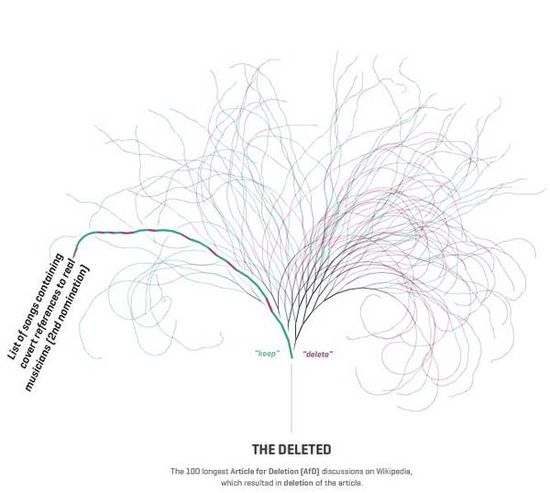
A chart of the longest discussion threads for both the deleted and kept entries on Wikipedia.
(Hat tip: Cory Doctorow)
A chart of the longest discussion threads for both the deleted and kept entries on Wikipedia.
(Hat tip: Cory Doctorow)
A new invention could allow dentists to cancel out their cringe-inducing drills. Cynthia Graber reports:
The device fits between any mp3 player or mobile phone and the patient’s own headphones. The patients could still hear the dentist or listen to their own music. But the microphone and chip in the device sample the incoming sound and produce an inverted wave that cancels out just the sound of the drill. As the drill’s frequency changes, the waveform quickly adapts to maintain the silence.

Kansas City, Missouri, 6.33 pm
Today on the Dish, we followed Tunisia as its President dissolved the government, and a state of emergency was declared. Larison stressed the importance of Tunisians deposing an autocrat on their own, without US intervention and Andrew debated Evgeny Morozov on how instrumental Twitter was. We rounded up reax and reports from the ground in Tunisia here, here, and here, and the role of Wikipedia in the coup here and here.
Sarah Palin said sorry seven times (last year), Limbaugh sunk to new lows, and Julian Sanchez explained why we love to hate politicians. Andrew called the death threats to Palin despicable, while Nancy Goldstein (and readers) scrutinized them. Clive Crook called Palin the anti-president, and she wouldn't even appear on Bill O'Reilly. Andrew pinpointed the divide in discourse is not between left and right but open and closed, while Mark Levin only suggested someone kill himself, not that they commit murder. Frum fought against paranoid narratives, Kate Pickert previewed the tone of next week's agenda, McWhorter railed against compromise, and Dan Amira didn't want Republicans and Democrats to sit together during the SOTU. Gary Wills connected Obama's speech to Lincoln's from Gettysburg, and Greg Sargent stressed Obama's smarts.
Andrew urged the GOP or Obama to take on tax reform, and Ezra Klein corrected the record on the "job-killing" healthcare bill. Ta-Nehisi explained slavery's social construct, Chabon jumped in on Obama's rain puddle in heaven, and the double space after a period is wrong. Computers can never copy human brains, meth travelled from Mexico, Pew predicted the fuel efficiency of cars in 2050, and it helped to know someone's name.
Cool ad watch here, quote for the day here, VFYW here, MHB here, ibogaine testimonial here, chart of the day here, Hewitt award here, and FOTD here.

Kenema, Sierra Leone, 12 pm
Thursday on the Dish, we rounded up the web's best reax on Obama's Tucson speech, where he called for a more civil and honest discourse, and Andrew characterized him as the most Christian president in recent memory. Conor proposed a civility pact for the blogosphere, Limbaugh's poster contradicted his defense, and this video evidenced how dangerous discourse has become. Andrew used "blood libel" in a historically appropriate manner, Joe Klein captured Obama's rhetorical power, and Politico dropped the ball. Sprung parsed Loughner's currency kick, Weigel made the case for enacting no Tucson-inspired legislation, Lee Woodruff shared the harder parts of healing a spouse's brain trauma, and more bloggers bucked against locking people up. Palin scrubbed her Facebook page in record time, Jennifer Rubin faulted her for surrounding herself with loyal amateurs, and even Jpod told her she needed to serious herself up. Chris Christie backed slowly away from her, and Palin's breath would keep Andrew awake tonight.
Tunisia had the Arab world on edge, Ethan Zuckerman wondered if it could be the next Twitter revolution, and the Internet captured the bloodshed and the spark that started it all. Andrew answered Greg Mankiw on what rich people deserve, Yglesias asked if the US caused the spike in global food prices, and Norquist kept conservative on a possible war in Lebanon. Pawlenty would reinstate DADT, and Serwer balked at the chaos it would cause. David Boaz summed up the CPAC controversy, climate change accelerated, and Palin intimidated future presidential candidates. Howard Gleckman pleaded for tax reform in the SOTU, the goverment could steal your tweets, and Jenny McCarthy couldn't let go of her vaccine conspiracies. Reihan hyped up the Florida Governor's new education reform proposal, and these were the five emotions invented by the Internet. Michael Chabon blogged, Wikipedia passed its own test, and it was hard to quantify the mechanics of beauty. A reader who wanted to adopt according to her own race defended herself, readers argued over neti pots and Sudafed, and a Cannabis Closet reader connected with "God." Chatroulette wanted to monetize more schlongs, Joan Rivers terrified Andrew, and a drag policewoman kept Baltimore on its toes.
Yglesias award here, VFYW here, comment of the day here, Glenn Greenwald's pledge drive here, chart of the day here, MHB here, and FOTD here.

(Photo: Kevork Djansezian/Getty.)
Wednesday on the Dish, Andrew live-blogged Obama's moving speech in Tucson. He still didn't buy Palin's victimization, which tightened her grip on the base. Readers broke down her skewed logic on whether rhetoric can inspire violence, Ezra Klein seconded Andrew on what she should have said, and Steve Benen focused on the ever-opaque Palin model of interacting with the press. We worked Dan Riehl over for his vile discourse and moral grandstanding, and Jews apologized to Palin. The left also had a bullseye map, and Andrew nominated Boehner to revolutionize the right in tone. Clive Crook pushed back against anger, Mark Thompson grew tired of debate over debate, and a reader amended Buchanan's Yglesias nomination. Nate Silver applied statistics to threats and tried to understand the evolution of the gun debate. Choire Sicha couldn't compute how we identify crazy, and Shafer sized up Loughner's mugshot. Tony Woodlief feared for his own parenting habits, and readers balked at involuntarily committing patients. Serwer and Sullum rejected Loughner's schizophrenic connections to cannabis, Andrew pored over his gamer days and political obsessions, and we grasped at the science of Giffords' survival here.
John Seabrook marked the Haiti earthquake anniversary on a personal note, Brazil whooped the US in combatting poverty, Cowen explained why the French succeed, and Stieg Larsson's trilogy upended our assumptions about Sweden. Larison had concerns about South Sudan, Schwarzenegger never wanted a safety net, and conservates and liberals both thought the other was illegitimate. Readers offered more background info on adoptions, and on the war against meth. Ta-Nehisi feared for the film adaptation of the Great Gatsby, Jessa Crispin decoded Berlin through books, some compliments were never doled out to restaurant websites, and 50 Cent made mad money off of Twitter.
Deep thought of the day here, unemployed in Brooklyn advice here, VFYW here, Malkin award here, cool ad watch here, MHB here and here, FOTD here, and dissent of the day here.
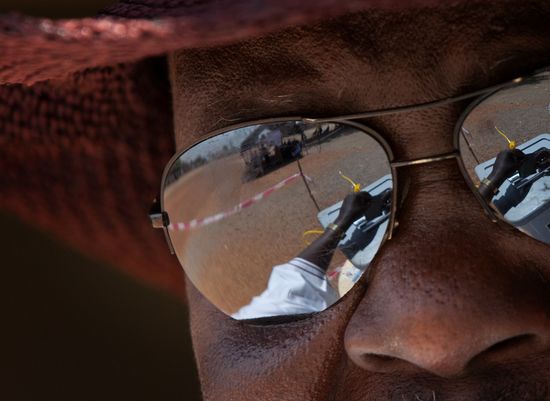
By Yasuyoshi Chiba/AFP/Getty Images.
Tuesday on the Dish, Andrew seized on David Brooks' accusation that the media dared to politicize the attempt on Giffords' life and Joe Klein sided with Brooks. Andrew fingered the right's rhetoric not for partisan reasons but out of genuine fear for the future. Limbaugh came out swinging, and Andrew thought he seriously crossed the line, along with many other leading conservatives in America. Ailes took the high road with calls for his staff to tone it down, and Scarborough and Buchanan admitted they'd have apologized if the crosshairs were theirs. Andrew predicted this moment was made for Obama to take charge, since the right flagrantly refused to take any responsibility. Pawlenty dug in at Palin, and Instapundit mocked Pawlenty's masculinity.
Glenn Beck brandished a gun to "stand together against all violence," Andrew once found himself in the line of crosshairs (and they weren't Palin's), and Amy Davidson considered the blood on our hands. E.D. Kain understood Loughner as at war with reality, Larison saw pure nihilism, William Galston advocated for involuntary commitment to protect the rest of society, and Weigel predicted an armed Arizona. Henry Farrell likened the debate over rhetoric to the climate change fight, and McWhorter argued that was in part the Internet's fault. The National Review called for more civility, and Matt Taibbi accepted some of the media's blame. Ross Douthat and Michelle Goldberg proved civil discourse is possible, and Giffords' doctor updated us on her condition.
DADT caused blackbirds to die, Kevin Drum offered a toin coss for $1 million that most people opted to refuse, and Angry Birds weren't all fundamentalists. Tom Delay was sentenced under the same rules that apply to all Americans, and the drug war on meth made it harder for sick people to get cold medicine and more lucrative for the meth business to buy drugs. Sudan verged on becoming two separate countries, and rape ran rampant in Haiti's tent cities. Huckabee pulled ahead in Iowa, and Greg Ip called out Paul Ryan. We wondered if the U.S. should shill for Internet freedom, and Arran Frood imagined computerized nutrition. James McWilliams argued animals aren't objects for eating, and a reader corrected the record on a dying Vanuatu culture. This Cannabis reader (and grower) also donated to the political cause, and a new drug entered the Dish spirituality thread. Porta-potties impressed Canadians, and green apples spark bonobo orgies.
Map of the day here, MHB here, Yglesias award here, quote for the day here, sane conservatism watch here, FOTD here, VFYW here, and VFYW contest winner #32 here.
Monday on the Dish, Andrew unravelled the right's evasions on the assassination. The market for Palin tanked, Andrew wouldn't let her dismiss the shooting as non-political, and Frum didn't think Palin demonstrated any larger humanity with her response. Beck calmed Palin down by presaging an assasination attempt on her, and Conor didn't want to blame her for thinking politics was all a big joke. Palin's own adviser evaded responsibility for her actions, while even enraged football players apologize for their violent rhetoric, and Giffords herself predicted Palin's need to accept the consequences. The 9-year-old father spoke, crosshairs weren't the culprit, and some chalked it up to a silly poster, instead of the usual Grand Theft Auto excuse. Loughner's friend admitted his unstable mentality reminded him of the Joker's, but it wasn't pot that pushed him over the edge. Andrew disparaged gun violence worship, and Ezra Klein begged for a dialdown in the rhetoric of fear. Some feared we'd become Pakistan, and most were concerned that the shooting would hurt the essence of in-person democracy.
A reader hoped we'd see the gay intern who saved Giffords' life at the State of the Union, Jonathan Alter hypothesized how Obama will reference it in his speech, and Westboro church amazed us with this pure vitriol. We examined the roll of Giffords' religion and the possible American Renaissance connection with Loughner's motives. Jim Burroway didn't think it could happen so close to home, and Peter Beinart imagined if Jared Lee Loughner were named Abdul Mohammed. Stephen Budiansky wouldn't let the right off the hook, especially when threats against congressmen have tripled. Reader's asked how Loughner got a legal gun, and the blogosphere examined his weapon of choice. Jonathan Cohn and Vaughan Bell assessed our mental health system, and Joe Gandelman predicted a temporary calm in rhetoric.
Answering David Link, Andrew unpacked what CPAC's version of conservatism would look like if it weren't anti-gay. Andrew Bacevich traced the military-industrial complex from Ike's day to ours, Gordon Adams questioned Gates on defense cuts, and Serwer argued that those "cuts" are really an increase. Noah Millman reconsidered military intervention, Goldberg praised Obama's work on Iran, and on the flipside, sanctions forced Iran to use 40-year-old planes which often crash. Scary climate changed commercials don't work, some Home Ec classes used to practice on real babies, and California outlawed ironic Twitter impersonators. Roger Ebert reprimanded HuffPo for wimping out on Huck Finn, readers attacked Phillip S. Smith's review of the Cannabis Closet, and the Tea Party really is that insane on the debt.
VFYW here, quote for the day here, FOTD here, and MHB here.
–Z.P.
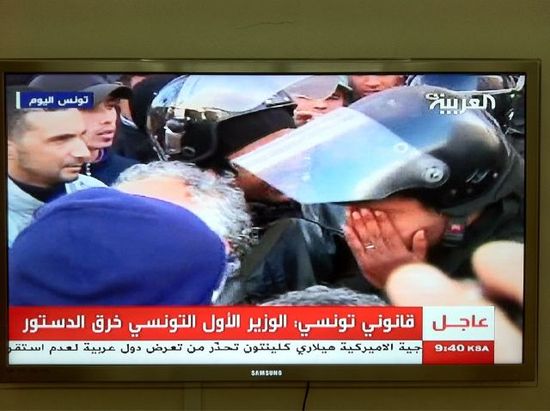
Scott Lucas captures it: "A crying policeman comforted by protesters".
Greg Scoblete uses the events in Tunisia to explore the US relationship with the Middle East:
As much as I agree that the U.S. should not be on the side of Middle Eastern/North African autocrats, the idea that we can simply throw those same autocrats under the bus while simultaneously holding onto the notion that America is the provider of stability and security in the Middle East is untenable. The U.S. pact with the devil in the region is born directly from a set of U.S. interests in the region – the defense of Israel and the stability and security of oil exporters. If you want to junk the autocrats, as I think would be wise over the medium term, then you have to redefine America's role with respect to those interests.
Who do you interact with on a daily basis?
Although learning people’s names takes a little bit of time (you must strike up a conversation), I’ve found that the act has incredible uncluttering benefits overall. Had I not started talking with my butcher, I’d have never known that I can order a quarter of a cow (instead of a whole cow) from a local grass-roaming, organic farm each year and that the butcher will cut up the meat for me exactly how I ask him to, free of additional charge (well, I do give him a nice tip). Buying a quarter of a cow has saved me incredible amounts of money (it’s insanely discounted compared to buying separate cuts of meat) and time (I don’t have to run to the store). Twice, I’ve called the receptionist at my hair salon and she has found a way to get me on the schedule at the last minute, and I haven’t had to whine or beg or threaten or do anything other than ask nicely.
The mail and package delivery folks always wait for me to answer the bell, instead of slapping a sticker on the door and driving away like I know some of them do. I get my package on the first delivery attempt instead of having to go to a central office to pick something up or wait another day. Bus drivers have waited for me as I’ve hurried down the street. Simply stated, my life runs more smoothly because I’ve taken the time to learn someone’s name and taken a sincere interest in what they do.
Evgeny Morozov dismisses the notion:
What strikes me about events in Tunisia is that social media seems to have failed in what many of us thought would be its greatest contribution (outside of social mobilization) – that is in helping to generate and shape the coverage of events in the mainstream media. On the contrary, despite all the buzz on Twitter it took four weeks to get the events in Tunisia on the front pages of major newspapers, at least here in the US (the situation in Europe was somewhat better – and it was way better in the Middle East – for all the obvious reasons).
This is an odd standard. The core test is whether Twitter and online activism helped organize protests. It appears they did, even through government censorship. Wikileaks also clearly helped. So did al Jazeera, for those who see it entirely as an Islamist front.
This is not to deny that many of us were watching the Tunisian events unfold via Twitter. But let's not kid ourselves: this is still a very small audience of overeducated tech-savvy people interested in foreign policy. I bet that 90% of Twitter users are not like that – and that percentage will get worse as Twitter becomes more mainstream. So, if we evaluate it in terms of awareness-raising by exploiting and building off the mainstream media, Tunisia's "Twitter Revolution" (as Andrew Sullivan was already quick to dub it), seems to have failed.
("Dubbing" is quite a stretch – the Dish merely aired Ethan Zuckerman's essay exploring the question.) Adrian Chen is also cynical of the social media aspect of the coup:
Nobody's citing Foursquare yet, but it's only a matter of time before some journalist finds a few protestors checking into a riot.
We'll soon have more facts and memories to help us assess the influence of new media on this event. I remain of the view that it can help a great deal, but is never, of course, sufficient.
Bernstein suspects Republicans aren't serious about healthcare repeal:
Republicans certainly didn't hesitate to oppose the bill in 2009-2010 despite the support from several groups who are normally GOP-aligned or at least GOP-friendly. Will they fight against the interests of those groups now? Will they, if they win full control of Congress and perhaps the White House in the near future? I don't know. What I do know, or at least suspect, is that industry lobbyists aren't really going to care one way or another about purely symbolic votes on the floor of the House. If that's all it takes to satisfy GOP activists, well, that's a deal that the lobbyists will be very happy to make.
So here's a question: if the GOP is prepared to hold purely symbolic votes, why not pass a balanced budget that the president is forced to veto? Why are Republicans unwilling actually to propose real cuts in entitlements and defense, the only way to fiscal sanity?
Or are they that unserious about fiscal conservatism as well?
Michael Chabon wrestles with the conclusion of the president's Tucson speech – where Obama memorably said that "If there are rain puddles in heaven, Christina is jumping in them today":
There is no heaven, man. The brunt, the ache and the truth of a child's death is that he or she will never jump in rain puddles again. That joy was taken from her, and along with it ours in the pleasure of all that splashing. Heaven is pure wishfulness, an imaginary solution to the insoluble problem of the contingency and injustice of life.
But I've been chewing these words over since last night, and I've decided that, in fact, they were appropriate to a memorial for a child, far more appropriate, certainly, than all that rude hallooing. A literal belief in heaven is not required to grasp the power of that corny wish, to feel the way the idea of heaven inverts in order to express all the more plainly everything—wishes, hopes and happiness—that the grieving parents must now put away, along with one slicker and a pair of rain boots.
Ezra Klein likewise thought the rhetorical flourish cheap. I think Obama's fatherhood probably led him to the slight excess.
 The Dish