"Never has such arrogance been combined with such utter incompetence and weakness in the White House. The result? We have the single worst President in American history and his first term's not even over yet," – John Hawkins, RightWingNews.
Month: January 2011
Chart Of The Day
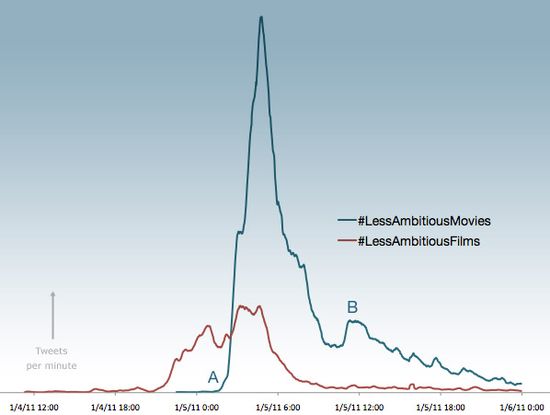
Twitter's Robin Sloan examines the history of a hashtag:
There's a lesson lurking here, but to see it, you need to scroll back up and look at the point marked "B" around midday GMT on January 5. The little bump you see there happens when Katy Perry retweets a #LessAmbitiousMovies Tweet. Now, it's pretty amazing to see a single account cause an inflection point like that. But notice that even with 5.2 million followers, Katy Perry didn't send #LessAmbitiousMovies into orbit again.
No: there was something special about the people who follow Lizz Winstead and Barracks O'Bama. There were fewer than 35,000 of them, but they were more attentive and more engaged — and maybe just funnier, too? — and it was their collective creativity that made #LessAmbitiousMovies briefly ubiquitous.
(Hat tip: Alexis)
Paranoid Narratives
David Frum zeroes in on the sort of rhetoric that's worth worrying about:
The problem is not military metaphors. It's not Glenn Beck joking about poisoning Nancy Pelosi's wine or Paul Krugman hanging Joe Lieberman in effigy at a party. The problem is, rather, the construction of paranoid narratives that might justify violence to a violent-minded person. When scruffy protesters drew swastikas on photographs of President George W. Bush, that was obnoxious. It was not likely to incite anyone. But when eminent persons argued on the public airwaves that the United States had been lied into a frustrating war in Iraq by a cabal of Jewish conspirators? That’s a very different matter.
Likewise, it's grossly ill mannered for a member of the House to shout "You lie!" at a president during a State of the Union address. Yet the republic staggered on somehow. What does do damage to the fabric of democracy is the charge made by prominent conservative broadcasters that the president is deliberately wrecking the U.S. economy to advance his scheme to overthrow the constitution and transform the nation into a Marxist or Leninist or even Maoist tyranny.
Or a Kenyan anti-colonialist's paradise.
The President And The Right
A very shrewd post from Greg Sargent. Money quote:
It's true that Obama stated clearly there that rhetoric didn't cause the shooting. But these lines are best understood as a set up to the larger point that followed, which is that the shooting confers a moral obligation upon all of us to improve the tone and integrity of our discourse. If Obama had delivered this latter message in isolation, without the set up, conservatives would have rejected it as political, as criticism directed at them.
A Journey, Not An Escape, Ctd
A reader writes:
I have been following your blog for some time, and I have really enjoyed the occasional post on psychedelics. I've read about psilocybin, LSD, and ayahuasca, but never about a plant that changed my life years ago: ibogaine. It is native to West Africa, and people who experiment broadly with psychedelics consider it the most powerful drug in the world.
During my junior year of college, I found myself sinking into a depression. On the surface, my life looked quite good, but something still felt wrong. I had been raised to believe that happiness came from successfully achieving your goals. I had achieved some fairly ambitious ones, and had acquired considerable respect from my peers, but happiness eluded me. Even worse, I had no hope that life would get better. I started drinking myself into blackness twice a week and watching a lot of TV, desperately hoping that one day I would feel better. When I decided to try ibogaine, I was nearing the end of my rope. Despite my antipathy towards drugs (aside from the occasional joint), I figured it could not hurt.
Ibogaine stays in your system for 48 hours, and the first 24 hours of my session were the most horrible 24 hours of my life.
Every single thought that I normally repressed came into my awareness – and I was forced to look at them without any filters. I saw that I had no idea who I was, and so I desperately sought other people’s approval. Everything I did, all my plans, were simply to make people give me positive feedback.
I also saw that everyone else was in the same boat. Society was one big lie – we all hide our suffering behind a façade of confidence and forced happiness, hoping that it will just go away. I saw images of people’s faces: friends, parents, teachers, politicians; and I saw the desperation hiding just behind their eyes. Finally, I saw how human beings are never truly happy. We may have a few moments of happiness in a long lifetime, but mostly we jump from one distraction to the next until death takes us. After 20 hours of visions like these, I drifted into sleep.
I woke up several hours later and sat down outside, staring into the trees behind my house. Physically I was fine, but emotionally I felt horrible. How could I possibly function in the world, knowing that life is a pointless joke? I realized I could not go back to my old self, but who would I be? I assumed my girlfriend would leave me, all my friends would grow tired of me, and my parents would stop loving me. And forget about a career. How could I possible compete with people who believed that success would bring them happiness? So I just sat in my deck chair, mentally preparing myself for a life of loneliness and menial work.
And then the bottom dropped out. Somewhere, deep down in my psyche, I accepted everything I had seen on ibogaine. I accepted that I did not know who I was; I accepted that all my previous plans were based on getting people’s approval; and I accepted that happiness cannot be achieved. And with this acceptance came an extraordinary bliss and that can only be described as religious. I saw light everywhere, and felt an intense love coming into me and through me. Over the next 24 hours, as the ibogaine left my system, this joy receded into the background and my normal mind slowly came back.
But I never returned to the person I had been before. A sense of peace is always there in the background, and while it can get obscured by the mind, it never goes away. I still don’t know who I am, but I don’t need to know. I stopped chasing after happiness, because I know happiness is my natural state. And my relationships did not fall apart; they were actually strengthened by an increase in love. Even my career in mainstream international economics has gone well. It turns out people really appreciate genuineness and authenticity.
This happened six years ago, and in this time I have come across many accounts of similar transitions; some with psychedelics, some with meditation or prayer, and some without any outside help. In comparison, my experience was relatively easy. Ibogaine was like a decade of psychotherapy and meditation rolled into one night, and while it was a horrible night, it saved me from years of suffering.
(Photo by Megan Scheminske)
One Space, Not Two
After this past week, it's time to address a truly burning issue in our culture: the double space after a period. In a thoroughly enjoyable rant, Farhad Manjoo begs his e-mailers to lay off the spacebar:
The people who study and design the typewritten word decided long ago that we should use one space, not two, between sentences. That convention was not arrived at casually. James Felici, author of the The Complete Manual of Typography, points out that the early history of type is one of inconsistent spacing…
Every modern typographer agrees on the one-space rule. It's one of the canonical rules of the profession, in the same way that waiters know that the salad fork goes to the left of the dinner fork and fashion designers know to put men's shirt buttons on the right and women's on the left. Every major style guide—including the Modern Language Association Style Manual and the Chicago Manual of Style—prescribes a single space after a period.
Says one expert:
I talk about 'type crimes' often, and in terms of what you can do wrong, this one deserves life imprisonment. It's a pure sign of amateur typography.
Megan erupts:
Let me just add: if you're spending time worrying over whether my emails contain one or two spaces, you need to ask them to let you out of the asylum more often so you can pursue a more interesting hobby. I double space after sentences because I learned to type on a manual typewriter, and it's not worth the effort to retrain myself.
Tom Lee dissents.
Tunisia’s Wikileaks Revolution, Ctd
Earlier this week, in a piece that has proved prescient, Elizabeth Dickinson discussed how certain unflattering cables "acted as a catalyst" for the coup:
The country's ruling family is described as "The Family" — a mafia-esque elite who have their hands in every cookie jar in the entire economy. "President Ben Ali is aging, his regime is sclerotic and there is no clear successor," a June 2009 cable reads. And to this kleptocracy there is no recourse; one June 2008 cable claims: "persistent rumors of corruption, coupled with rising inflation and continued unemployment, have helped to fuel frustration with the GOT [government of Tunisia] and have contributed to recent protests in southwestern Tunisia. With those at the top believed to be the worst offenders, and likely to remain in power, there are no checks in the system."
Of course, Tunisians didn't need anyone to tell them this. But the details noted in the cables — for example, the fact that the first lady may have made massive profits off a private school — stirred things up. Matters got worse, not better (as surely the government hoped), when WikiLeaks was blocked by the authorities and started seeking out dissidents and activists on social networking sites.
Vikash Yadav highlights how the hacktivist group "Anonymous", which made its name targeting Mastercard and Paypay for boycotting Wikileaks, retaliated against government websites. The truth is: this is a major, er, coup for Wikileaks and the transparency it promotes – especially against tyrants like Ben Ali.
Mental Health Break
A visually involved video from The Freelance Whales:
Freelance Whales – Enzymes from NEUE on Vimeo.
Quote For The Day II
"You show me an actor doing a shit movie, I'll show you a guy with a bad divorce," - Bill Murray.
The “Job-Killing” Healthcare Bill
Ezra Klein sets things straight:
There's no "job-killing" health-care law. There's only the health-care bill. And my problem with the modifier "job-killing" isn't that it's uncivil, though perhaps it is. It's that it's untrue.
The GOP lifted the claim from this Congressional Budget Office report (pdf) — but the report never says the bill will kill jobs. What it says, rather, is that the law will slightly reduce labor. It's not that employers will fire workers. It's that potential workers — particularly older ones — will retire somewhat earlier. "The expansion of Medicaid and the availability of subsidies through the exchanges will effectively increase beneficiaries’ financial resources. Those additional resources will encourage some people to work fewer hours or to withdraw from the labor market."
 The Dish