Exiting Egypt

by Patrick Appel

ABC News reports:

The U.S. Embassy in Cairo says it is arranging to begin flying Americans out of Egypt on Monday. The announcement Sunday evening comes hours after the embassy advised Americans in Egypt to consider leaving as soon as possible. The statement said the State Department is making arrangements to provide those who want to leave with flights to "safehaven locations in Europe."

Earlier State Department travel advisory here. For Americans in Egypt who want to leave, the State Department's Bureau of Consular Affairs official twitter is probably worth keeping an eye on.

Design Dieting

US

by Zoe Pollock

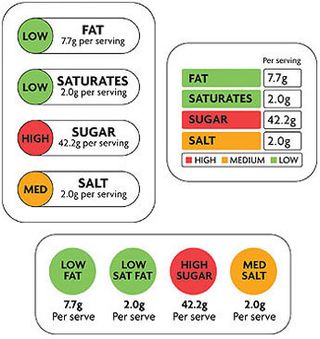
Peter Smith questions the "junk design" of the new food labels from the Grocery Manufacturers Association and the Food Marketing Institute:

[W]hat the new icons really lack is a clear signal about whether, say, 25 percent of the daily value of saturated fat a good thing or a bad thing. Which may be a case when colors could help send a clearer message.

He offers the United Kingdom's as a counterpoint, after the jump:

  UK

A Crackdown Coming?

by Patrick Appel

 Stratfor reports:

[A]ccording to STRATFOR sources, the Egyptian military and internal security forces have coordinated a crackdown for the hours ahead in an effort to clear the streets of the demonstrators. The interior minister has meanwhile negotiated his stay for the time being, in spite of widespread expectations that he, seen by many Egyptians as the source of police brutality in the country, would be one of the first ministers that would have to be sacked in order to quell the demonstrations. Instead, both Egyptian President Hosni Mubarak and al-Adly, the two main targets of ire for the demonstrators, seem to be betting that they can ride this crisis out and remain in power. So far, the military seems to be acquiescing to these decisions.

Diplomat As Novelist

by Zoe Pollock

 Ken Silverstein returns to Wikileaks cables as literature:

[D]iplomats are trained to chronicle the same tics and quirks of character that masters of fiction carefully record—and often with the same aim, of penetrating the surface equanimity of the characters they depict in order to win through to some more essential truths about their motivations. There's a reason, after all, that the fictional world, like the diplomatic one, is governed by plots—and that both fields share a comfort with moral ambiguity and casual deception that you don't find in most other endeavors.


What Benefits Islamists?

by Patrick Appel

Danielle Pletka argues that "the truth is that our support for secular dictators does more for Islamists than democracy promotion ever did." Larison differs:

I have seen some variant of this several times over the last few days. It is such a brazen lie that I marvel at how frequently some have been saying it, and how few people have objected to it. U.S. support for secular authoritarian rulers doesn’t do very much for Islamists. It does focus Islamist political grievances on the U.S. as a patron of those governments, but that isn’t actually much of an advantage for them.

In Tunisia, which had what was in some respects the most repressive police state of all Arab authoritarian states, Islamists ceased to matter politically because the government suppressed them so severely. When the U.S. and France encouraged the Algerian government to ignore the results of the ’91 election, that didn’t help the Islamists in Algeria who were poised to take power, but instead triggered an awful civil war that resulted in the defeat of the Armed Islamic Group (GIA) and the overall weakening of Islamist opposition to the government. Throughout all of this, as ugly as it was, the U.S. supported the Algerian government, and this was not exactly a boon for Algerian Islamists.

Shades Of Right And Wrong

by Zoe Pollock

Elon James can't stand the treatment of Kelley Willams-Bolar, a mother who falsified records to send her children to a better (whiter) school:

My initial reaction to this was outrage. I sat at my computer, heart pounding, eyes tearing, because when you peel off all the layers, you have this: a woman (who works with special education children and was attending school for her teaching degree) is being vilified because she wanted something better for her children. And we can't possibly ignore the racial aspect of this situation. A poor BLACK woman on public assistance is being jailed for sending her kids to the rich white school. I'm not arguing whether this is how it should be looked at; I'm saying that is how it is looked at. It's questionable at this point whether the teaching degree she's been working toward will be allowed, because she has a felony charge against her. A family's life is in virtual ruins because of this situation.

And many say she deserves this.

Becoming The Story

by Zoe Pollock

Lydia Cacho considers the price of international investigative reporting:

 There are always those who demand drama: a few tears from the Mexican journalist who was tortured and imprisoned, then raped in order to ensure her silence, feeds the morbid desire for titillation, not for indignation. In Uganda, the reporter whose hands were mutilated by the military in order to stop him ever writing again is asked to display his stump as if begging for pity. The media ask the Iraqi journalist to recount a hundred times over how US soldiers murdered her children to quell her voice, and how she herself washed their little bodies alone in her house. They insist the South African poet stops reading his verses of love and hope and instead relives the darkness of his cell, shows the camera the marks of the torture he has spent the last ten years trying to forget, and explains how the love of his family faded to the point where, one autumn afternoon, nobody at all came to visit him in prison.

And they ask the Russian woman journalist – only two months before she dies – "Are you afraid that they'll kill you? Have you ever thought what might become of your children?" To which she stoically replies, as one who recognises her struggle as moral as well as political must reply, that for as long as the lives of others are not secure, then neither is our own. Later, alone in her hotel room, she calms her sobs by burying her head in a feather pillow. In her dreams, she begs her children's forgiveness and visualises a world in which those who tell the truth – about shameful acts of war and humanity's incapacity to negotiate conflict, about the rapaciousness of the powerful, who use war to exterminate or for the acquisition of material goods – do not pay with their lives.

Dissent Of The Day, Ctd

by Patrick Appel

A reader writes:

I study political narrative for a living (for instance in books like this), and while I agree with the reader who saw The King's Speech that narratives obviously do take hold and drive coverage of events like those in Egypt, I disagree that this has been a very noticeable problem in this case – either on the Dish or on CNN, which I’ve been relying on for TV coverage. If anything, the story as it’s being told at the moment lacks narrative “oomph”: the protestors are consistently identified just as protestors (which they clearly are), not “freedom fighters” or “the pro-democracy movement” or with other such loaded terms, and we’re constantly reminded of the ambiguities of Mubarak’s rule and the uncertainty over what might follow it.

Although not many people who favor freedom and political rights are unhappy to see a dictator in trouble, there’s remarkably little Hollywood-style cheerleading for the “good guys” to win, or even clarity about who they might be. (I am listening to a CNN reporter at this moment wondering aloud which side the army is on, and quoting protestors with different views about this. That kind of ambiguity is just not what we’d see in a feel-good Hollywood film.)

All this may just be happenstance, and in another case, where the facts are different, the ready-made narrative might well overwhelm the reality on the ground. We’ve seen that happen many times. But I think your other reader also overlooks two further points.

First, we can’t avoid narratives – they’re the basic structure of how human beings think. Without narrative, all we have is chaos. And second, it’s not necessarily the case that the first narrative imposed on fast-breaking events will stick. Even when powerful agencies are pushing a particular storyline, as the Bush Administration did in claiming that “freedom” (as opposed to Shi’ite client rule) had been brought to Iraq, the reality may be different enough that most people won’t buy it. And some narratives prove to be fluid, dynamic, and open to fairly rapid revision as events unfold.  Whatever we make of developments in Egypt today, there’s no reason to assume we’ll still be seeing them through the same framework a year or two from now, or even a week or two from now.