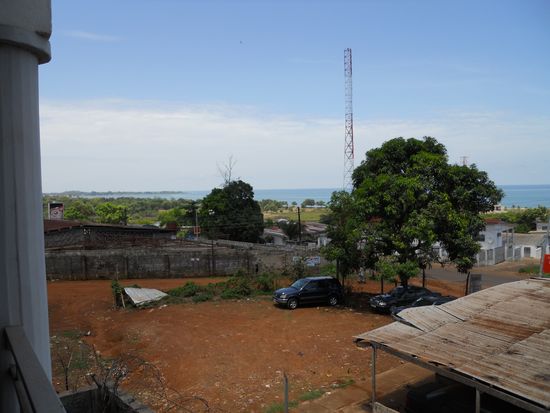
Freetown, Sierra Leone, 12 pm
Freetown, Sierra Leone, 12 pm
Nancy Goldstein scrutinizes the claims:
If Palin is receiving death threats, especially at allegedly "unprecedented levels," all of us should be concerned. But Palin should be calling the police or the FBI, not mere "security experts," as reported. To neglect engaging law enforcement is a disservice to her own safety and the safety of her staff and family. Yet neither Palin's staff nor the news outlets elaborate on this point, except to admit that the former has not signed off on changing Palin's security arrangements. The media, however, has clearly been alerted.
A reader writes:
Sarah has lied about almost everything. You are believing her now why?
Apparently, even Bill O'Reilly is not safe enough an interview. So Palin is now not only not engaging with the media as every other politician does, she is not engaging with parts of Fox News either. Even though they pay her as an "analyst" to do puff-ball interviews promoting herself.
Larison collects his thoughts:
Ben Ali and his family are now out of power, and publicly the U.S. had no hand in any of it. That could well be the best outcome for Tunisia and the U.S. In any case, the Tunisian protesters have evidently succeeded in forcing Ben Ali out without U.S. support, which can only help make their success appear more legitimate in the eyes of Arab publics elsewhere. There was no reason for the U.S. to insert itself publicly into the dispute, and more important the Tunisian protesters apparently did not need the U.S. to become publicly involved. Tunisians attended to their own affairs, and successfully deposed an autocrat. Instead of dwelling on our failure to meddle publicly, let’s take some satisfaction that Tunisians didn’t need Americans to “speak out” or “take a stand.”
Lets also remember that Ben Ali was close ally of the US.
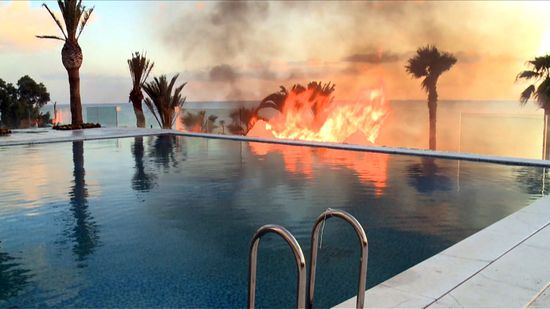
There seems little doubt that the Wikileaks-released cable describing the opulence of now former president Ben Ali's lifestyle played a key part in bringing him down. Here's a fascinating account from a young Tunisian about the series of events:
The internet is blocked, and censored pages are referred to as pages "not found" – as if they had never existed. Schoolchildren are exchanging proxies and the word becomes cult: "You got a proxy that works?"
We all know that Leila has tried to sell a Tunisian island, that she wants to close the American school in Tunis to promote her own school – as I said, stories are circulating. Over the internet and under the desks, we exchange "La régente de Carthage" [a controversial book about the role of Leila Trabelsi and her family in Tunisia]. We love our country and we want things to change, but there is no organised movement: the tribe is willing, but the leader is missing.
The corruption, the bribes – we simply want to leave. We begin to apply to study in France, or Canada. It is cowardice, and we know it. Leaving the country to "the rest of them". We go to France and forget, then come back for the holidays. Tunisia? It is the beaches of Sousse and Hammamet, the nightclubs and restaurants. A giant ClubMed.
And then, WikiLeaks reveals what everyone was whispering. And then, a young man immolates himself. And then, 20 Tunisians are killed in one day.
(Photo: A video grab shows a fire at a residence said to be owned by a member of Tunisian President Zine El Abidine Ben Ali's inner circle. By Clotilde Gourlet/AFP/Getty Images.)
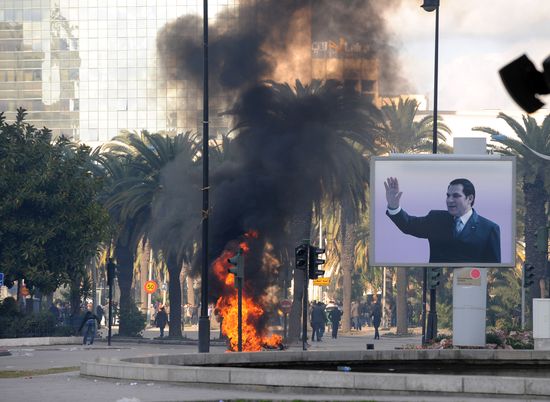
Dramatic scenes from today's protests that culminated in a coup:
Yglesias thinks not:
If the President goes and leads the charge for tax reform, what happens is that tax reform passing becomes “a victory for the White House” and we start getting stories about “President Obama’s goal of overhauling the tax code.” And a proposal like that will be dead on arrival. Fundamental tax reform has a chance if and only if there’s a bipartisan group of hardworking members of the House and Senate who sincerely want to reach consensus on a tax reform proposal.
So why on earth shouldn't the president try and get this started? I think Matt is seriously wrong here – and my own personal test for the seriousness of this presidency from here on out is its commitment to long-term fiscal balance and tax reform. Readers know I am sadly underwhelmed by the sincerity of the GOP on the debt. I don't believe they are serious, although I want to. But if they prove their intent in a manner that actually risks unpopularity – as the Tories have done in Britain – they will get no more enthusiastic supporter than yours truly.
"The historical significance of what happened in Tunisia is huge. This is the first time an Arab dictator is overthrown by a popular uprising. It is too early to speculate whether this will or can spread, but I think one lesson is too obvious: the Arab people has realized that overthrowing a regime is much much easer than they had thought. If the Iranian Revolution had an impact on Arab politics, this will certainly have an impact," – As'ad, at angryarab.
Blake Hounshell reacts to the sudden transition of power from Ben Ali to Prime Minister Mohamed Ghannouchi, "a colorless functionary in his late 60s":
This may not solve the crisis. Ghannouchi is not necessarily any more popular than Ben Ali, though he's not nearly as tainted by the lurid tales of corruption and excess that so damaged the ruling family. But Tunisians certainly don't respect the prime minister; they call him "Mr. Oui Oui" because he's always saying yes to Ben Ali.
Larison's take:
It remains to be seen if the rest of the regime survives, but it seems likely that without Ben Ali as the focus of public anger the interim government might be able to quiet things down.
The “Tunisia scenario” looks remarkably like the overthrow of Bakiyev in Kyrgyzstan, and somewhat like Kyrgyzstan the Tunisian riots exploded out of a combination of resentment against corruption in the ruling family, rising prices, and authoritarian government. We can hope that Tunisia will not be wracked by the factional violence that plagued Kyrgyzstan after Bakiyev’s fall.
Elizabeth Dickinson spoke with a Tunisian opposition journalist:
"There will be a military coup — we will see. You will see," [Taoufik] Ben Brik told me. "The army has just closed down the airspace in Tunisia, and they are arresting members of the family."
Max Boot believes "the end of Ben Ali’s long-lived and heavy-handed rule is not to be mourned, even if he was a reliable American ally":
[Today's coup] is either good news or bad news. It all depends on what comes next. If Tunisia makes the transition to democratic rule, that would be an epochal development that could influence neighboring states in a positive way. If another dictator comes to the fore, that would not be so good. Even worse would be if that dictator emerges from the Islamist fringe. Stay tuned.
(Photo: Smoke rises from fire left after clashes between security forces and demonstrators in Tunis on January 14, 2011 after Tunisian President Zine El Abidine Ben Ali's address to the nation. By Fethi Belaid/AFP/Getty Images)
Tim Heffernan showcases the humble list. Dish fave:
"I'm sorry that I'm not so hoity-toity."
But she did apologize for being late to a 9/11 rally. So, strictly speaking, it has happened.
 The Dish