Pockets Of Drunken Resistance

Jacob Sullum points out that prohibition "was resisted in the wetter provinces of America, where the authorities often declined to enforce it":

[Prop 19's] detractors claimed legalizing marijuana at the state level would run afoul of the Supremacy Clause, which says “this Constitution, and the laws of the United States which shall be made in pursuance thereof…shall be the supreme law of the land.” Yet even under a prohibition system that, unlike the current one, was explicitly authorized by the Constitution, states had no obligation to ban what Congress banned or punish what Congress punished. In fact, state and local resistance to alcohol prohibition led the way to national repeal.

He later writes that this precedent should be treated with caution given "federalism isn’t what it used to be."

A Human Brain Of Ones and Zeros?

Timothy B Lee dashes the hopes of transhumanists everywhere when he writes that we'll never be able to "emulate the human brain on a digital computer":

[Robin] Hanson’s fundamental mistake is to treat the brain like a human-designed system we could conceivably reverse-engineer rather than a natural system we can only simulate. We may have relatively good models for the operation of nerves, but these models are simplifications, and therefore they will differ in subtle ways from the operation of actual nerves. And these subtle micro-level inaccuracies will snowball into large-scale errors when we try to simulate an entire brain, in precisely the same way that small micro-level imperfections in weather models accumulate to make accurate long-range forecasting inaccurate.

The First Test

Kate Pickert previews next week's agenda:

Political truces in Washington are always fleeting and next week's health care debate will provide the first test of how long this one will hold. Of course, Republicans will proceed with their symbolic vote to repeal the Affordable Care Act. There's no reason they shouldn't. They have the votes to do so and they promised their constituents. The test will be in the tone of the thing.

There's no real ball to move forward here. Health care reform is the law of the land and, while it may be whittled down somewhat, it's not likely to be overturned by Congress. This means fear-mongering floor speeches from either side of the aisle will serve no purpose other than to land political blows and whip voters into a frenzy over their distrust of their political opponents. Will these kinds of over-simplified and even dishonest rhetorical excesses happen over health care next week? Probably. But there's an opportunity for things to go differently.

Capturing The Bloodshed In Tunisia, Ctd

Bassam Bounenni sketches out the censorship regime in Tunisia and how it's losing its grip:

The government has been caught off guard by the new media. Rioting young eyewitnesses have gone beyond the official sacrosanct principle of not leaking any "harmful" video. Since the early hours of the protests, they have become a dynamic and compelling news source for international media outlets. They have posted dozens of videos showing spiraling discontent and updated death tolls in real time.

Regarding the above Youtube:

Nawaat bloggers uploaded an extremely graphic clip showing the body of a man they identify as a university professor, “shot by the Tunisian government police’s snipers [Wednesday] during the protest in the southern city of Douz.

Enduring America compiled a series of clips from yesterday's unrest. More here.

The Daily Wrap

Today on the Dish, we rounded up the web's best reax on Obama's Tucson speech, where he called for a more civil and honest discourse, and Andrew characterized him as the most Christian president in recent memory. Conor proposed a civility pact for the blogosphere, Limbaugh's poster contradicted his defense, and this video evidenced how dangerous discourse has become. Andrew used "blood libel" in a historically appropriate manner, Joe Klein captured Obama's rhetorical power, and Politico dropped the ball. Sprung parsed Loughner's currency kick, Weigel made the case for enacting no Tucson-inspired legislation, Lee Woodruff shared the harder parts of healing a spouse's brain trauma, and more bloggers bucked against locking people up. Palin scrubbed her Facebook page in record time, Jennifer Rubin faulted her for surrounding herself with loyal amateurs, and even Jpod told her she needed to serious herself up. Chris Christie backed slowly away from her, and Palin's breath would keep Andrew awake tonight.

Tunisia had the Arab world on edge, Ethan Zuckerman wondered if it could be the next Twitter revolution, and the Internet captured the bloodshed and the spark that started it all. Andrew answered Greg Mankiw on what rich people deserve, Yglesias asked if the US caused the spike in global food prices, and Norquist kept conservative on a possible war in Lebanon. Pawlenty would reinstate DADT, and Serwer balked at the chaos it would cause. David Boaz summed up the CPAC controversy, climate change accelerated, and Palin intimidated future presidential candidates. Howard Gleckman pleaded for tax reform in the SOTU, the goverment could steal your tweets, and Jenny McCarthy couldn't let go of her vaccine conspiracies. Reihan hyped up the Florida Governor's new education reform proposal, and these were the five emotions invented by the Internet. Michael Chabon blogged, Wikipedia passed its own test, and it was hard to quantify the mechanics of beauty. A reader who wanted to adopt according to her own race defended herself, readers argued over neti pots and Sudafed, and a Cannabis Closet reader connected with "God." Chatroulette wanted to monetize more schlongs, Joan Rivers terrified Andrew, and a drag policewoman kept Baltimore on its toes.

Yglesias award here, VFYW here, comment of the day here, Glenn Greenwald's pledge drive here, chart of the day here, MHB here, and FOTD here.

–Z.P.
Tunisia’s Spark

Bouazizi

Theodore Dalrymple compares the Tunisian and Algerian riots to what the future holds for Europe. He also recounts the figure at the center of it all:

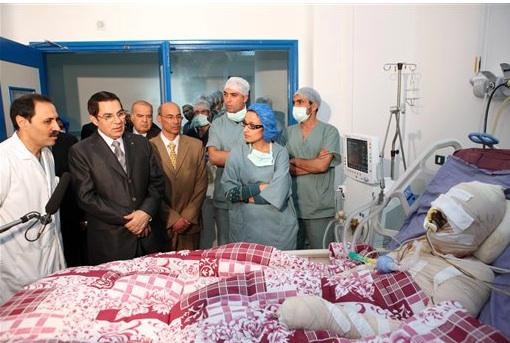
The story of the young Tunisian Mohammed Bouazizi, whose suicidal self-immolation was the spark that set Tunisia aflame, is instructive.

He was 26 and had a degree in computer science. Like 200,000 other university graduates in Tunisia (in a population of 10 million), he could not find a job. He then tried selling fruits and vegetables from a stall. However, he did not have bureaucratic permission to do this—such permission being bestowed by other university graduates, lucky or well-connected enough to have found jobs in the public-sector bureaucracy. The police constantly harassed him because he didn’t have the requisite licenses. It is said that he set fire to himself when a policeman spat in his face. …

The penny is not likely to drop soon regarding the fact that governments don’t create jobs; at best, they create the conditions in which jobs can be created. The future of Europe, I fear, can be discerned in Tunis and Algiers.

(Photo released by the Tunisian Presidency office.)

The Mechanics Of Beauty

Ok Trends finds that the "more men disagree about a woman's looks, the more they like her", which prompts them to conclude that there is "mathematical evidence that minimizing your 'flaws' is the opposite of what you should do." Alex Tabarrok reads the data slightly differently:

I think there are certain types of beauty that greatly attract some men but repel others. Analagously, some people will pay hundreds of dollars for an ounce of caviar that other people won't eat for free. The reason some people love caviar, however, is not that other people dislike it. Instead, it just so happens, that the thing that some people love is the very thing that repels others. We see the same phenomena in art, some people love John Cage, other people would rather listen to nothing at all.

Amanda Marcotte likewise finds Ok Trends' analysis wanting.

Glancing Up The Hill

Incomegraph

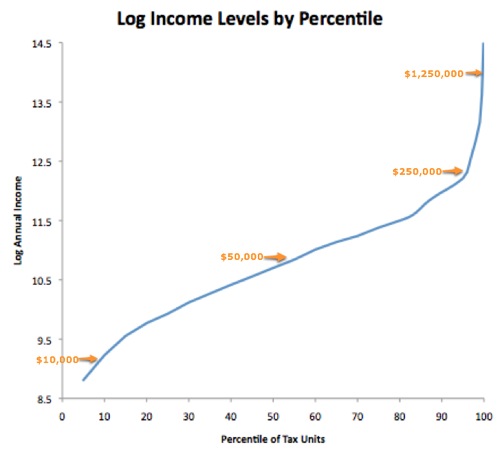
Krugman imagines that greater inequality can make the rich feel poorer. He assumes that individuals with similar incomes socialize together:

[I]f you’re in the middle of the income distribution, your uphill neighbor is about as much richer than you than your downhill neighbor is poorer, but in the upper reaches that’s no longer true.

“I’m Traumatized”

A reader writes:

I hope you’re right about Obama’s speech being a pivot point in our politics and culture. I know the Tucson shooting has forever changed the way I think – and will talk – about politics. My oldest and closest friend was one of the people shot on Saturday.

Thankfully, none of the three bullets (one in each arm, one in the back) hit bone, major arteries, or any organs. She is truly fortunate that she didn’t die while shielding her teen daughter (who was there to thank Congresswoman Gifford for allowing the girl to serve as a page for Gifford last summer) from the gunman. Her husband and son were also there, ran at the first gunfire, and then helped staunch my friend’s bleeding, etc. until she could be transported to a hospital.

As you can well imagine, all of them are traumatized. I’m traumatized. I’ve been politically involved on and off all of my life, but since this incident, I can’t stomach the rhetoric, have stopped reading many blogs and don’t know if I’ll ever have the same interest in politics again.

I was upset by the news of the shooting Saturday morning, hours before I knew my friend and her family were there. When I found out my friend was among the wounded, my feelings ranged from shock to the sheer unfairness that my friend, in particular, should be caught up in such a thing because she has always maintained a sensible calm with regard to politics, always looked at all sides (having her roots in Texas), and she is incredibly civil in all her words and actions.

I realize we’ll never know the shooters motives or real state of mind. Maybe the ‘me’ who ran around in the days before the last election dropping off fliers and talking to college kids about voting will venture back into political activity at some point. But right now, if somebody so much as says “tea party” I just want to cry — I’m so sad for my friend, her family, and the polarized state that the country has sunk to.