What You Feel Online

Leigh Alexander identifies "five emotions invented by the Internet." Example number one:

A vague and gnawing pang of anxiety centered around an IM window that has lulled.

During this time an individual feels unsure whether they have offended the IM recipient, committed a breach of IM etiquette, or have otherwise spoilt the presentation of themselves carefully crafted thus far thanks to the miracles of the textual medium. The individual must be at least vaguely aware that they are being vaguely paranoid, and must tell themselves things like ‘he probably just stepped away from the keyboard’ or ‘I know she is at work right now so perhaps she has stopped replying because she is busy.’

The Limits Of Gun Control

Adam Serwer writes that the following paragraph from Mark Kleiman's book, When Brute Force Fails, destroyed "basically any appetite I had left for gun control":

We might, with mighty effort against strong political resistance, manage to reduce the prevalence of handgun possession by 10 percent. Current studies suggest that such a reduction would be expected to shrink the number of homicides by no more than 3 percent, with no measurable effect on other crimes. Under current U.S. conditions, the project of substantially reducing violent crime by reducing the sheer number of guns may be a case of "you can't get there from here."

Face Of The Day

PigJoernPollexGettyImages

Young pigs are seen in their pen at the Ebsen organic farm on January 13, 2011 in Langenhorn, Germany. Organic foods retailers are reporting a surge in demand following a recent contamination scandal. Investigators are pursuing a criminal investigation against the leading employees at Harles and Jentzsch – which announced some of the fatty proteins they had supplied to animal feed producers was tainted with dioxin. German authorities responded by barring 4,700 mostly poultry and hog farms from selling their products until laboratory tests could guarantee them dioxin free. Organic farms have thus far been immune from the scandal since they use no industrially-produced animal feed. By Joern Pollex/Getty Images.

Locking Them Up, Ctd

A reader writes:

Galston’s article was refreshing. Anyone who has had close-up experience with extreme mental illness understands that there’s little you can do when your adult mentally-ill  mother, father, sister, brother or spouse refuses treatment. And don’t even think about intervening with a friend or neighbor!

My sister’s life has been ruined by some combination of bipolar disorder and schizophrenia, and our family has been unable to do anything about it.

If she “presents well,” the doctors and lawyers tell us, no judge will commit her, even if she is hostile and obviously (to us) unstable. We have watched her buy thousands of dollars worth of diamonds and throw them away; drink herself sick and get in a car; ramble on, when she’s not belligerent, about her TV talking to her – and on and on. Her doctors say we are powerless, and even the police when we’ve reported her missing can’t do anything about it. Her right to be nuts and to destroy her own life, in spite of herself, wins.

In the awful Arizona shooting, we read about everyone knowing he was deranged and scary – the community college professors, neighbors, friends, and probably his parents – as if something could have been done, or should have been to stop it. But what? Unless that person makes an explicit threat against others, or against himself, there is no recourse.

Another writes:

While I agree with those who wrote to caution about institutionalizing people for mental illness, I am reminded of one of my dearest friends who suffered from bipolar disorder.  She was a brilliant writer and one of the most engaging people I have ever known.  Several years ago she was 51/50'd (California code for mental disorders) and, according to the law, was given a hearing after three days to determine if she was a threat to herself or others.  While she was in the grip of a delusion about overthrowing the government of the Philippines, she was savvy enough to bring her published books to the hearing and the judge set her free.

Within several hours she sent out a fevered email to a long list of inappropriate people, many of whom replied when they recognized the symptoms of her disease.  It destroyed her career – decades of establishing herself in her profession were wiped out with one click of the mouse, and for the next several years until she died she had to rely on Social Security and the help of her children for survival.

I understand the limitations and cost of a true evaluation of each individual situation.  I don't know where the money will come from to reform these laws.  But my friend could have been a self-sufficient, contributing member of society if that judge had simply ordered her to be institutionalized and medicated for a bit longer – perhaps no more than two or three weeks.

Open-Source Authority

Clay Shirky marks Wikipedia's 10th anniversary:

An authority isn't a person or institution who is always right — ain't no such animal. An authority is a person or institution who has a process for lowering the likelihood that they are wrong to acceptably low levels. And over the last ten years, Wikipedia has been passing that test in an increasing number of circumstances.

The Hottest Year

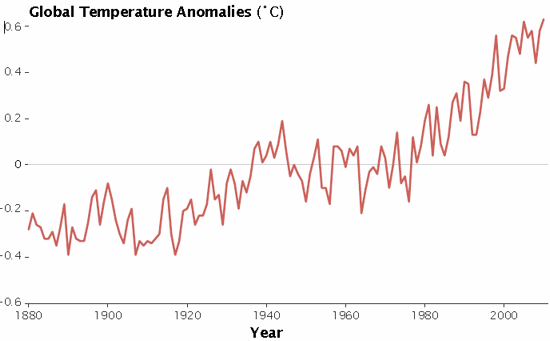
NASA-2010

2010 tied the record. Deny this:

2010 featured prodigious snowstorms that broke seasonal records in the United States and Europe; a record-shattering summer heat wave that scorched Russia; strong floods that drove people from their homes in places like Pakistan, Australia, California and Tennessee; a severe die-off of coral reefs; and a continuation in the global trend of a warming climate.

And Brisbane is now an underwater war zone and Brazil is grappling with mudslides of historic proportions. Ezra Klein warns:

There is no doubt, at this point, that we are leaving a warming world for the next generation. And this is not merely like leaving health-care reform undone, or infrastructure unbuilt: Those problems might persist, but they are not much harder to solve in 2020 than in 2010, or 1990. Climate change, however, doesn't merely persist. It accelerates. 

Unpredictably.

(Chart via Climate Progress)

Absorbing Last Night

TUCSONROSEKevinCCox:Getty

I'm inclined to see it as a potential pivot in our politics and culture, but it's obviously too soon to know. Today, I have been trying to find fault in it, and can't. I've read so many of your emails this past week I know some of you would have raised a pointed critique if it were plausible. None has appeared. And then I come across an email that reveals a depth of understanding you rarely find among professional pundits.

A reader writes:

I think we've just seen how a master works.  I tend to be lukewarm on most of Obama's speeches because, unlike Bill Clinton, he can't really sustain the "this is worth hearing, America!" impetus unless he really crafts the speech well.  He's not really an applause-line speaker (though that does seem to be what he aims for most of the time), but a Kennedy-esque "coiner" whose greatest strength is the philosophy of his phraseology.  Lines like "We are the ones we have been waiting for" make you pause, think, reflect – not stand up and cheer, necessarily – and stick with you well beyond the speech and even the context.  When Obama doesn't do that, when he's just lecturing or doing his "fired up, ready to go" bit, he's really not particularly great.

But what Obama did in Tucson was a magic trick. 

For one thing, he was able to maintain the gravitas of his message not only despite the crowd, but at times even heighten it because of the crowd–such as when he sort of laughed about how the guys tackled Loughner, as though it was such a heroic act that OBAMATUCSON2KevorkDjansezian:Getty even he couldn't believe it, turning a routine ceremonial thanks into something more personal.  (He also managed to maintain his tempo evenly throughout the 30 minutes, which is difficult to do even if you don't have impromptu cheers interrupting you and urging you in a campaign-style atmosphere).  For a speech that (presumably) wasn't designed for a pep-memorial, he made it work remarkably well.
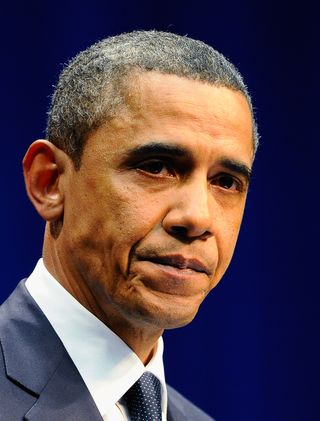
Secondly, he kept a fine balance between addressing the victims and addressing the nation–it would have been easy for this to turn into a "look at me, I have compassion for normal people" photo-op, and on the flip side, have it be a crass political speech using the dead as cover.

But if you look at the speech as a whole, it's truly remarkable what an illusion Obama pulled off.  Even as I was listening to it, I was somewhat perturbed by Obama's theme on "rather than pointing fingers or assigning blame"–a tacit rebuke of Democrats' criticism of Sarah Palin, despite the fact that no Democrat of any consequence has actually assigned the blame on anyone but Loughner; if we cannot scream at the top of our lungs at someone who is, for whatever reason or intention, whatever effect or consequence, indicating that people be "targeted" by the masquerade of a gun-sight, then what sort of healing can be expected when the eliminative harm-mongers can scream at the heal-mongers all they want? 

Yet as Obama's speech unfolded, realize what he did: he led, by example.  His speech was about community, brotherhood, love, understanding, listening, caring, healing, and yes, hope–all the things that are anathema to the world-view the Palinites are trying to espouse.  Obama effectively took the rug out from under them, baring to the American people the soul of this Stalin, this Hitler, this death-panelist, and showing us that he is none of those things.  You want to call Barack Obama Hitler?  Then show me Hitler's Tucson. 

So while Obama's words were more condemning of the Democratic discourse of the past few days, the speech itself was a ringing rebuke of all the Republican delusions, the delusions that the Democratic government is evil, that it's full of Manchurian candidates and sleeper agents and gran'ma-smotherers, that it's on the verge of turning America into the Union of the Third Reich of Kenyanistan.  In one fell swoop, Obama pulled his entire party away from the brink of confrontation with a weaponized political lunacy and stood, alone on a stage, staring all the hordes down, like Wyatt Earp at the OK Corral, daring them to draw their guns and aim their sights and try to take him down, that no cross-hair or brandished gun can stop the power of love and hope, that no bullet can defeat the strength of the human spirit to open its eyes, and that there is no hate that cannot be washed away by rainpuddles.

I am glad that this man is our President.

Me too. He is earning his Peace Prize – but at home more than abroad.

Meth 1; Drug War 0, Ctd

A reader writes:

A reader states, "Sudafed, etc. isn't effective anyway. Use a freaking neti pot, eat right, use steam and hot baths if you have a bad cold." Really?

Here's a study that counters that point. The conclusion was, "The results demonstrate that pseudoephedrine is a safe and effective treatment for nasal congestion associated with URTI. The results from the laboratory study on day 1 demonstrate by both objective and subjective measures of nasal congestion that a single dose of 60 mg pseudoephedrine is superior to placebo treatment."

Another writes:

While those who have an occasional cold might not mind going to a doctor for a prescription, those of us suffering from allergies more than half the year feel differently. Personally, there are literally weeks out of the year I would be debilitated without pseudo.  Nothing else helps (and yes, before other readers chime in, I've had scratch tests, shots, etc).  Nothing else works on those bad days.

Another:

I do use a neti pot, thankyouverymuch, and yes it is effective. But it serves a different purpose at a different stage in a sinus infection.  The pot won't do squat if your head is truly congested because there is literally no place for the water to go.  After a couple doses of Sudafed, those passages will clear up enough for the rinse to flow, and within a few minutes you'll be able to hock out that kaleidoscope of colors so familiar to sinus sufferers.

Another:

As a third-year medical student (and pharmacology doesn't get any more fresh than now for anyone not a pharmacologist), I can tell you that your reader's statement is completely and utterly wrong on virtually every point.  Neti pots are only marginally effective, and have been shown conclusively to actually increase the likelihood of additional colds (Nsouli TM, et al "Long-term use of nasal saline irrigation: Harmful or helpful?" ACAAI2009; Abstract O32.) I will, however, concede that steam can be helpful for relieving symptoms, which is all Sudafed does.

Sudafed has a known chemical pathway that is extremely effective at relieving nasal congestion by inducing vasoconstriction in the vessels of the nose, preventing fluids from emerging into your nasal cavity, which is the origin of that stuffed up feeling.  It also does this without severe tissue damage (a-la neti pot).  The same stimulating nature that stops fluids from getting into your nose counteracts the malaise that illness induces, producing relief of both a specific symptom and the general feeling of being "sick."     

I also take issue with this idea that drug companies are monstrous.  Drug companies are companies.  Some parts do amazing things, some parts do terrible things, but without them many people (for instance, you, Andrew) would not be alive.

Another:

It is one thing to pull a drug off the market because it is not effective or has detrimental side-effects for the patients for whom it's prescribed.  But to remove it entirely because it's abused by others makes no sense and is unfair.  There are many drugs that are available only by prescription that are also abused, yet the patients who need them still have access, despite others' abuse.

Capturing The Bloodshed In Tunisia

Robert Mackey is all over it:

One clip, uploaded by contributors to Nawaat — a group blog using Posterous, YouTube, Facebook and Twitter to spread news of the protests — showed a huge banner of the country’s president, Zine el-Abidine Ben Ali, being torn down in Hammamet on Thursday. As my colleague David Kirkpatrick reported from Hammamet, an exclusive Mediterranean beach town, “rioters calling for the ouster of Tunisia’s authoritarian president swarmed the streets, torched bank offices and ransacked a mansion belonging to one of his relatives.”

Despite apparent efforts by the government to keep Tunisians from using social networks to report on the crisis, new video continues to be posted day after day.

As the casualties mount, and the government continues to use violence to suppress the discontent, video of dead protesters has been added to Nawaat’s YouTube channel with disturbing regularity. On Thursday,  one extremely graphic clip, apparently filmed earlier in the day on the streets of Tunis, the capital, showed the body of a man the bloggers said was gunned down by a sniper.

Seen above. Enduring America is also covering the protests with its usual doggedness. Scott Lucas is live-blogging at the helm.