Sleeping On The Square, Ctd

Camping
by Patrick Appel

Heba Morayef is still blogging from Tahrir Square:

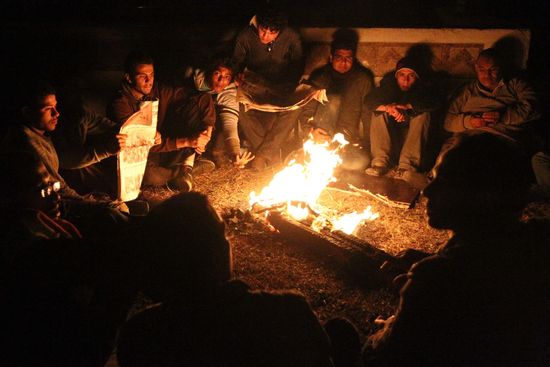
The square has emptied out since the afternoon but it's still a great atmosphere, a sense of solidarity, and very well-behaved – people are sitting around bonfires, or walking around picking up rubbish. Crowds who find occasional looters drag them over to the soldiers and hand them over. And no sexual harassment – which is not the norm downtown, especially when there are big groups gathering! We're happy to be eating koshary – thank goodness vendors are still selling street food because we're starving.

(Photo: Egyptian demonstrators sit around a fire to keep warm in Tahrir Square, in central Cairo, on January 30, 2011By Khaled Desouki/AFP/Getty Images)

“Cable companies: Add Al Jazeera English NOW!”

by Patrick Appel

Jeff Jarvis demands:

It is downright un-American to still refuse to carry it. Vital, world-changing news is occurring in the Middle East and no one–not the xenophobic or celebrity-obsessed or cut-to-the-bone American media–can bring the perspective, insight, and on-the-scene reporting Al Jazeera English can.

Strong Enough For Democracy?

by Patrick Appel

Massie collects his thoughts:

Pessimists, of whom there is no shortage, tell us that the [Egyptian] middle-class is neither ready nor strong enough to sustain anything that might even approach a western understanding of "democracy". Perhaps they are right. But do the liberal, moderate, middle-classes need to be quite that strong? Or do they need to be just strong enough to prevent a slide towards total extremism and the spectre of an Algerian-style civil war?

A Poem For Sunday

  108433685

by Zoe Pollock

"Together" by Charles Wright:

I wish I had the capacity
                                        to see through my own death.
Some flash light, some force of flame
Picking out diamond points
                                 of falling leaves and the river of stars.

This is the year I'm scraping the ice away from its sidewalks.
This is the year I've slid its shoes off.
This is the year I've started to keep it company,
                                                                           and comb its hair.

(Photo: Children play in the snow on January 27, 2011 in the Brooklyn borough of New York.Photo by Spencer Platt/Getty Images.)

Elections Amid Chaos

by Patrick Appel

The Working Group on Egypt has called "for free and fair elections for president and for parliament to be held as soon as possible." Max Boot is wary of immediate elections:

As we’ve seen in Iraq and Afghanistan, elections that occur in an atmosphere of instability can exacerbate that instability. This is an especially tricky moment in Egypt because Mubarak has ruthlessly repressed the secular opposition. The only large nongovernmental organization in the country is the Muslim Brotherhood. The Islamists would thus have an advantage in any immediate election, which could allow them to win, as Hamas won Palestinian elections in 2006, even though they have not been at the forefront of recent protests and most Egyptians would no doubt recoil from the imposition of an Iranian-style theocracy. (Whether the Brotherhood would in fact try to impose such a regime is unknown. Unfortunately, the only way to find out would be to let them take over.)

A safer alternative, to my mind, would be to call for Mubarak to step down immediately and hand over power to a transition government led by Mohammed ElBaradai, the secular technocrat who has recently returned to Egypt to become the most high-profile opposition leader. As is now happening in Tunisia, he could work with military support to prepare the way for elections in a suitable period of time — say in six months or a year.

Egypt In 2011, Ctd

by Patrick Appel

Andrew Exum has asked everyone to "to stop using European historical analogies to describe what is taking place in Egypt". One of his commenters counters :

All historical analogies are revealing up to a point and misleading thereafter, and that line should be specified. But comparisons themselves are not inherently misleading, and are often illuminating.

For example, I've written that Egypt is in a "1989 moment" – and that the question is whether we are in June or November. That's not Eurocentric (June is a reference to Tienanmen, obviously), and it is meant to illuminate a specific point which seems to me entirely relevant to an analysis of the situation in Egypt today, which is that the level of street protest seems to me to have reach a crucial political point where either a government-initiated bloodbath, or a government collapse (or possible both) seems unavoidable at this point. If that analysis is correct, then it clarifies policy and advocacy choices for all concerned.

Sleeping On The Square

by Patrick Appel

Protesters are camping out

Unwilling to let their movement disperse even for a few hours of sleep, many protesters are setting up tents or blankets in Tahrir Square, which has been a focal point of the nationwide protests. Democracy Now's Sharif Kouddous reports from Cairo, " A few tents in the middle of the square. Some people lying down on grass. Many will sleep here. They refuse to leave." It's a sign not just of the absolute dedication of many protesters, which has only strengthened since the demonstrations began on Tuesday, but the nagging anxiety, vaguely apparent in many interviews with the men and women filling Egypt's streets, that the movement could peter out, the momentum could be lost. 

Army As Kingmaker

MilitaryEgyptGetty

by Patrick Appel

Noah Millman hopes for "a transitional period orchestrated by the military"

The role of the United States is, basically, to try to smooth the way behind the scenes for something approximating a South Korean-type endgame, where a transitional regime affiliated with the old powers agrees to play by new rules, paving the way for an opposition coalition to win in the future. Is that possible? I don’t think anybody can say for sure. But we don’t need to know, because second-best outcomes follow the same path.

The worst-case scenario would be for Egypt to arrive at a truly revolutionary situation, with the collapse of the government and the seizure of power by a temporarily united opposition. This is the most likely scenario to lead to an Islamic regime, precisely because the Muslim Brotherhood is the most organized non-state political force, which privileges it in a situation of political chaos.

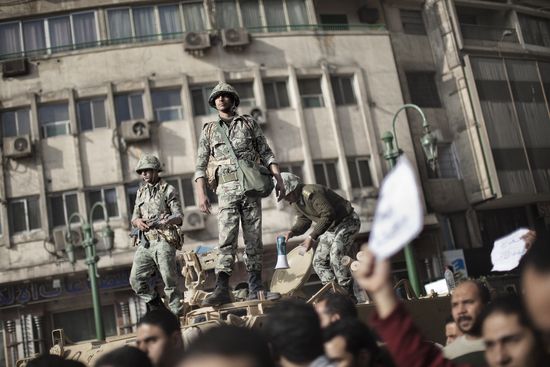
 Nearly as bad would be for the army to side explicitly with the Mubarak regime and crush the Egyptian people by force, as this would make the Egyptian regime transparently illegitimate, and would make it practically impossible for the United States to continue its relationship with Egypt as it has in the past (and the Egyptian regime would, undoubtedly, look for other sponsorship to shore up its position). The only way to avoid either scenario would be to rely on the military to ease the current regime out, and do so in a context of some dialogue with the opposition. This appears to be pretty much what the United States is quietly nudging the military to do behind the scenes.

(Photo: Eyptian demonstrators gather around an army position in Tahrir Square in central Cairo, on January 30, 2011. By Marco Longari/AFP/Getty Images)

The Arab Exception

by Patrick Appel

John Quiggin observes:

The idea that the US can legitimately use its military power to ensure continued access to oil resources rests, in large measure, on the (not entirely unfounded) assumption that those controlling the resources are a bunch of sheikhs and military adventurers who happened to be in the right place, with guns, at the right time. Without the Arab exception, the idea of oil as a special case, not subject to the ordinary assumption that resources are the property of the people in whose country they are found, will also be hard to sustain.

Yglesias nods:

Certainly if you were just to look at things in coldly rational terms, the resource-rich country the US should be seeking to dominate militarily is Canada, located conveniently next door. And, indeed, in the first half of the nineteenth century that’s how hawkish American politicians saw things. But it would be politically unacceptable in a modern context to try to bully Canada or Norway into coughing up oil.