Locking Them Up, Ctd

A reader writes:

I am chilled by your post about involuntary commitment quoting William Galston. I know there can be procedures, due process and guidelines – there already are. But strengthening them, quite frankly, frightens me.

A friend was involuntarily committed to a state facility because her mother lied to the judge.

She was denied medication, then improperly medicated, for epilepsy and bipolar disorder. She was humiliated and abused. My friend is a lawyer, a former law professor, and a victim's rights advocate. Even she was helpless.

I wish Jared Loughner had been treated or restrained too. But I'm unwilling to call for more government authority and encroachment on civil liberties until I'm convinced that existing law and procedures are insufficient.

Another writes:

There's a problem with involuntary commitment: it costs money. Publicly-funded money through higher taxes and whatnot. Didn't the United States see massive funding cuts to mental health services since the 1980s?  How much, let us ask, does it cost to keep someone with schizophrenia locked up and medicated on a monthly basis?

There's a second problem with involuntary commitment: who gets to decide who gets involuntarily committed?  Family members holding a grudge against an eccentric relative?  A social worker from the local government?  Just how bad does someone have to act in public to be determined a mentally unstable threat?  Because while those like Loughner might be easy to spot, there have been those who seem perfectly normal or socially well-adjusted who just suddenly snap under stress, and we're never going to be able to spot those right away.

Another:

I recommend everyone listen to the "This American Life" episode entitled "Pro Se".  It details the travails of a person who has tried to prove he is sane enough to be released, but everything he does to show his sanity is considered to be more evidence that he is insane. The individual is not particularly sympathetic, nor was I necessarily convinced that he was sane. But his story about his struggle does make me worry that we should have a better way to consider people able to be released before we start involuntarily committing more of them.
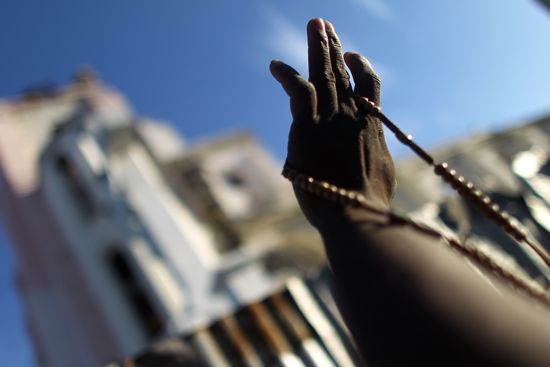
Navigating Misfortune And Joy

BeadsMarioTamaGetty

In the wake of the earthquake, John Seabrook adopted a girl from Haiti. He marks the anniversary of the disaster:

The truth is, I don’t want to associate the earthquake with Rose. And in some ways her arrival seems divorced from the earthquake or even from Haiti. She is our child now, not a refugee or a victim, not an orphan any longer. The small everyday responsibilities of being a parent—changing diapers, wiping a runny nose, reminding her to draw only on the paper, feeling pride in her accomplishments (she is incredibly smart, and that’s not just coming from a proud dad) and sometimes feeling overwhelmed by how much energy a small child takes—this is the stuff that’s real, and next to it the cosmic coincidence of her getting here seems like an grim abstraction.

(Photo: A mourner holds rosary beads outside the destroyed Port-au-Prince cathedral January 12, 2011 in Port-au-Prince, Haiti. Today is the one-year anniversary of the magnitude 7.0 Haitian earthquake which killed over 200,000 people. By Mario Tama/Getty Images)

Malkin Award Nominee

"Yeah, and Frank, this is very unusual for our country because despite a person’s ethnic background or religious background, when a war begins, we’re all Americans. But in this case, this is not the situation. And whether it’s pressure, whether it’s cultural tradition, whatever, the fact is the Muslim community does not cooperate anywhere near to the extent that it should," – Congressman Peter King, the new chairman of the Homeland Security Committee, speaking with conspiracy peddler Frank Gaffney.

The Muslim father of the undie-bomber, the Muslim father of the Portland bomber, and the Muslim vendor in Times Square must have slipped King's mind. Truly we live in Fox's World.

What Palin Should Have Said

Chait defends Palin. Ezra Klein agrees with yours truly on a very simple, obvious point:

Imagine if Palin had come out and said, "My initial response was to defend the fact that I had never condoned such violence, and never would. But the fact is, if I in any way contributed to an unhealthy political climate, I have to be more careful and deliberate in my public language rather than merely sharpen my defenses." That would've been leadership: It would have made her critics look small, and it would've made her look big.

The Palin Model, Ctd

Benen puts Palin’s video in context:

It’s a standard tactic — the right-wing media personality can’t subject herself to questions or muster the confidence to deal with cross-examinations, so to communicate, Palin’s forced to hide behind statements others write for her, and then upload them. It’s not exactly the stuff Profiles in Courage are made of.

And so the obvious central question that needs to be asked – “Even though you bear no responsibility for this murder, do you now regret putting metaphorical cross-hairs over Giffords’ district and name?” – is not asked. One of the more troubling aspects of the Palin phenomenon is its abdication of any actual adult responsibility or accountability. The press allowed this to happen in the 2008 campaign when they never united to demand an unscripted press conference. Now they are reduced to embedding Vimeo videos.

The Incoherence Of Palin

A reader notes:

How about this for logic:

1. "Acts of monstrous criminality stand on their own. They begin and end with the criminals who commit them."

2. "Especially within hours of a tragedy unfolding, journalists and pundits should not manufacture a blood libel that serves only to incite the very hatred and violence they purport to condemn."

In the first statement, she is saying that you can't incite people to violence, they stand on their own. The second statement, however, makes the opposite claim (that you can incite people to violence).

From Boy To Monster

Tony Woodlief fears "that one day it will be my son leering at the world like that Loughner boy, his loveless eyes like a demon’s, his smile divorced from joy":

It’s easy to imagine this only happens to the bad, bad children of bad, bad parents. I had such a notion, back when I thought I knew how to be a good father. But most days, these days, I struggle to be a decent father. I snap at one of my sons, and I see his heart close up. I get caught up in work or distraction and a precious day is gone, another day I didn’t knit up the ever-fraying bonds between father and sons. I want to believe a parent has to be utterly negligent to yield a boy gunning down people on street corners, but then I think of that woman weeping in her bed over her lost, monstrous son, and I don’t know. I simply don’t know.