Decoding Cities

Jessa Crispin makes an effort to understand her city of Berlin:

Sometimes it’s the tiniest moments that reveal the most about a city. I read Miranda Carter’s George, Nicholas and Wilhelm to try to understand better the lead up to World War I. But Carter spends so much time in palaces and at state dinners, in royal families’ parlors that I came away just as confused as before. But in a small aside, she mentions that Kaiser Wilhelm used to ask his generals to dress up in tutus and dance for his amusement. And they did. And suddenly I felt I understood a lot more about the German military and its leader, much more than from the book’s other 800 pages.

As a beautifully crafted counterpoint, the "Cities" episode of RadioLab offers a glimpse into how much we can infer from a city's statistics.

“Crazy”

Choire Sicha asks how we decide violence is crazy:

[P]eople commit heinous, antisocial acts of violence all the time and we don't think they're crazy. And on the other side? Most of society's "crazy people" (which range from perhaps you and I to a number of less "functional" people) don't actually commit violence. But in our minds, thanks probably to the TV, people are most crazy when they are 1. weird and 2. mass murderers. But then you have to start asking hard questions, like: is bin Laden a murderous monster who knows what he's doing? Or is he "crazy"?

A Threat Index

Nate Silver can't apply statistical analysis to isolated incidents because it is "almost impossible to come to meaningful conclusions about probability from a sample size of one." He suggests, instead, that we focus on threats:

If it turns out, for instance, that Democratic members of Congress are much more likely to receive such threats than Republican ones, that might tell us something meaningful. Likewise, if threats made against Mr. Obama routinely invoke his race, that could tell us something too. It might also be possible, with careful study, to see whether there is a correlation between the frequency of different types of political rhetoric and the number of such threats. …  [Such statistics] would probably provide us with considerably more insight into the risks posed by assassination, domestic terrorism, and other severe forms of political violence, than any degree of scrutiny of Mr. Loughner’s case could on its own. 

Rich And Poor, Here And There

Tina Rosenberg explains how conditional cash transfers have turned around Brazil's wealth disparity:

Today, however, Brazil’s level of economic inequality is dropping at a faster rate than that of almost any other country.  Between 2003 and 2009, the income of poor Brazilians has grown seven times as much as the income of rich Brazilians.  Poverty has fallen during that time from 22 percent of the population to 7 percent.

Contrast this with the United States, where from 1980 to 2005, more than four-fifths of the increase in Americans’ income went to the top 1 percent of earners. …  Productivity among low and middle-income American workers increased, but their incomes did not.  If current trends continue, the United States may soon be more unequal than Brazil.

The Missing, Ctd

A reader writes:

The two stories about unadopting a child reminded me of a series of articles about adoption I read in the New York Times last spring, in the aftermath of the Tennessee mother who returned her adopted child to Russia on a one-way flight. This article has some touching and informative interviews with families who have encountered unbelievable difficulties after adopting. But what left the most lasting impression on me was the Ranch for Kids Project, which provides adopted children from Russia with some respite. Video from the NYT here.

Another passes along more material:

I watched the film "Daughter from Danang" on American Experience several years ago. It is a very moving documentary about a bi-racial girl, given up by a Vietnamese woman in the "Orphan Airlift" of the 1970s. Her father was an American (white) Navy official. The adopted girl is raised in the South, "101% American," in circumstances that are far from ideal, and returns to Vietnam to meet her birth mother and half-siblings as an adult. To say she experiences culture shock is an understatement.

In intimate, beautifully shot sequences in Danang, the film follows mother and daughter over the course of their one-week reunion. And in painful, difficult scenes, viewers see the women's many hopes and expectations dashed as it becomes apparent that the cultural gulf between them is much larger than either ever imagined. In a final, wrenching confrontation, the gap seems unbridgeable.

In some ways, this story is an argument both for and against an immersion in "cultural heritage" – when the adoptive family is of a different race and culture from the adopted child. However, I think it is more about the tragedy of inequality; the Vietnamese family are terribly poor with few opportunities. If her family had been educated and middle class, the cultural shock would have been much less. Her adoptive mother is also a very questionable parent – you are left to ponder why she chose to adopt anyone, much less a non-white child. Sad all around.

“Pockets Of Imagination”

Ta-Nehisi is wary of the upcoming Great Gatsby adaptation:

As in so many of the books I love, I found the plot in ‘Gatsby’ to almost be beside the point. Whenever I see it translated to cinema, the film-maker inevitably crafts a story of doomed romance between Daisy and Gatsby. It’s obviously true that Gatsby holds some sort of flame for Daisy, but what makes the book run (for me) is the ambiguity of that flame. Does he really love her? Or is she just another possession signaling the climb up? I always felt that last point—the climb up—was much more important than the romance. What I remember about Gatsby is the unread books. His alleged love for Daisy barely registers for me.

I think it might be interesting to see a movie very loosely inspired by ‘Gatsby,’ much like it’s interesting to see poems inspired by paintings. But every poem shouldn’t be made a painting. Art is not necessarily made better by literalization. I’m not convinced that “The Great Gatsby” works without those pockets of imagination which make the written word, still, a unique experience.

Douthat defends the flick.

The Daily Wrap

Today on the Dish, Andrew seized on David Brooks' accusation that the media dared to politicize the attempt on Giffords' life and Joe Klein sided with Brooks. Andrew fingered the right's rhetoric not for partisan reasons but out of genuine fear for the future. Limbaugh came out swinging, and Andrew thought he seriously crossed the line, along with many other leading conservatives in America. Ailes took the high road with calls for his staff to tone it down, and Scarborough and Buchanan admitted they'd have apologized if the crosshairs were theirs. Andrew predicted this moment was made for Obama to take charge, since the right flagrantly refused to take any responsibility. Pawlenty dug in at Palin, and Instapundit mocked Pawlenty's masculinity.

Glenn Beck brandished a gun to "stand together against all violence," Andrew once found himself in the line of crosshairs (and they weren't Palin's), and Amy Davidson considered the blood on our hands. E.D. Kain understood Loughner as at war with reality, Larison saw pure nihilism, William Galston advocated for involuntary commitment to protect the rest of society, and Weigel predicted an armed Arizona. Henry Farrell likened the debate over rhetoric to the climate change fight, and McWhorter argued that was in part the Internet's fault. The National Review called for more civility, and Matt Taibbi accepted some of the media's blame. Ross Douthat and Michelle Goldberg proved civil discourse is possible, and Giffords' doctor updated us on her condition.

DADT caused blackbirds to die, Kevin Drum offered a toin coss for $1 million that most people opted to refuse, and Angry Birds weren't all fundamentalists. Tom Delay was sentenced under the same rules that apply to all Americans, and the drug war on meth made it harder for sick people to get cold medicine and more lucrative for the meth business to buy drugs. Sudan verged on becoming two separate countries, and rape ran rampant in Haiti's tent cities. Huckabee pulled ahead in Iowa, and Greg Ip called out Paul Ryan. We wondered if the U.S. should shill for Internet freedom, and Arran Frood imagined computerized nutrition. James McWilliams argued animals aren't objects for eating, and a reader corrected the record on a dying Vanuatu culture. This Cannabis reader (and grower) also donated to the political cause, and a new drug entered the Dish spirituality thread. Porta-potties impressed Canadians, and green apples spark bonobo orgies. 

Map of the day here, MHB here, Yglesias award here, quote for the day here, sane conservatism watch here, FOTD here, VFYW here, and VFYW contest winner #32 here.

–Z.P.
The Rhetoric Of The Right, Ctd

A reader writes:

The interesting question is not whether inflammatory rhetoric can influence action, that question has been settled a thousand times by a thousand demagogues in just about every place in the world. The relevant issue is why the individuals engaging in this rhetoric (now mostly from the right, but not long ago in this country from the left, for example, The Weather Undergound) cling to the rhetoric as if their very identity and existence depends upon its validity.

The defensive posture of the right speaks directly to their existential crisis. Theirs appears a reactionary, reflexive narcissism, lashing out at the world that refuses to bend itself to their ideological demands. Unfortunately there is no psychotherapy or drug therapy available for our culture. The fear is that the craziness spins out of control and before devouring itself (for the appetite of paranoia is never satisfied) it will eat the rest of us.

The View From Tucson

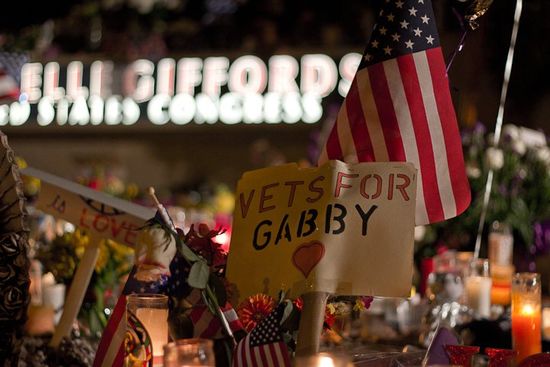
Vetsforgabby_impulsenine

A reader writes:

I was at Rep. Giffords' office late last night. I wanted to get a few photos to help me deal with what happened, and there were still people there well past midnight. The FOX News crew was packing up, and it was cold (40s with a dry breeze). The news crew seemed friendly enough, but nobody talked much – whether the crowd was 300 (at 6pm) people or 10 (at midnight). There was still too much weight to speak.

Ten years ago, Tucson seemed to be home to a range of opinions, from the Greens to the Libertarians to the Dems and Republicans. Even the University of Arizona logo is red and blue. Now Tucson feels blue or red – a mix of only two sides. But this is belied by the mix of homages at her office: Mexican Catholic votives and rosaries, Jewish symbols, Vets for Gabby placards, University of Arizona mascots, private religious school posters (with hundreds of well-wishes or signatures), childrens' stuffed animals. They were placed by the hundreds of yuppies, grandparents, rednecks, and kids standing around with candles and pizza that were donated by local businesses.

The change from shades to bichromatic happened within 10 years; perhaps it will change again.