Meth 1; Drug War 0

In one of the most recent escalations of the War On Drugs, Congress made it more difficult to buy certain over-the-counter pharmaceuticals, arguing that the restrictions would help the fight against meth. That's why I have to jump through hoops to get a little Sudafed. Surprise!:

Electronic systems that track sales of the cold medicine used to make methamphetamine have failed to curb the drug trade and instead created a vast, highly lucrative market for profiteers to buy over-the-counter pills and sell them to meth producers at a huge markup. An Associated Press review of federal data shows that the lure of such easy money has drawn thousands of new people into the methamphetamine underworld over the last few years.

Balko sums up the rest of the findings:

Meth use was also up 34 percent in 2009. So the new laws are inconveniencing law-abiding people who want to treat cold and allergy symptoms, have had either zero or a positive effect on meth use, have lured new people into the meth trade, and have created a bigger market for smuggling meth and meth ingredients into the country from Mexico. But perhaps we should go easy on the politicians who passed these laws. I mean, it’s not like anyone could possibly have predicted any of this.

Thanks, drug warriors.

Culture And Mental Health

A rebuttal to David Brooks' view that we can only understand this event outside of politics and culture:

"It's a reasonable question to ask," Dr. Marvin Swartz, a psychiatry professor at Duke University who specializes in how environment impacts the behavior of the mentally ill, said in an interview this morning. "The nature of someone's delusions is affected by culture. It's a reasonable line of inquiry to ask, `How does a political culture affect the content of people's delusions?'"

Palin Keeps Mum

Bernstein bets that the Giffords shooting won't have much, or any, effect the GOP nomination. But Palin's response prompts him to ask whether there is "anyone who has shown such a consistent lack of growth as a national politician as Sarah Palin?"

There are lots of Republicans who would would be open to changing their minds about her, if she gave them a reason. It’s just that every time she’s had the chance, she pushes everyone outside of her personal faction away.

That is, she’s so far shown herself either incapable or unwilling to be more than a factional candidate, and factional candidates don’t win presidential nominations, at least not since around 1976 or so.  

On cue, Pawlenty dings Palin for the cross-hairs map. Sargent analyzes:

This story has now raged well out of control for Palin, revealing the limitations of her current communications approach. For the first time, Palin's foes sense a real opportunity to take her down a few pegs without any serious political risk to themselves.

Weigel differs, calling Palin's silence "smart media strategy". 

Walking In Darkness

Joe Klein concedes that I make some "good points" while criticizing David Brooks, but Klein is more in David's corner than mine:

We may have some clues to Loughner's motivation, but nothing definitive, since he hasn't said anything and the feds are probably withholding the most relevant material they may have found in his home (especially the note found in his safe).

So, we're walking in darkness here–and dealing in our own personal punditorial prejudices. Given what we do know, the notion that Sarah Palin's "reload" target ads had anything to do with this barbarity has less likelihood than a scenario that both Andrew Sullivan and I would find terribly inconvenient: that Loughner was a paranoid schizophrenic whose illness was exacerbated by frequent marijuana use. (Both Andrew and I favor legalization.) I'm not saying that marijuana was the cause of this–again, no one knows why Loughner went berserk–but as Massimo Calabresi writes below, frequent drug use can have a deleterious effect on those with schizophrenic tendency.

Frum doubles down on the connection between schizophrenia and cannabis, a subject Dish readers wrestled with yesterday.

The American Political Landscape

Interesting insights here:

Tyler Cowen observed on Twitter that “political polarization has been rising since the 70s, and the importance of assassination in U.S. politics has been going down.”

I think this is mostly a reminder that partisan polarization is a very particular sort of thing.

If you go back in time 45 years you’ll find that Martin Luther King, Jr and George Wallace are both influential political figures. And the substantive gap between their views is much, much bigger than is the gap between the views of any comparably prominent people today. But they were both Democrats! In the intervening years I think we’ve mostly seen a narrowing of the range of policy options that receive serious consideration (mostly, but not entirely, by eliminating bad ideas) but we’ve also seen the national political parties transform into something resembling real left vs right ideological coalitions rather than patchworks based on region and ethnicity.

Huckabee’s Strengths

It's still too early for these polls to mean much, but a new PPP poll finds Huck currently ahead in Iowa – a state he won last cycle:

The key to Huckabee's success is the ability to unite the disparate ideological factions of the Republican Party. 31% of voters think the party's too liberal and with them Huckabee has a 26-21 lead over Gingrich, with Palin a little surprisingly coming in further back at 16%. 48% are comfortable with where the party is ideologically and they go for Huckabee too, by a 33-23 margin over Romney. Huckabee comes in a close second behind Romney with the small group of voters who think the party's too conservative, 27-23.

Another poll, released yesterday, had a similar result.

Porta-Potty 2.0

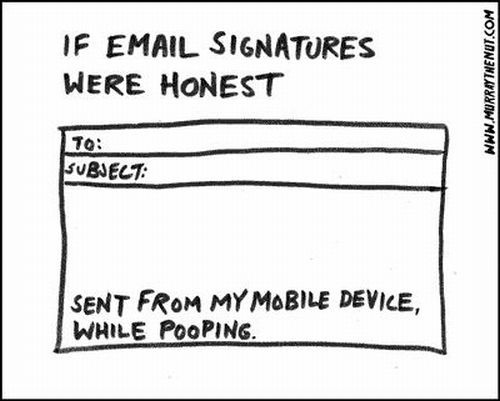
Signatures

Canadians gush over a new automated public toilet and tourist attraction:

There is even soft music and an emergency escape hatch. When vacated at the push of a button, the toilet seat retracts for heat mist cleaning, and after three uses, water sluices the interior, draining through the porous, non-slip floor.

(Image via Murray The Nut)

Sane Conservatism Watch

Heather Mac Donald brings it to the Corner:

I don’t think that questioning the possible role of political discourse in this tragedy merely represents callous opportunism on the part of the Left; it is a salutary human instinct after a tragedy of this dimension to search for any possible collective responsibility, even if that collectivity rarely includes oneself. And let’s not pretend that if a Republican politician had been shot during the Bush years, no one on the Right would have blamed anti-Bush “war criminal” rhetoric as a possible contributor.

And of course, in such a scenario, almost all of the Left would have been just as outraged at being inculpated in an act over which it had no control. If a police officer is shot in cold blood, I myself am not immune from wondering if anti-cop rhetoric by left-wing activists fed into the murder.

Homicidal madness does not need political demagoguery to trigger the slaughter of innocent people. In the last year, there have been many mass killings that had no apparent political overlay. That does not mean, however, that demagoguery may not on rare occasions sometimes be part of that trigger. Indeed, rhetoric and ideas inevitably contribute to individual actions. The question then becomes, are the purveyors of extremist rhetoric at all responsible for the extremely rare violence that may result when a crazed individual takes their rhetoric as partial inspiration for murder? I don’t see a hard and fast answer here, or one that is independent of one’s politics. To deny any responsibility for rhetoric under any conditions without an inquiry into its content and context seems to me to be too hard and fast a position, and yet the very definition of “extremist rhetoric” is obviously in the eye of the beholder. One man’s preposterous exaggeration is another’s sober evaluation of reality.

She goes on to offer examples:

I find the charges that Obama hates America and intends to destroy it ludicrous and, yes, gratuitously inflammatory. And yet I know that many smart, sober people believe — in sincerest good faith — that such charges are literally true. By supporting the Arizona immigration law, I believe that I am merely standing up for the rule of law and for a sober evaluation of the facts on the ground. I would strenuously reject the charge that I am engaged in “hate speech,” yet that charge is also made in good faith. Sarah Palin’s bull’s-eye targets on Democratic districts disturb me; if I were a gun enthusiast, I might feel differently. And those targets pale in comparison to inflammatory political caricatures and cartoons from the past.