by Patrick Appel
David Bell compares Egypt's uprising to famous revolutions throughout history. He argues that "the crucial point to keep in mind, as events in Egypt unfold, is that … the Egyptian Revolution of 2011 may still just be getting started":
Egypt probably does not face the prospect of an Islamic Revolution in the next few months. But if Mubarak falls and is replaced by a weak, unstable series of governments that cannot restore order or deliver serious social and economic reforms — and thus quickly lose credibility and legitimacy among the population — then a different, far more radical revolutionary movement may yet develop. And despite the current lack of a charismatic leader for such a movement, one could quickly emerge out of the torrent of events. In July 1789, Maximilien Robespierre and Georges Danton were unknown lawyers; Jean-Paul Marat an unknown doctor, known to most of his acquaintances as something of a crackpot. Within four years, they had emerged as leaders of the most radical revolution yet seen in history.
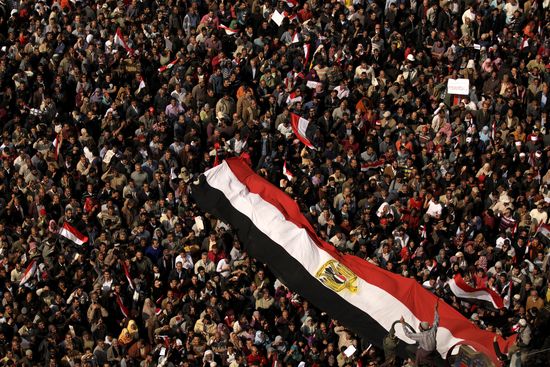
(Photo: Egyptian anti-government protesters hold a huge national flag as they gather at Cairo's Tahrir square on February 8, 2011 on the 15th day of demonstrators against the regime President Hosni Mubarak. By Patrick Baz/AFP/Getty Images)
 The Dish