Gladwell Sticking To It, Ctd

Faceboook

by Zoe Pollock

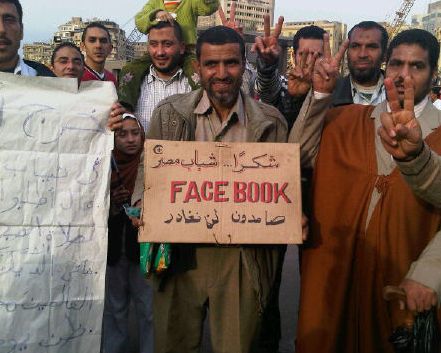
Maria Bustillos piles on the Gladwell refutation train on why social media matters, even if it often appears in English:

It is really hard to believe that a famous communicator like Malcolm Gladwell wouldn't understand instinctively what it means to people simply to be heard. That goes double for people who are suffering in a just cause. It is strengthening to speak and be heard, and most strengthening of all to hear words of support in return, even (and maybe in this case, especially) from very far away.

And for those in the US:

If the Egyptian protesters are tweeting and broadcasting photos and video to the U.S., proving that the Mubarak regime is killing them in Tahrir Square, isn't it fair to argue that the Obama administration will become more reluctant to continue sending that regime our money? Because if many, many Americans are seeing such proof, it can, at the very least, reverberate in our next elections as well.

(Photo by Richard Engel saying "thank you Facebook," via Soup Soup)

No Profession For Old Men

by Conor Friedersdorf

In a longer meditation on professional athletes and their inevitable decline, Joe Posnanski remembers how it ended for baseball's greatest:

There were no poetic words written for Babe Ruth's final game at the stadium he built. Nobody mused about Gods and letters. The game was Sept. 23, 1934. It was well known before the game even started that this would certainly be his last home game as a regular, and probably his last home game as a Yankee. About 2,000 people showed up to see it. Ruth walked for the 104th time that season — one thing the man could still do was draw a walk — and then he came out of the game for what the papers called a "charley horse." Ruth did finish off the season on the road, playing three games in Philadelphia and Washington, and he went to Boston the next year to play 28 sad games as a gimmick for the Braves. This proved, in the reverse of those immortal words by John Updike, that Babe Ruth did not know how to do the hardest thing: Quit.

Do you know who else waited too long to quit? Gary Payton. It was painful to watch him that year he and Karl Malone teamed up on the Lakers. Of course, Kareem Abdul Jabbar was just the opposite: he stuck around an impossibly long time, until he looked like a grandfather hobbling up the court and shooting his sky hook. Every franchise in the NBA gave him gifts on his farewell tour. And his team made it to the NBA finals.

He is the tallest player in the basketball hall of fame.

The Al Jazeera Effect

by Patrick Appel

John Sides flags a new study:

In a newly published — and very timely — piece (ungated pdf; press release), Erik Nisbet and Teresa Myers argue that exposure to trans-national Arab media like Al Jazeera weakens national identities and strengthens identification as Muslim and Arab. The data come from 4 surveys conducted between 2004 and 2008 in Saudi Arabia, Egypt, Morocco, Jordan, Lebanon, and the United Arab Emirates.

The Press And Academia: An Ongoing Love Affair

by Conor Friedersdorf

In the windup for a post criticizing The Atlantic's higher education coverage that he promises is coming soon, Freddie writes:

I've found that many journalists and pundits love to attack the academy. My guess is that this is generally out of resentment towards the academic project. As a field, journalism is deeply hostile to any other systems of knowledge generation. It is particularly unfriendly to those who would attempt to counter the worst failings of the journalistic enterprise – its ludicrously short attention span, its impatience, its desire to condense complex phenomena into pithy sound bites, its lack of moderation of its messages, and more than anything, its absolute dogged attachment to sensationalism and provocation. Against these, the academy pits depth over breadth, the slow accumulation of qualified knowledge, the gradual acquisition of right practices, and moderation, moderation, moderation.

It is seldom useful to talk about the journalistic enterprise as a single effort – it requires subsuming The National Enquirer, Dateline NBC, This American Life, The New York Post, The American Scholar, and book length journalism into a single entity with common charactertistics. For the sake of argument, however, let's take The Washington Post as an influential journalistic entity that shares features with many others. Is it ludicrously impatient, pithy when it could go into more depth, sensationalistic and provacative? Sometimes it is. Often journalists face pressure to succomb to those pathologies.

But it misses something to declare that "as a field, journalism is deeply hostile to any other systems of knowledge generation," especially if your example is the academy. Go to any journalism school, daily newspaper, or national magazine, and you'll find that academic sources are among the most prized by writers and editors.

Need an authority figure on policy? Most newsrooms have a literal book of professors who are expert in various subjects. It's a thing. And universities know it. Thus pages like this one at nearly every major institution. Need an expert on industrial politics? Three clicks gets you three names! And these people are treated as authorities. Often as not, the problem is that any study they produce is quoted too deferentially, that by virtue of being an academic they're granted too much authority. Lots of reporters attend masters programs at universities, where they adopt an academic model to study the field. Academic stars like Paul Krugman and Stanley Fish are prized as editorial hires by media companies. Reporters often return to institutions of higher education to bone up on some subject they've covered. 

So while I agree that the academic approach and the output of various media outlets flow from different imperatives, and that there is some tension between them, it gets something wrong to say that journalism is deeply hostile to academic knowledge. In fact, it signals its reverence for that knowledge by privileging it as an authoritative source, and by maintaning a close, symbiotic relationship between the press and the academy. As a point of comparison, consider the approach the biggest daily newspapers take to claims of knowledge made by religious people. I'd say they're far more hostile to that system of knowledge.
Face Of The Day

108823100

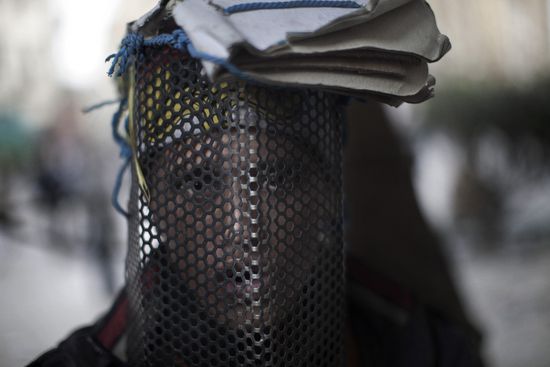
An anti-government demonstrator wears a metal grid across his face to protect himself from stones thrown by supporters of embattled Egyptian President Mubarak on February 4, 2011. Tens of thousands of protesters gathered for sweeping 'departure day' demonstrations to force out Mubarak, who said he would like to step down but fears chaos would result. By Marco Longari/AFP/Getty Images.

The National Interest

by Patrick Appel

Yglesias debates it:

When the USA assembles a large coalition of allies that is, among other things, a large coalition of customers for American defense contractors. What’s more, the allies then often need defending, both in terms of military bases and general expeditionary capabilities. So we have a controlling domestic political coalition that’s defined our “interests” in the Middle East as consisting of collecting a large and diversified portfolio of local allied regimes who we then directly and indirectly subsidize.

But the proposition that this reflects the real interests of the American population is contestable. The connection to real interests is that the price of gasoline is very important to the welfare of the average American household, and that Middle Eastern politics are important to the price of gasoline. But I’m not sure Middle Eastern politics really are all that important to the price of gasoline over the long run and I’m quite certain that the past 30 years worth of American policy in the region don’t represent a cost-effective way of coping with the economic risks of oil price instability. 

Where’s DC’s Mafia?

by Patrick Appel

Bradford Plumer claims that organized crime has never made inroads in DC because it "never had a significant Italian-American population—probably because it lacked the industrial base to lure immigrants in from Sicily and southern Italy." The bigger picture:

The historical causal chain here seems clear enough: Italian-American neighborhoods gave Mafia organizations a healthy pool of new recruits. But that’s not the full story. Mike Dash, the author of The First Family: Terror, Extortion, and the Birth of the American Mafia, argues that, contrary to the myth of the Godfather films, the Mafia didn’t get its start as a protector of Italians against other ethnic groups (notably the Irish). Instead, the Mafia was able to grow mainly by preying on Italian communities; police weren’t all that concerned with intra-ethnic crime.

Why I’m Suspicious Of Most Street Protests

by Conor Friedersdorf

Earlier in the week, I questioned the utility of that protest against the Koch brothers. Now the inevitable opposition video has come out – the one where someone "on the other side" goes around with a video camera to record event attendees saying outrageous stuff. Probably you saw the Tea Party iteration of this tactic, and big surprise, the crowds at progressive rallies are as easy to portray as racists or intemperate blowhards:

This doesn't surprise any reporter who has ever attended a street protest. I've covered a lot of them: the lefty sort at my alma mater, Pomona College, left and right wing immigration protests, anti-war protests, municipal protests calling for the recall of city council members, etc. In my experience, being out in a big crowd makes a lot of people behave like idiots – the closest analogy I can come to is that it approximates the percentage of sanity and insanity that one finds in a blog comments section. The observer is left wondering, "What is it about this setting that makes people behave in ways they'd never act if you encountered them anywhere else?"

There are street protests that I support. How else do you topple a dictator or dramatize the massive opposition to a war or demonstrate the moral wrong of a regime like Jim Crow? For the most part, though, I'm turned off by them, and although I don't think the people in the video above actually want to do the violence that they so casually invoke, I do think they're behaving shamefully, and I'm always a bit surprised that it's so easy to get people to say those things on camera. It signals that they're so unaware of the problem with they're behavior that the notion of it being preserved forever on the Internet is insufficient to make them think twice. To close with a tentative hypothesis I alluded to before, "If you're on the left and Andrew Breitbart shows up with a video camera at your event, odds are it's going to do you more harm than good."

Feast And Famine In Ireland

by Conor Friedersdorf

As long as Michael Lewis keeps parachuting into foreign countries to explain how their particular economies imploded I'll keep linking. His dispatches from Iceland and Greece were fascinating. His latest installment is from Ireland.

Across the financial markets this episode repeated itself. People who had made a private bet that went bad, and didn’t expect to be repaid in full, were handed their money back—from the Irish taxpayer. In retrospect, now that the Irish bank losses are known to be world-historically huge, the decision to cover them appears not merely odd but suicidal. A handful of Irish bankers incurred debts they could never repay, of something like 100 billion euros. They may have had no idea what they were doing, but they did it all the same. Their debts were private—owed by them to investors around the world—and still the Irish people have undertaken to repay them as if they were obligations of the state. For two years they have labored under this impossible burden with scarcely a peep of protest.

A fascinating anecdote that illustrates how easy loans could be got in a country where the cheap labor was largely Polish:

A few months after the spell was broken, the short-term parking-lot attendants at Dublin Airport noticed that their daily take had fallen. The lot appeared full; they couldn’t understand it. Then they noticed the cars never changed. They phoned the Dublin police, who in turn traced the cars to Polish construction workers, who had bought them with money borrowed from Irish banks. The migrant workers had ditched the cars and gone home. Rumor has it that a few months later the Bank of Ireland sent three collectors to Poland to see what they could get back, but they had no luck. The Poles were untraceable: but for their cars in the short-term parking lot, they might never have existed.

And some figures that explain what fueled the boom and bust:

…more than a fifth of the Irish workforce was employed building houses. The Irish construction industry had swollen to become nearly a quarter of the country’s G.D.P.—compared with less than 10 percent in a normal economy—and Ireland was building half as many new houses a year as the United Kingdom, which had almost 15 times as many people to house. He learned that since 1994 the average price for a Dublin home had risen more than 500 percent. In parts of the city, rents had fallen to less than 1 percent of the purchase price—that is, you could rent a million-dollar home for less than $833 a month. The investment returns on Irish land were ridiculously low: it made no sense for capital to flow into Ireland to develop more of it. Irish home prices implied an economic growth rate that would leave Ireland, in 25 years, three times as rich as the United States. (“A price/earning ratio above Google’s,” as Kelly put it.) Where would this growth come from?

The whole piece is great, save one inconsequential false note:

The politicians in Ireland speak Gaelic the way the Real Housewives of Orange County speak French. To ask “Why bother to speak it at all?” is of course to miss the point.

There are a lot of status symbols in The OC. Peppering conversations with French isn't one of them. Still, you get his point.