Why Revolutions Appear Out Of Nowhere

EgyptFlagCape
by Patrick Appel

A hypothesis from an old Timur Kuran paper:

A feature shared by certain major revolutions is that they were not anticipated. Here is an explanation, which hinges on the observation that people who come to dislike their government are apt to hide their desire for change as long as the opposition seems weak. Because of this preference falsification, a government that appears unshakeable might see its support crumble following a slight surge in the opposition's apparent size, caused by events insignificant in and of themselves. Unlikely though the revolution may have appeared in foresight, it will in hindsight appear inevitable because its occurrence exposes a panoply of previously hidden conflicts.

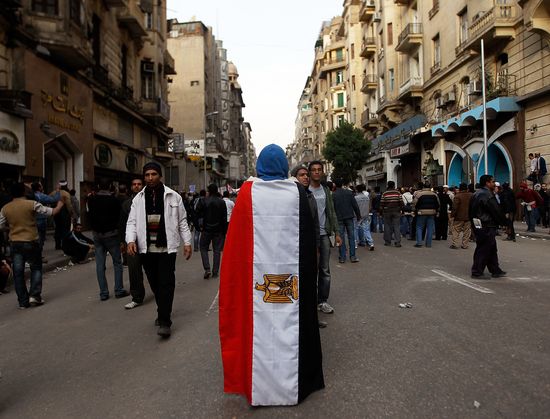
(Photo: An anti-government protester draped in an Egyptian flag stands near government loyalists down the block in Talaat Harb Square the afternoon of February 4, 2011 in Cairo, Egypt. By Chris Hondros/Getty Images. Hat tip: Cowen.)

Where Will The Cuts Come From?

by Conor Friedersdorf

Progressive deficit hawk Derek Thompson asks for specifics at Ezra's blog:

You don't see many liberal economists writing about the best places to cut domestic spending in the next few years. But maybe they should be — if only for the selfish reason that it might clear the way for their spending ideas. When I asked Adam Hersh, an economist from the Center for American Progress, to identify some non-security discretionary items he could part with in exchange for infrastructure money, he acknowledged that the pickings might be slim. But there are still pickings.

"You could shift spending from activities with low stimulating multipliers to higher job multipliers — like shifting timber subsidies toward infrastructure and R&D," Hersh said. Cut farm subsidies, eliminate duplicate and wasteful domestic programs, and throw in the president's promise to freeze non-security discretionary spending and federal wages, and you've got tens of billions of dollars that could offset spending projects under the conservative House's cut-go rules. Who knows if this would lure Republicans across the aisle. But what's the harm in identifying cuts that would make important initiatives more palatable to moderates?

Reclaim Our Foreign Policy

by Zoe Pollock

Johann Hari has harsh words for the governments that have aided and abetted Mubarak:

In Cairo, there is an area called the City of the Dead. It is a large ancient graveyard filled with tombs. One million families with nowhere else to go have had to break them open and live in the graves. It’s a symbol of the living death the dictators we arm and fund have inflicted on the Middle East. While the people live in coffins, Mubarak’s family buy palaces here in London: I just went to see the five-storey Georgian mansion they own round the corner from Harrods here in London.

It doesn’t have to be like this. We could make our governments as moral as we, the British people, are in our everyday lives. We could stop them trampling on the weak and fattening thugs. But to achieve it, we have to democratize our own societies and claim control of our own foreign policy. We would have to monitor and argue and campaign over it, and let our governments know there is a serious price for behaving viciously abroad. The Egyptian people have shown this week they will risk everything to stop being abused. What will we risk to stop our governments being abusers?

What Makes Wikipedia Special?

by Conor Friedersdorf

I've got a question about Wikipedia and the concern expressed in so many places that only 13 percent of its contributors are women: what factors determine when a gender disparity is something about which we should care? Is it a bad thing that there are so few women cab drivers? Or sanitation workers? Or floor traders on Wall Street? Or peanut vendors at baseball stadiums? Or corporate CEOs? Or congressional canidates? Or beer pong players? Or talk radio hosts? Or authors of economics textbooks? Or plumbers? Or online poker players?

Like most people, there are some gender disparities that I find troubling, and others I don't much care about. I wonder how others decide when they care, because it seems to me that people care about Wikipedia, even though its general characteristics make it seem a lot like the things we don't normally care about. There aren't any barriers to entry blocking women who want to participate, there isn't an ugly history of discriminating against women, being a Wikipedia contributor isn't a high status position or a proving ground for other high status positions, the women foregoing participation aren't missing out on career opportunities or sacrificing future financial security, we aren't intuitively aware of the disparity, no one particularly complains that Wikipedia entries are biased against women in any way, a group of concerned volunteers could easily add articles on any subjects the mostly male club of contributors is missing…

So what gives? Society is rife with gender disparities. Why focus on this one when the consequences of other gender disparities are problematic in the ways listed above? The Feministing writer argues that with only 13 percent of all contributors being women "we’re all missing out on a pretty hefty loaf of knowledge." Are we? Like what? I actually thought about this, and try as I might I couldn't come up with a very good list, but maybe Dish readers can do better – remember, this isn't stuff that an all male group wouldn't be able to contribute, it's stuff that a mostly male group with some women thrown in too couldn't handle. (Related question: do men feel less guilty about editing Wikipedia entries at work than women? Just a thought.)

Physical Health Break Update

Today is the first day I can breathe fully and move around a little. Mercifully, I'm not in Glenn Greenwald's situation, where he had to be hospitalized for dengue fever and something else (but is now mercifully back home and recovering). I have a lung specialist's appointment today to check my progress, but, barring any bad news, I very much intend to be back Monday.

Thanks for your kind words, advice and above all, thanks to the Dish team. This is the first year in the Dish's decade that I have been able to take sick leave (and, man was I sick) and know that the Dish carries on and thrives – even during a period of history I would have given what's left of my right lung to blog through. Since this team has only really been in place in full for six months, that's something.

So barring any sudden turn for the worse, see you Monday. Inshallah. — Andrew

Conflict Photography

108811493

by Zoe Pollock

The NYT's Lens blog speaks with nine photojournalists on the ground:

Photographers of the increasingly violent upheaval in Egypt are being forced — in the interest of personal safety — to adopt practices that limit their range of coverage at exactly the moment the world is hungriest for as many images from as many perspectives as possible. …

[They] find themselves traveling in packs (which they do not typically like to do), staying away from whole sections of Cairo (which is anathema) and donning helmets (which raises the likelihood they will be mistaken for government spies). And still there are no guarantees of safe conduct, given the turbulence and the passion all around.

(Photo: Foreign journalists and Egyptian anti-government demonstrators take cover behind makeshift shields during clashes with pro-regime opponents at Cairo's Tahrir Square on February 3. By Miguel Medina/AFP/Getty Images.)

How To Get Someone With Friends In Egypt To Lose His Temper

by Conor Friedersdorf

The ignorant prick of the day award goes to Big Government's Peter Schweizer – of course he writes on a Breitbart site – who says this:

There has been widespread condemnation of the violence directed against journalists covering events in Egypt–and there should be.  But honestly,  I don’t have a great deal of sympathy for those who have been attacked.

Journalists have a job to do,  but when they take huge risks for the sake of ratings and then find themselves in trouble,  it’s hard to take seriously any “shock” that media executives express about their journalists being targeted.   A journalist walking into a crowd of tens of thousands of protestors facing off against tens of thousands of other protestors is akin to the foolish hikers you read about from time to time who end up getting trapped in a snowstorm and have to be taken off the mountain by helicopter.  They made a foolish decision to ascend a mountain and simply were not prepared.

The world is a brutish, dangerous, and nasty place.  Don’t expect people in the developing world to smile and be friendly just because you have a press pass.   Journalists should use judgment and not race into the middle of what amounts to a massive bar room brawl without expecting something bad to happen.

If Schweitzer weren't so callous and uninformed about his own profession, he would understand that every editor who sent a journalist to Egypt did do with the sickening knowledge that they might be targeted; that lots of preparation is done and lots of precautions are taken; that many who head out to report these stories do so with a lump in their throat, braving dangerous situations not because they are naive or foolish or unprepared, but because they rightly believe that having eyes and ears on the ground is vital even when it is dangerous, so that reliable information is available (even to sites like Big Government, which link reports from the field, but mostly dishonor the brave men and women who do the work by imposing on it distorted analysis as blinkered as anything you'll find).

I understand how a writer for a Web site filled daily with intellectually dishonest nonsense, written to advance a twisted, incoherent ideological agenda, would lose site of the fact that other people who call themselves journalists are engaged in work that rightly makes them proud. But the fact of the matter is that foreign reporting is poorly compensated, dangerous work that is of vital importance to our world, and seldom undertaken by anyone whose primary concern is ratings. How someone fails to grasp this while writing at what is ostensibly a foreign affairs Web site boggles the mind. If you're in journalism for the money, it's much easier to launch some hack Web sites where ideologues flatter the prejudices of fellow travelers by slapping up links to stories reported by real journalists, and then publishing people who insult those same professionals, implying their work has no more value than recreational mountain climbing. So Schweitzer disparages these journalists in Egypt while his boss, who owes his fortune to curating their work, roller skates around a parking lot confronting liberals.